
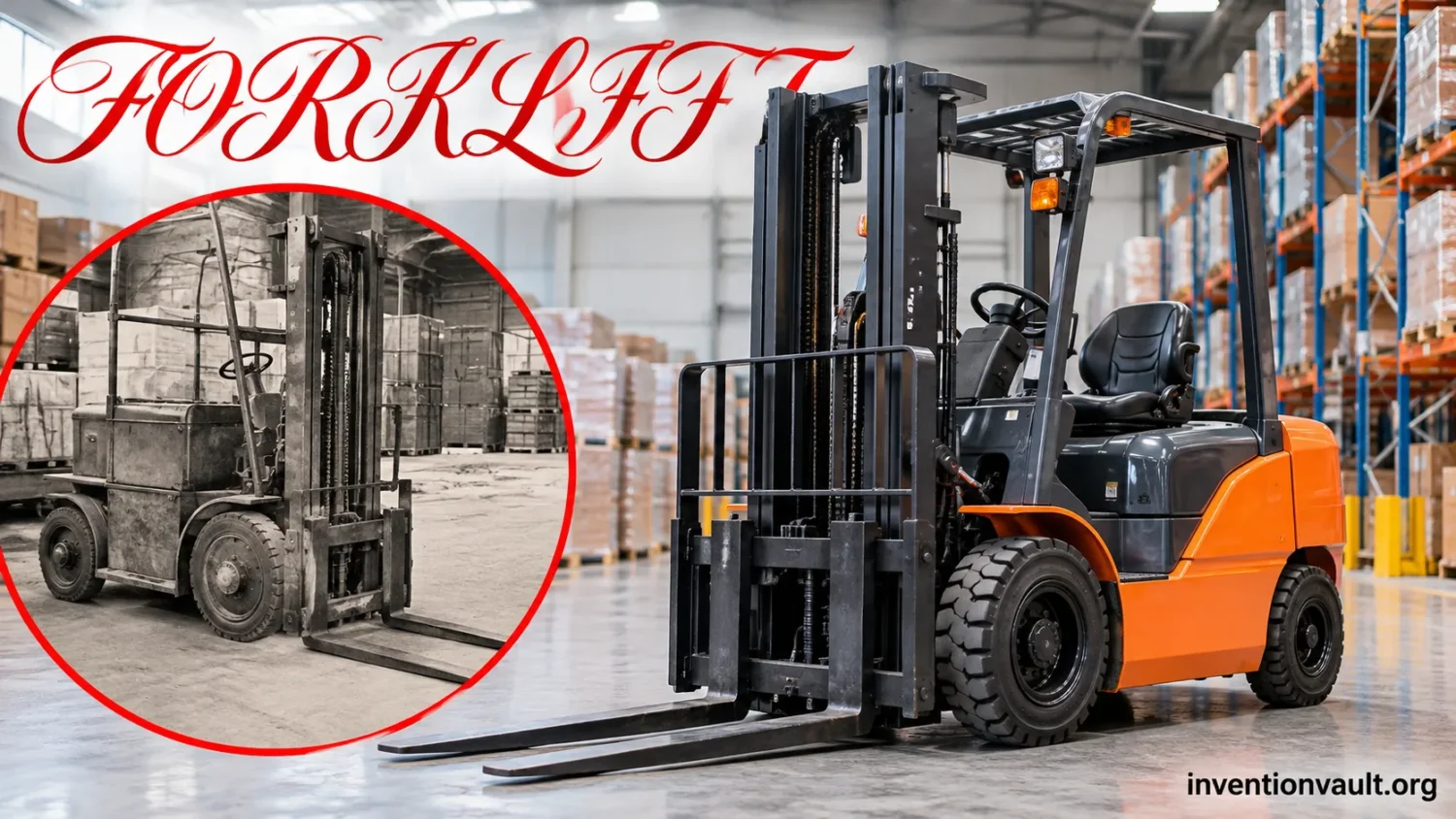
Machine and Warehouse Evolution
How the Forklift Took Shape
Follow powered transport, lifting, hydraulics, pallets, narrow aisles and automation as separate advances converged into modern warehouse handling.
Powered transport precursor
The 1917 CLARK Tructractor
Current stage
Factory problem
CLARK employees in Buchanan, Michigan built the Tructractor to move materials between manufacturing departments without relying on hand-pushed carts or teams moving each load separately.
What it could do
The vehicle supplied powered horizontal transport using an internal-combustion engine, giving industrial plants a self-propelled carrier for moving material over the factory floor.
What it could not do
CLARK records the early Tructractor as a flat-bed or cargo-box vehicle that was manually loaded and unloaded. It therefore lacked the defining load-picking function of a later forklift.
Powered movement solved one handling problem, but the load still had to be placed onto the vehicle by another method.
Parallel lift-truck branch
Battery Trucks and Tilting Forks
Current stage
C.W. Hunt development
Hyster-Yale’s corporate history credits C.W. Hunt with a battery-powered low-lift platform truck in 1919, showing that early material-handling development was not confined to gasoline-powered vehicles.
Yale expansion
After acquiring C.W. Hunt, Yale & Towne introduced battery low-lift trucks, high-lift platform trucks, tow tractors and one of the early lifting trucks equipped with tilting forks in 1920.
Two development paths
Internal-combustion carriers and battery-powered lifting machines developed in parallel. The recognizable forklift emerged as powered travel, controlled lifting and fork handling were combined more effectively.
The forklift was already becoming a family of related machines rather than the product of one isolated prototype.
Lift mechanism change
Hydraulic Lifting Enters the Truck
Current stage
CLARK Truclift
Introduced in 1922, the Truclift was an internal-combustion platform lift truck. CLARK records it as using hydraulics instead of mechanical gears and linkage to raise the load.
Why fluid power suited lifting
A pump can pressurize hydraulic fluid and move a cylinder under controlled force. The arrangement allowed a compact truck to raise heavy loads without relying only on large mechanical lifting linkages.
Still not the final layout
The Truclift was a platform lift truck. Hydraulics had solved part of the lifting problem, while fork geometry, mast arrangements and stacking layouts were still developing.
Hydraulic power supplied the controllable vertical force that later became central to lift-truck mast systems.
Forklift architecture
Forks, Tiering and the Short-Coupled Truck
Current stage
1924 tiering attachment
CLARK records a modified Duat shipped with a tiering attachment in 1924 and describes it as its first internal-combustion forklift form. The wording is a manufacturer first claim rather than a universal invention date.
1928 Tructier
The Tructier combined an internal-combustion forklift layout with hydraulic load lifting. CLARK contrasts this system with earlier lifting arrangements that depended on chains and cables.
1938 Carloader
The later Carloader adopted the compact short-coupled arrangement that CLARK identifies with the modern internal-combustion forklift, placing load handling, propulsion and counterbalancing in a maneuverable industrial vehicle.
By the late 1930s, the machine had acquired the compact layout and controlled vertical handling associated with a modern counterbalanced forklift.
Unit-load system
The Pallet Becomes the Forklift’s Partner
Current stage
1939 pallet patent
George G. Raymond and William C. House received U.S. Patent 2,178,646 for a two-faced pallet designed to cooperate with a lift truck. Their application had been filed in 1937.
Not the first pallet
The patent itself describes the two-faced pallet as a type already known in the art. Raymond and House therefore patented a particular improved design, not the entire concept of the pallet.
Machine and load interface
Fork-entry spaces allowed a load to remain on its platform while forks entered beneath it. Boxes, sacks or components could then move as one unit rather than being rehandled individually.
The pallet converted many separate packages into a repeatable unit that a forklift could pick up, move and store.
Warehouse geometry
The 1951 Narrow-Aisle Truck
Current stage
Patent record
U.S. Patent 2,564,002, granted August 14, 1951, identifies Christian D. Gibson as inventor of a power-driven material-handling truck and Lyon-Raymond Corporation as assignee.
Different stability strategy
Rather than depending on a large rear counterweight, the early narrow-aisle arrangement used load-supporting baselegs, allowing the vehicle to work within a much smaller turning envelope.
Warehouse consequence
Raymond describes its Model 700 SpaceMaker as operating in aisles under seven feet wide. Reducing aisle width allowed a larger share of the same building to hold pallet positions.
Forklift design was now shaping the warehouse itself: truck geometry determined aisle width, rack spacing and achievable storage density.
Warehouse automation
Forklift Driving Moves into Software
Current stage
Modern control problem
Autonomous forklifts add localization, perception, route planning, pallet detection, motion control and fleet coordination to the mechanical lifting system developed during the previous century.
Research scale
A 2026 review examined 122 peer-reviewed forklift-automation studies and found that many real deployments still involve fleets of roughly 2 to 50 vehicles rather than hundreds working together.
Remaining barrier
The difficult step is no longer simply raising a pallet. Mixed traffic, variable payloads, human movement and large-fleet coordination make real warehouses harder than controlled laboratory demonstrations.
The engineering question has shifted from how to lift a load to how many machines can move loads safely without constant human driving.
The forklift was not invented in one event by one person. CLARK’s 1917 Tructractor was an important powered industrial truck, but CLARK’s own history says its flat bed or cargo box was manually loaded and unloaded. C.W. Hunt and Yale & Towne developed battery-powered lift trucks and early tilting-fork machines around 1919–1920, while CLARK added hydraulic lifting and progressively more recognizable forklift arrangements during the 1920s. By the late 1930s, powered travel, forks, vertical lifting and a compact truck layout had converged. Pallets then gave the machine a standardized load interface, and narrow-aisle trucks changed how warehouses used floor space and height.
| Development | Date | What changed |
|---|---|---|
| CLARK Tructractor | 1917 | Powered industrial transport, but the early vehicle was manually loaded and unloaded. |
| C.W. Hunt / Yale lift-truck line | 1919–1920 | Battery low-lift and high-lift trucks developed alongside early tilting-fork lifting trucks. |
| CLARK Truclift | 1922 | Hydraulic lifting appeared on an internal-combustion platform lift truck. |
| Modified CLARK Duat | 1924 | A tiering attachment produced a machine CLARK identifies as an early internal-combustion forklift. |
| CLARK Tructier | 1928 | Hydraulics were used to lift the load on a fork-truck arrangement. |
| CLARK Carloader | 1938 | A compact short-coupled internal-combustion layout approached the familiar counterbalanced forklift form. |
| Raymond–House pallet and lift-truck patents | 1939 | A two-faced pallet and matching hand lift-truck system strengthened the unit-load approach. |
| Gibson narrow-aisle patent | 1951 | Truck geometry was redesigned around denser warehouse storage. |
Why the 1917 Tructractor Is a Starting Point, Not the Finished Forklift
Forklift histories often begin in 1917 because that is when employees of the CLARK Equipment Company built the first Tructractor in Buchanan, Michigan. The machine addressed a real factory problem: parts and materials needed to travel between CLARK’s axle, drill and wheel departments, and powered transport could replace some of the repeated manual hauling.
The Tructractor was self-propelled, which separated it from the hand trucks and carts that had dominated much internal movement. Demand also spread beyond CLARK’s own factory. The company’s history records eight units built in 1918 and more than 75 in 1919.
Yet the same company record places an important boundary around the invention claim. The Tructractor originally carried a flat bed or cargo box, and workers loaded and unloaded it manually. It could transport material under its own power, but it did not yet perform the defining forklift action of placing forks beneath a load, raising it and carrying it away.
Dating the First Forklift
Calling the 1917 Tructractor “the first forklift” uses the modern term broadly. It is better treated as a powered industrial-truck precursor because the early vehicle lacked the fork-lifting arrangement that defines a forklift in ordinary modern use.
This distinction explains why different histories give different invention dates. One may date the first powered industrial truck. Another may require forks. A third may require hydraulic lifting or the compact counterbalanced layout recognizable today. Those are different historical questions.
A Parallel Branch: Battery Lift Trucks and Tilting Forks
The internal-combustion branch was only part of the story. Hyster-Yale’s company history credits C.W. Hunt with a battery-powered low-lift platform truck in 1919. After Yale & Towne Manufacturing acquired C.W. Hunt, it introduced a broader battery-powered material-handling range in 1920, including low-lift platform trucks, high-lift platform trucks, tow tractors and one of the early lifting trucks fitted with tilting forks.
This branch matters because it shows why assigning the entire forklift to a single company is too simple. Engineers were attacking several related problems at nearly the same time: powering movement, getting beneath a load, raising it, tilting it, steering in confined spaces and doing all of that without making the vehicle too large for factory aisles.
Electric trucks also fit indoor work especially well. They did not need the same onboard combustion arrangement as gasoline-powered industrial trucks, and battery systems became an enduring branch of warehouse vehicle design rather than a later addition to a gasoline invention.
Hydraulics Turned Lifting into a Controllable Truck Function
Moving a loaded platform horizontally was useful, but warehouses needed a vehicle that could pick up a load and change its height. CLARK’s 1922 Truclift brought hydraulic lifting into its internal-combustion lift-truck line. CLARK describes the machine as a platform lift truck using hydraulics rather than mechanical gears and linkage for the lifting action.
Hydraulics fit the task because a pump can pressurize fluid and send it into a cylinder. Cylinder movement can then raise a carriage or mast assembly under controlled force. Later forklift arrangements often combine hydraulic cylinders with chains, rollers and telescoping mast sections, so “hydraulic forklift” does not mean that fluid alone directly carries every moving component. The hydraulic circuit supplies the lifting force while the mast structure guides and transfers movement.
CLARK’s next steps show the machine becoming more recognizable. In 1924, the company shipped a Duat with an optional tiering attachment and describes that configuration as its first internal-combustion forklift truck. In 1928, it introduced the Tructier, which CLARK records as using hydraulics rather than chains and cables for load lifting.
The 1938 Carloader brought another layout change. CLARK describes it as a modern short-coupled internal-combustion forklift. A shorter, integrated arrangement reduced the space needed to maneuver while placing the lifting assembly at the front and the truck’s mass behind it.
| Machine | Powered travel | Load-lifting form | Historical boundary |
|---|---|---|---|
| 1917 Tructractor | Yes | None on the original flat-bed/cargo-box form | Powered carrier rather than a complete modern forklift |
| 1920 Yale range | Battery powered | Low lift, high lift and an early tilting-fork machine appear across the range | The features belonged to a developing family of trucks, not necessarily one universal configuration |
| 1922 Truclift | Internal combustion | Hydraulic platform lifting | Hydraulic lift truck, but still a platform-based form |
| 1924 modified Duat | Internal combustion | Tiering attachment | CLARK identifies it as an internal-combustion forklift first |
| 1928 Tructier | Internal combustion | Hydraulic load lifting | Closer to the integrated fork-lift architecture |
| 1938 Carloader | Internal combustion | Compact front lifting arrangement | CLARK identifies the short-coupled layout with the modern form |
How a Forklift Combines Lifting, Balance and Movement
A forklift does something that a simple cart cannot: it takes responsibility for both the load’s vertical position and its horizontal movement. That requires more than attaching two steel forks to a powered vehicle.
- Enter the loadThe forks pass into the openings of a pallet or beneath another load designed for fork handling. Their spacing and insertion position affect how the load is supported.
- Raise the carriageA hydraulic pump supplies pressurized fluid to lifting cylinders. Mast components, rollers and chains guide the carriage upward according to the truck’s mast design.
- Balance the loadOn a counterbalanced truck, mass behind the front axle opposes the forward moment created by the load carried on the forks.
- Transport the unitThe drive and steering systems move the combined truck-and-load system while the operator or control system keeps the load within the truck’s operating limits.
- Place and withdrawThe truck positions the load at floor, dock or rack level, lowers it onto its support and withdraws the forks without dismantling the load unit.
The front axle acts like a fulcrum
The physics of a counterbalanced forklift resembles a lever. A load in front of the truck creates a turning moment around the front-wheel area. The basic relationship is straightforward: load moment equals load weight multiplied by its horizontal distance from the tipping point. Moving the same load farther away therefore increases the moment even though its weight has not changed.
This is why a forklift’s rated capacity cannot be interpreted as “any object below this weight.” Capacity is tied to a specified load center and truck configuration. Attachments, long loads, uneven weight distribution and load position can alter the effective moment.
Stability also has a sideways dimension. OSHA explains the familiar stability-triangle model for many counterbalanced powered industrial trucks: the combined center of gravity of the truck and load must remain within the support area. Lifting, braking, turning and travelling on grades can move that combined center of gravity.
Capacity and Stability
A historical explanation of load moment is not a forklift capacity calculator. Actual handling limits depend on the specific truck, load center, attachment and data plate; elevated, off-center or oversized loads can reduce stability.
The Pallet Completed the Forklift System
A forklift becomes much more useful when loads are prepared for it before the truck arrives. That is the role of the pallet. Instead of a worker moving cartons or sacks individually onto a vehicle, the goods can remain on a platform with openings for fork entry. The entire load then moves as one unit.
This change is sometimes hidden in forklift histories because the pallet looks passive beside a powered machine. Logistically, however, the two technologies depend heavily on each other. The forklift supplies movement and lift; the pallet supplies a repeatable mechanical interface between the truck and the goods.
George G. Raymond and William C. House filed a pallet application in 1937 and received U.S. Patent 2,178,646 on November 7, 1939. Their patent described a two-faced pallet designed to cooperate with a lift truck. On the same date, they also received U.S. Patent 2,178,647 for a lift truck adapted to work with two-faced pallets.
The wording of the pallet patent prevents an overly broad invention claim. It states that the invention relates particularly to the type “known in the art as a two faced pallet.” In other words, Raymond and House did not claim to have created the entire idea of a pallet from nothing. Their work improved the pallet-and-lift-truck combination.
What the Patent Establishes
U.S. Patent 2,178,646 documents a specific two-faced pallet design by George G. Raymond and William C. House and explicitly acknowledges earlier two-faced pallets. It supports an improvement claim, not a claim that all pallets began in 1939.
This distinction matters because the modern warehouse did not emerge from a forklift acting alone. It emerged from unit-load handling: loads were assembled onto platforms that machines could repeatedly lift, carry, stack and transfer.
World War II Pushed Palletized Handling Beyond the Factory
Before World War II, powered lift trucks and pallet-like load platforms already existed, but adoption was uneven. Many facilities still relied on hand trucks, low stacking and repeated manual handling.
Wartime supply placed different demands on material movement. The U.S. Army Quartermaster Museum records the use of “palletized unit loading” in the Pacific, where rations, petroleum products and other supplies were strapped to rectangular wooden platforms or sleds so they could be discharged quickly and moved inland. The museum notes that this type of cargo handling had barely been known commercially at the beginning of the war.
The logistical lesson was broader than any one pallet design. If goods arrived as a unit that matched mechanized handling equipment, fewer individual pieces needed to be touched during each transfer. Warehouses, depots, docks and transport operations could begin designing their workflows around repeatable loads rather than around individual packages.
After the war, the forklift-pallet combination had a much larger base of trained users, manufacturers and facilities familiar with mechanical handling. The machine had moved beyond being a specialized factory carrier and had become part of a wider logistics system.
The Forklift Changed Warehouses from Floor Plans into Storage Volumes
A hand truck can move a load across a floor. A high-lift truck can also change where that load exists vertically. Once pallets, suitable racks and lift trucks worked together, warehouse design could exploit building height rather than treating most storage as a floor-level problem.
This affected several parts of warehouse planning at once. Rack openings had to accept repeatable pallet loads. Aisles had to accommodate a truck’s body, steering behavior and turning radius. Mast height had to match the required lift. Floors had to support concentrated wheel loads. Loading docks could be arranged around faster unit transfers.
| Warehouse constraint | Earlier handling pattern | Forklift-and-pallet response |
|---|---|---|
| Individual packages | Repeated loading and unloading by hand | Goods remain grouped as a unit load |
| Vertical space | Storage height limited by manual handling or separate hoisting equipment | Mast-equipped trucks place pallets into elevated rack positions |
| Transfer between areas | Separate carting, hoisting and restacking operations | One vehicle can pick, travel, raise, deposit and withdraw |
| Aisle planning | Space arranged mainly around people, carts and static stacks | Rack and aisle dimensions become closely tied to truck geometry |
| Storage capacity | Large share of building volume remains difficult to use | Racking and lift height turn more cubic volume into pallet positions |
This also explains why later forklift development did not focus only on lifting heavier loads. For many warehouses, reducing the space consumed by each aisle could be as valuable as raising capacity.
The 1951 Narrow-Aisle Truck Changed Warehouse Geometry Again
Christian D. Gibson began work on a new narrow-aisle material-handling vehicle at Lyon-Raymond in 1949. U.S. Patent 2,564,002, Power-Driven Material Handling Truck, was granted on August 14, 1951.
The design attacked a problem created partly by the success of palletized storage: ordinary counterbalanced trucks need enough room to position the vehicle and load in front of a rack opening. That turning space becomes non-storage floor area.
Narrow-aisle trucks use a different physical arrangement. Load-supporting legs can extend forward around or beneath the pallet area, reducing dependence on a heavy rear counterweight. The truck can therefore be shorter and can position loads within a smaller aisle envelope. Raymond describes the Lyon-Raymond Model 700 SpaceMaker as capable of working in aisles less than seven feet wide.
Later patents treated Gibson’s 1951 machine as an established narrow-aisle predecessor. A 1968 Raymond patent on steering and suspension, for example, explicitly identifies U.S. Patent 2,564,002 as Gibson’s earlier material-handling truck and discusses the commercial use of machines based on that arrangement.
Patent Credit Check
Raymond’s corporate histories and anniversary material often credit George Raymond Sr. and Christian Gibson together for the 1951 narrow-aisle development. U.S. Patent 2,564,002 itself identifies Christian D. Gibson as inventor and Lyon-Raymond Corporation as assignee. Company development credit and formal patent inventorship are therefore not identical.
The distinction is especially relevant in 2026 because Raymond marked the 75th anniversary of the 1951 narrow-aisle patent. The anniversary is not merely a corporate date: it highlights how long warehouse density has been an engineering problem tied directly to lift-truck geometry.
Different Forklift Types Grew from Different Warehouse Constraints
The many machines now called forklifts or lift trucks did not arise simply to create more product categories. Different warehouse jobs impose different physical constraints, so the machines diverged.
| Truck form | Problem being solved | Design response |
|---|---|---|
| Counterbalanced forklift | General loading, transport and stacking without forward support legs beneath the load | Rear truck mass counterbalances the forward load around the front axle |
| Reach truck | High rack storage in aisles too narrow for a conventional counterbalanced turning pattern | Baselegs support the truck while the load-handling assembly reaches toward the rack |
| Low-lift pallet truck | Moving pallet loads horizontally without needing high stacking capability | Forks raise the pallet only enough to clear the floor for transport |
| Order picker | Selecting individual cases or items from elevated storage positions | The operator platform or picking position rises to the required level |
| Very-narrow-aisle truck | Using even less aisle floor while serving tall rack faces | Specialized fork or mast movement reduces the need to turn the entire truck toward the rack |
These designs show a change in what “better forklift” meant. The early challenge was simply to mechanize material movement and lifting. Later engineering had to balance load height, stability, aisle width, maneuverability, picking method and warehouse capacity.
Who Invented the Forklift?
No single name cleanly covers every step that created the modern forklift. The most defensible answer depends on what part of the machine is being dated.
CLARK and its employees occupy an important place because the 1917 Tructractor established an early internal-combustion industrial-truck line, followed by the hydraulic Truclift in 1922, the tiering-equipped Duat in 1924, the Tructier in 1928 and the compact Carloader in 1938. These are separate engineering stages rather than one finished invention appearing in 1917.
C.W. Hunt and Yale & Towne represent another early path. Battery low-lift equipment and early tilting-fork machines show that electric material handling was developing alongside internal-combustion trucks.
George G. Raymond and William C. House contributed to the unit-load side of the system through their paired 1939 pallet and lift-truck patents. Their pallet patent should be described as an improved two-faced pallet, since the document itself acknowledges that such pallets already existed.
Christian D. Gibson is named as inventor on the 1951 patent for the power-driven material-handling truck that became an important reference point in narrow-aisle design.
What Different Records Actually Establish
- Company product historiesThey document when a manufacturer says its own machines were introduced and how it describes those machines. A manufacturer’s “first” claim should not automatically be treated as an independent judgment covering the entire industry.
- Patent recordsThey establish a filed technical claim, named inventor or inventors, assignee and grant date. They do not automatically establish the first use of the broader machine category.
- Later patent citationsThey help show how an older design was understood by later engineers. Raymond’s later patents, for example, identify Gibson’s 1951 patent as an earlier narrow-aisle truck.
- Adoption historyMilitary and commercial use shows when a handling system moved beyond prototypes and isolated factory applications, which can occur years after an invention or patent.
The result is more precise than naming a single inventor: the modern forklift emerged from the convergence of powered industrial trucks, controlled lift mechanisms, forks, hydraulic systems, palletized loads and warehouse-specific vehicle geometry.
From Mechanical Forklift to Autonomous Warehouse Vehicle
Modern forklift development has shifted toward sensing and control without removing the mechanical system underneath. An autonomous forklift still needs forks or another load interface, a mast or lifting structure, steering, brakes, traction and a stable relationship between the truck and its payload. Automation adds another layer: the machine must determine where it is, recognize loads and obstacles, plan a path, position itself accurately and coordinate with other traffic.
A 2026 systematic review by researchers at California Polytechnic State University examined 122 peer-reviewed studies on forklift-specific automation published from 2010 through 2025. The review found strong laboratory work across localization, planning, control, vision, manipulation and safety, yet it also identified a deployment gap. Real autonomous-forklift fleets commonly remain in the range of roughly 2 to 50 vehicles, while large industrial sites may require coordination among hundreds of vehicles.
The remaining difficulty is therefore different from the one CLARK faced in 1917. A century ago, engineers were trying to move factory loads without pushing them by hand. The present problem is coordinating many powered lifting machines in environments where payloads vary, routes change and people may move unpredictably through the same space.
This makes autonomous forklifts a continuation of the same warehouse history rather than an unrelated technology. Each major stage has removed a different handling constraint:
- Powered industrial trucks reduced dependence on human force for horizontal movement.
- Lift mechanisms let the vehicle change the load’s height.
- Forks and pallets made repeatable pick-up possible without repacking the goods at every move.
- High-lift and rack systems made building height usable for storage.
- Narrow-aisle trucks reduced the amount of floor consumed by vehicle movement.
- Autonomous control aims to reduce dependence on a human driver for every transport cycle while coordinating the vehicle with a larger warehouse system.
Forklift Development Timeline
| Year | Milestone | Why it belongs in forklift history |
|---|---|---|
| 1917 | CLARK Tructractor | Powered industrial transport enters CLARK’s factory operations, although the vehicle is still manually loaded. |
| 1919 | C.W. Hunt battery low-lift truck | Battery-powered material handling develops alongside internal-combustion industrial trucks. |
| 1920 | Yale & Towne expands the lift-truck range | Low lift, high lift and an early tilting-fork machine demonstrate several routes toward the later forklift. |
| 1922 | CLARK Truclift | Hydraulic lifting replaces a purely mechanical lifting arrangement on CLARK’s internal-combustion platform lift truck. |
| 1924 | Tiering-equipped CLARK Duat | CLARK identifies this modified machine as an early internal-combustion forklift configuration. |
| 1928 | CLARK Tructier | Hydraulic load lifting is integrated into a more recognizable forklift form. |
| 1938 | CLARK Carloader | The compact short-coupled arrangement moves closer to the familiar counterbalanced forklift layout. |
| 1939 | Raymond–House pallet and lift-truck patents | The pallet and truck are engineered as complementary parts of a unit-load handling system. |
| 1940s | Wartime palletized logistics | Forklifts, pallets and unit loads spread through high-volume supply operations and depots. |
| 1951 | Gibson’s power-driven narrow-aisle truck patent | The vehicle is redesigned around tighter warehouse aisles and denser rack storage. |
| Late 20th century | Specialized warehouse truck families | Reach trucks, order pickers and very-narrow-aisle machines divide according to storage and picking requirements. |
| 21st century | Telematics, sensors and automated operation | Control software begins managing tasks once performed entirely by a human operator. |
What the Forklift Actually Changed in Warehouse Logistics
The forklift’s lasting effect cannot be reduced to “lifting heavy objects faster.” Cranes could lift heavy objects long before forklifts appeared. The new capability was the combination of pick-up, horizontal travel, vertical placement and repeatable load handling in one mobile machine.
The pallet extended that capability by making the load itself compatible with the truck. Racking then gave the load a repeatable destination. Narrow-aisle designs reduced the amount of building area reserved for maneuvering. Modern automation is now attempting to coordinate those movements without assigning a driver to every truck.
Seen this way, forklift history is also the history of warehouse geometry. Early industrial trucks reduced the effort needed to cross a factory floor. High-lift machines made vertical space useful. Pallets turned packages into unit loads. Narrow-aisle vehicles reclaimed floor area from traffic lanes. Autonomous forklifts are now trying to reduce another constraint: the need for continuous human driving during every pallet movement.
That sequence is why 1917 remains an important date without being a satisfactory single invention date. The forklift became recognizable only as several mechanical and logistical ideas converged over the following decades.
References Used for This Article
- CLARK Material Handling — Company History. Used for the documented chronology and manufacturer descriptions of the 1917 Tructractor, 1922 Truclift, 1924 tiering-equipped Duat, 1928 Tructier and 1938 Carloader.
- Hyster-Yale — History. Used for the company’s record of C.W. Hunt’s 1919 battery-powered low-lift truck and Yale & Towne’s 1920 material-handling range.
- U.S. Patent 2,178,646, “Pallet”. Used to verify the Raymond–House filing, 1939 grant and the patent’s acknowledgment that the two-faced pallet type already existed.
- U.S. Patent 2,178,647, “Lift Truck”. Used for the companion Raymond–House lift-truck design associated with two-faced pallet handling.
- U.S. Patent 2,564,002, “Power-Driven Material Handling Truck”. Used for the 1951 narrow-aisle patent record, Christian D. Gibson’s inventorship and Lyon-Raymond Corporation’s assignee role.
- U.S. Patent 3,392,797, “Steering and Suspension Systems for Motorized Lift Trucks”. Used as a later Raymond patent record identifying Gibson’s 1951 truck as an earlier narrow-aisle design.
- The Raymond Corporation — 75 Years of Narrow-Aisle Innovation. Used for Raymond’s 2026 anniversary account and its description of the long-term narrow-aisle development line.
- U.S. Army Quartermaster Museum — Quartermasters of World War II. Used for wartime palletized unit-loading practices and their role in moving supplies.
- U.S. Occupational Safety and Health Administration — Stability of Powered Industrial Trucks. Used for load center, moment, counterbalance and stability-triangle principles.
- Patil and Farzan, Robotics, 2026 — Autonomous Forklift Research Review. Used for the 122-study research set, present deployment scale and unresolved coordination, payload and human-interaction limits.