
Claims and Milestones
How 3D Printing Became a Machine
Follow the evidence from early photopolymer experiments to Hull’s working stereolithography system, patent, commercial machine, and digital workflow.
Published precursor
Hideo Kodama’s Photopolymer Method
Current stage
Published record
In 1981, Hideo Kodama described automatic fabrication of three-dimensional plastic models by exposing liquid photo-hardening polymer to ultraviolet light and stacking solidified cross-sections.
Physical principle
His method already contained the defining additive idea: convert a three-dimensional form into layers, harden one cross-section, then build the next on top.
Historical limit
Kodama demonstrated the method in experimental equipment, but it did not become the commercial platform that later made stereolithography an industrial tool.
Kodama’s work makes the origin of 3D printing earlier and broader than a single 1984 patent story.
Working proof
Hull’s 1983 Stereolithography Part
Current stage
Prototype goal
Chuck Hull was trying to shorten the slow cycle between a plastic part design and a physical prototype, especially when tooling changes forced designers to start again.
Material insight
Work with ultraviolet-curable materials suggested a way to solidify selected areas of liquid resin, repeat the operation at new heights, and create a solid object.
Successful part
3D Systems records March 9, 1983 as the date Hull produced an early successful stereolithography part, a small eye-wash cup used as proof that the process could work.
The 1983 experiment turned a layer-by-layer photopolymer idea into Hull’s working stereolithography system.
Independent claim
The French July 1984 Filing
Current stage
Filing date
Jean-Claude André, Alain Le Méhauté, and Olivier de Witte were named on French application FR8411241A, filed on July 16, 1984.
Related mechanism
The filing described producing a model of an industrial part from a liquid material using radiation and controlled scanning, placing it in the same early photopolymer fabrication race.
Credit question
The French filing predates Hull’s U.S. application by about three weeks, so patent chronology alone cannot support a simple claim that Hull was the only 1984 originator.
Independent work in France shows that several teams were converging on computer-controlled, light-cured fabrication during the same period.
U.S. filing
Hull Files for Stereolithography
Current stage
Application date
Hull’s U.S. application was filed on August 8, 1984 under the title “Apparatus for production of three-dimensional objects by stereolithography.”
System concept
The application described creating cross-sectional patterns at the surface of a fluid medium whose physical state changes under controlled stimulation, then building successive sections into an object.
Problem stated
The patent text directly addressed the time, labor, and cost of conventional plastic prototyping and repeated redesign before production tooling.
Hull’s filing tied the fabrication principle to a repeatable machine architecture aimed at rapid prototype production.
Patent and company
1986 Turns the Process Into a Business
Current stage
Patent issued
U.S. Patent 4,575,330 was issued on March 11, 1986. The date is later than the 1984 filing, which is why “patented in 1984” is imprecise.
Commercial vehicle
Hull co-founded 3D Systems in 1986 to turn stereolithography from an experimental apparatus into equipment that engineering organizations could buy and operate.
What changed
The invention was no longer only a curing experiment. It now had protected machine claims, a company, software work, materials development, and a route to manufacturing customers.
The 1986 milestone joined legal protection and product development, preparing stereolithography for commercial use.
Commercial machine
SLA-1 Becomes a Product
Current stage
Machine identity
The SLA-1 combined a photopolymer vat, controlled ultraviolet exposure, scanning optics, a movable build platform, and computer instructions into a dedicated rapid-prototyping machine.
Introduction date
3D Systems and ASME landmark material date the SLA-1’s introduction to 1987. Some later ASME material uses 1988 for commercial sale or use, reflecting a launch-versus-sale distinction.
Early market
The first buyers were not home users. The system was aimed at design, research, tool-room, and product-development work where a physical prototype could shorten design verification.
SLA-1 is the point where stereolithography became commercial equipment rather than only a laboratory or patent record.
Digital workflow
STL Connects CAD to Fabrication
Current stage
Surface representation
STL represents a three-dimensional surface as triangular facets, giving software a comparatively simple way to pass model geometry into rapid-prototyping workflows.
Documented format
The Library of Congress records the StereoLithography Interface Specification as first documented by 3D Systems in 1988, with a second edition in 1989.
Why it mattered
A printer without a dependable digital handoff from CAD would have remained awkward to use. STL helped make digital geometry part of the repeatable production chain.
By the late 1980s, 3D printing was becoming a connected digital manufacturing workflow, not only a clever resin-curing machine.
The modern 3D printer emerged from several early-1980s attempts to turn digital cross-sections into physical objects, but Chuck Hull was the engineer who made stereolithography into a working, patented, and commercially organized system. Hideo Kodama had already published a layer-by-layer photopolymer method in 1981. Hull produced a successful stereolithography part in 1983, filed his U.S. patent application in 1984, received the patent in 1986, and helped bring the SLA-1 to market in the late 1980s. That sequence is more accurate than assigning the invention to one date.
| Milestone | Date | What it establishes |
|---|---|---|
| Hideo Kodama publishes a photopolymer layering method | 1981 | An early documented method for making 3D plastic models by stacking UV-hardened cross-sections |
| Chuck Hull produces an early successful SLA part | 1983 | A working stereolithography proof in Hull’s development path |
| French application by André, Le Méhauté, and de Witte | July 16, 1984 | An independent, earlier 1984 patent filing in closely related light-cured fabrication |
| Hull files U.S. stereolithography application | August 8, 1984 | The patent filing for Hull’s stereolithography apparatus |
| U.S. Patent 4,575,330 issued | March 11, 1986 | Patent grant for Hull’s stereolithography apparatus |
| 3D Systems founded | 1986 | A company formed to commercialize the technology |
| SLA-1 introduced | 1987 | The first commercial stereolithography system in the 3D Systems/ASME landmark chronology |
| STL interface documented | 1988 | A practical CAD-to-fabrication data format for stereolithography workflows |
Dating the First
1981, 1983, 1984, 1986, and 1987 can all appear in 3D-printing histories because they describe different evidence: an early published method, a working Hull prototype, a filing, a patent grant, and a commercial machine introduction. Some sources use 1988 for the first SLA-1 commercial sale or use.
Why the 3D Printer Was Not a One-Date Invention
The phrase “invention of the 3D printer” hides several separate events. A researcher can describe a layer-by-layer process before anyone builds a widely adopted machine. A working apparatus can exist before its patent is filed. A patent can be granted before a machine reaches customers. In the case of 3D printing, all of those distinctions matter.
Kodama’s 1981 paper provides an early published record of automatic three-dimensional fabrication with a photo-hardening liquid polymer. Hull’s contribution came later but went further toward an industrial system: a working stereolithography process, machine architecture, patent protection, a commercial company, a printer product, and a digital data workflow. The French 1984 filing adds another layer because it shows that a separate team was developing a related radiation-cured fabrication method at nearly the same time.
This is why “Chuck Hull invented 3D printing in 1984” is too compressed. Hull is strongly associated with the birth of commercial 3D printing, yet 1984 is specifically the year of his U.S. patent filing, not the beginning of all layer-based 3D fabrication and not the year the patent was issued.
Before Hull: Hideo Kodama Had Already Built with Light-Cured Layers
Hideo Kodama of the Nagoya Municipal Industrial Research Institute described a method for making solid models from liquid photo-hardening polymer in 1981. Ultraviolet exposure hardened selected material. Repeating that operation across stacked cross-sections produced a three-dimensional plastic form.
The method already contained several ideas that would become familiar in additive manufacturing: divide a three-dimensional shape into cross-sections, form each cross-section in material, and stack the sections in their correct spatial order. Kodama’s paper also described constructed equipment and fabricated models, so his work was more than a vague proposal.
What Kodama did not create was the commercial chain later associated with stereolithography. His work did not develop into a widely sold rapid-prototyping platform with the same combination of machine, software interface, service organization, and manufacturing customers. That difference helps explain why Hull is more often named as the inventor of the 3D printer even though the published technical record begins earlier.
The Problem Hull Was Trying to Solve Was Prototype Delay
Hull’s patent begins with a practical manufacturing complaint. Plastic parts were designed, prototyped, reviewed, changed, and often prototyped again. Conventional prototype work could demand machining, forming, or expensive tooling. Injection molding was efficient for high-volume production, but making or revising a mold simply to inspect a developing design added time and cost.
Hull was working around ultraviolet light and UV-curable materials. That experience offered a different route: if light could harden selected areas of a liquid resin, then a machine could draw one thin solid cross-section, reposition the work surface, and repeat the operation. A physical shape could emerge directly from a sequence of two-dimensional sections.
The target was rapid prototyping. The first customers needed a faster way to inspect geometry, test fit, evaluate form, and find design errors before committing to production tooling. The idea was not conceived as a desktop machine for printing toys or household objects.
1983: Hull Turns UV Curing into a Working Stereolithography Part
3D Systems records March 9, 1983 as the date Hull produced his first successful stereolithography part, a small eye-wash cup. The exact object matters less than what it demonstrated: a computer-directed process could repeatedly cure a liquid photopolymer in layers until a freestanding three-dimensional part existed.
That successful part should not be described carelessly as the uncontested first 3D-printed object in history. Kodama had already reported fabricated photopolymer models. A narrower statement is better supported: the eye-wash cup was an early successful part in Hull’s stereolithography development and a direct ancestor of the commercial SLA system.
What the Evidence Supports
Hull’s 1983 work is firmly tied to the stereolithography process that led to U.S. Patent 4,575,330 and the SLA-1. Calling it the first object made by any layer-based photopolymer method overstates the record.
How Hull’s Original Stereolithography Process Worked
Stereolithography depended on a photopolymer: a liquid resin that changes into a solid when it receives suitable light energy. Hull’s system controlled where that solidification occurred and repeated it at successive heights.
- Define the objectA three-dimensional design is converted into a sequence of cross-sectional shapes that the machine can fabricate one layer at a time.
- Expose one cross-sectionControlled ultraviolet energy traces or forms the required pattern at the working surface of the liquid photopolymer.
- Cure the selected resinThe illuminated region changes from liquid to solid, creating one thin section of the final object.
- Reposition for the next layerThe platform or working relationship between the part and resin changes so fresh liquid can occupy the next fabrication level.
- Repeat until completeSuccessive cross-sections bond into a single three-dimensional object that can be removed and finished after the build.
The machine therefore had to coordinate optics, resin behavior, vertical positioning, geometry data, and timing. A failure in any one of those areas could distort a layer or prevent it from bonding correctly. Stereolithography was a coupled manufacturing system rather than a UV lamp pointed at resin.
Two Patent Paths Reached Similar Territory in 1984
The French Filing Came First by About Three Weeks
French application FR8411241A was filed on July 16, 1984 and names Jean-Claude André, Alain Le Méhauté, and Olivier de Witte as inventors. Its subject was a device for producing a model of an industrial part, using a liquid medium, radiation, and scanning. The filing is evidence that a separate European team was working on a closely related route to light-based layer fabrication.
Hull Filed in the United States on August 8
Hull’s U.S. application followed on August 8, 1984. It used the term stereolithography and described generating a three-dimensional object by creating cross-sectional patterns at a selected surface of a fluid medium capable of changing state under controlled stimulation.
The dates do not reduce Hull’s engineering contribution. They change the way credit should be phrased. The 1980s origin of 3D printing involved independent development, while Hull’s line of work became the best-established commercial platform.
What Different Evidence Can Prove
- Peer-reviewed publicationKodama’s 1981 paper establishes an early documented and tested photopolymer layer-fabrication method.
- Patent filingThe French and U.S. records establish what was formally claimed and when applications were filed; filing date alone does not prove first conception or first working machine.
- Working prototype recordHull’s 1983 part establishes a functioning stereolithography development path before his U.S. patent application.
- Commercial equipment recordThe SLA-1 establishes when stereolithography moved into a machine intended for customer use rather than only experimental demonstration.
What Hull’s 1986 Patent Actually Covered
U.S. Patent 4,575,330, titled Apparatus for production of three-dimensional objects by stereolithography, was issued on March 11, 1986. The application had been filed in 1984, so the filing year and patent-grant year should not be used interchangeably.
The patent described a system that forms three-dimensional objects from a fluid medium by generating successive cross-sectional patterns. Radiation was one way to trigger the required physical change. The patent’s value was not a claim that solid objects could somehow be made from layers in the abstract; it described apparatus and control concepts for doing so rapidly and automatically.
The same year, Hull co-founded 3D Systems. That business step matters because industrial adoption required more than a patent. Customers needed a machine that could be installed, materials that behaved predictably, software that accepted design data, operating procedures, maintenance, and support.
Patent vs. Prototype
Hull’s stereolithography work was already functioning before the patent grant. The development sequence is 1983 working part, 1984 U.S. filing, and 1986 patent issue. Treating the 1986 grant as the moment the process first existed would reverse that chronology.
SLA-1: When Stereolithography Became Commercial Equipment
The SLA-1 brought the parts of Hull’s process into a dedicated rapid-prototyping machine: a vat of liquid photopolymer, controlled ultraviolet exposure, scanning optics, a movable platform, and computer instructions that translated a design into build actions. ASME later designated the SLA-1 a Historic Mechanical Engineering Landmark.
3D Systems and ASME’s landmark material place the SLA-1 introduction in 1987. A later ASME article and an ASME timeline use 1988 when describing commercial sale or use. The difference is best read as a boundary between introduction and actual commercial sale, rather than as evidence that one of the years must be discarded.
Its customers were primarily engineering organizations. A designer could produce a physical model without first creating full production tooling, inspect it, find errors, revise the CAD geometry, and build another version. This changed the iteration loop in product development. The machine’s strongest early value was speed in learning from a design, not high-volume final-part production.
The Digital Half of the Invention: STL and Slicing
A programmable fabrication machine still needed a practical way to receive shape information. That problem led to another part of Hull’s legacy: the STL data format and the slicing strategies used to turn three-dimensional geometry into buildable cross-sections.
The Library of Congress describes STL as a format that represents an object’s surface as triangular facets and records its first documentation in a 1988 3D Systems StereoLithography Interface Specification. The format is also called Standard Tessellation Language or Standard Triangle Language in later usage, but its original name is tied to stereolithography.
STL deliberately carries limited information. It describes surface geometry rather than a full product model with rich material, texture, or manufacturing metadata. That simplicity helped software systems exchange printable geometry with fewer dependencies on a particular CAD package. It became a de facto format for rapid prototyping and remained widely supported long after newer formats appeared.
Slicing completes the bridge. Once the surface model is available, software computes the successive cross-sections the machine must fabricate. The physical printer and the digital preparation pipeline therefore evolved together.
Why Hull Receives Most of the Credit
Hull’s historical position rests on a sequence of connected achievements rather than on being the first person to imagine every element of additive fabrication. His stereolithography work produced a functioning process, a detailed U.S. patent, a company built to commercialize it, a dedicated machine, and a practical digital handoff between CAD data and fabrication.
| Contributor | Documented role in the 1980s story | Why the distinction matters |
|---|---|---|
| Hideo Kodama | Published and tested UV-cured, layer-by-layer plastic model fabrication in 1981 | Shows that documented photopolymer additive fabrication predates Hull’s patent path |
| Jean-Claude André, Alain Le Méhauté, Olivier de Witte | Filed a French patent application on July 16, 1984 for a related light-based model-making process | Shows independent development during the same early period |
| Chuck Hull | Developed working stereolithography, filed the U.S. SLA application, co-founded 3D Systems, and advanced the machine/software workflow | Explains why Hull is most closely associated with the commercial birth of 3D printing |
A fair description is therefore narrower than “Hull alone invented every form of 3D printing.” He invented stereolithography as the process that became the first commercially established 3D-printing platform, and his work connected fabrication physics to the software and business systems needed for repeated industrial use.
Why Hull’s SLA Printer Looked Different from Today’s Filament Printers
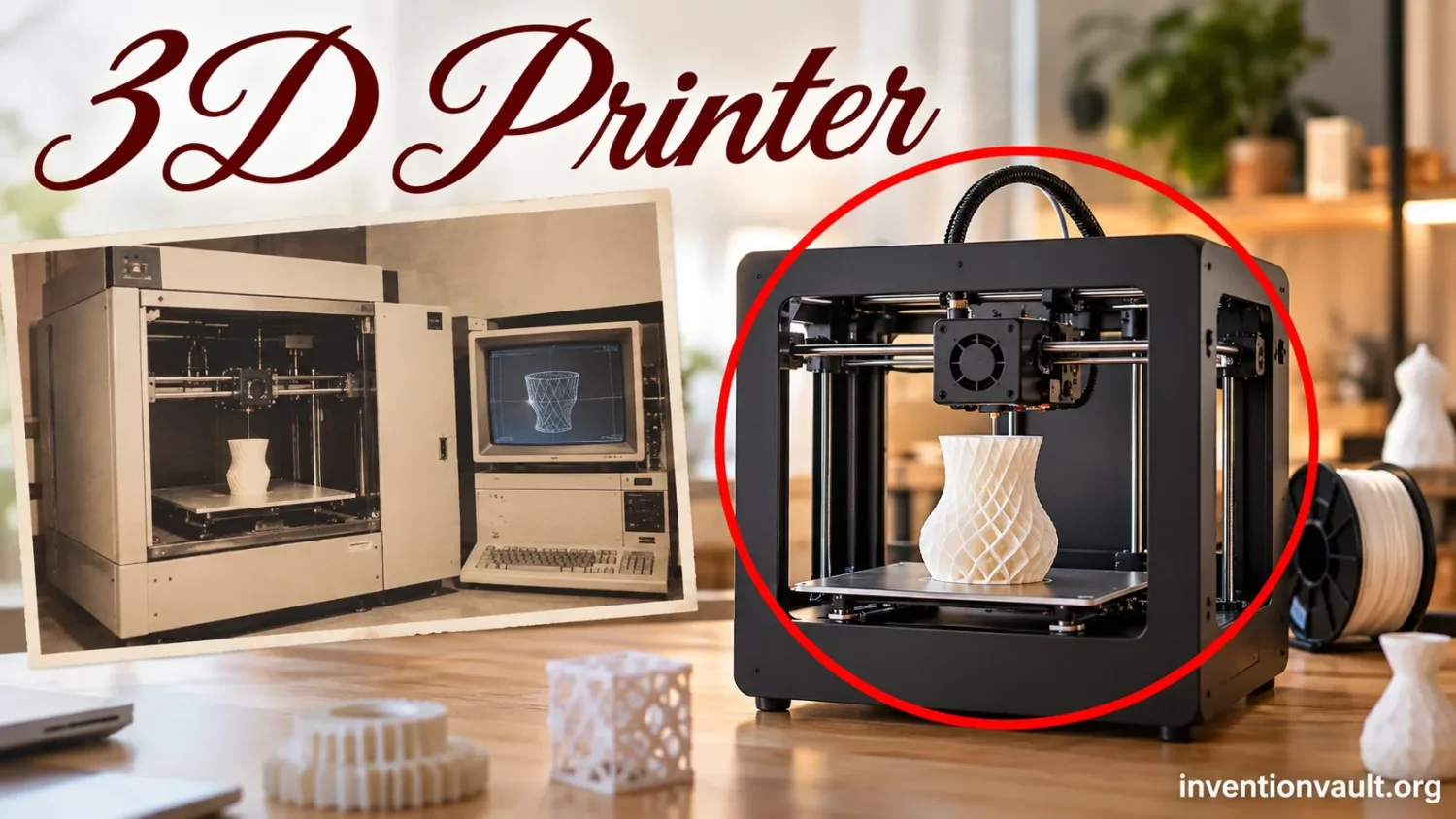
Modern consumer awareness is dominated by machines that melt thermoplastic filament and push it through a nozzle. Hull’s system used a different material state and a different way of forming each layer. That difference is one reason the phrase “first 3D printer” can be visually misleading when illustrated with a modern desktop filament machine.
| Feature | Hull-era SLA | Typical filament printer |
|---|---|---|
| Starting material | Liquid photopolymer resin | Solid thermoplastic filament |
| Layer-forming action | Selective light curing | Extrusion of melted plastic |
| Main working hardware | Resin vat, light source, scanning optics, moving platform | Heated nozzle, filament feed, motion system, build plate |
| 1980s historical role | Commercial stereolithography and rapid prototyping | FDM emerged later in the decade and commercialized afterward |
By the End of the 1980s, 3D Printing Was Already Splitting into Different Processes
Stereolithography did not remain the only route. Carl Deckard’s selective laser sintering work used a laser to fuse powder rather than curing a liquid photopolymer. Scott Crump’s fused deposition modeling used extrusion of softened thermoplastic. Those methods answered different material and machine-design problems.
This branching matters because “3D printing” became an umbrella term. Hull’s SLA is one founding process within additive manufacturing, not the mechanism used by every later printer. A filament machine and a resin-vat SLA machine both build objects additively, but they do not share the same material transformation or deposition method.
The early history is therefore best understood as the formation of a manufacturing family during the 1980s: photopolymer curing became commercially established through stereolithography, while powder fusion and material extrusion developed into separate process lines.
What the 1980s Actually Established
The lasting invention was a digital route from geometry to matter. A design could be represented on a computer, divided into cross-sections, and fabricated directly as a physical object without first making a dedicated mold for that individual prototype. That shortened the feedback loop between design and inspection.
Kodama’s work belongs at the beginning of that story because it documents successful light-cured layer fabrication before Hull. The French filing belongs in it because it shows independent 1984 development. Hull’s role remains the clearest commercial through-line: working stereolithography in 1983, a U.S. filing in 1984, patent and company formation in 1986, the SLA-1 in the commercial launch period of 1987–1988, and a digital interface that helped CAD models move into the manufacturing workflow.
For that reason, Chuck Hull is best described as the inventor of stereolithography and the central figure in the commercial birth of 3D printing, while the broader origin of additive manufacturing belongs to several overlapping experiments, claims, and process families.
Questions People Ask About the Invention of the 3D Printer
Did Chuck Hull invent the first 3D printer?
Hull created the stereolithography system that became the first commercially established 3D-printing platform and is widely credited with inventing stereolithography. Earlier work by Hideo Kodama had already demonstrated layer-by-layer photopolymer fabrication, so “first” depends on whether the question means earliest documented method, Hull’s working SLA system, patent, or commercial machine.
Was the 3D printer invented in 1983 or 1984?
1983 refers to Hull’s successful stereolithography part. August 8, 1984 is the filing date of his U.S. patent application. The patent itself was issued on March 11, 1986. These dates describe different stages of the same development path.
Why is 1987 sometimes given as the invention date?
1987 is associated with the SLA-1’s introduction as a commercial rapid-prototyping system, not the first conception or prototype of stereolithography. Some ASME material uses 1988 for first commercial sale or use, so the most precise wording distinguishes introduction from sale.
References Used for This Article
- Hideo Kodama, “Automatic method for fabricating a three-dimensional plastic model with photo-hardening polymer,” Review of Scientific Instruments (1981) — used for Kodama’s UV-cured, stacked cross-section fabrication method and publication record.
- U.S. Patent 4,575,330, Charles W. Hull — used for the August 8, 1984 filing date, March 11, 1986 issue date, patent title, stated prototyping problem, and stereolithography apparatus description.
- French Patent Application FR8411241A / FR2567668A1 — used for the July 16, 1984 filing date, named inventors Jean-Claude André, Alain Le Méhauté, and Olivier de Witte, and the related radiation-cured model-making approach.
- ASME Historic Mechanical Engineering Landmark: Stereolithography — used for the SLA-1 landmark record, 1987 commercial-system chronology, and stereolithography machine context.
- ASME, “The Prototyping Technology that Disrupted the World” — used for Hull’s prototyping motivation, 1983 stereolithography part, SLA-1 hardware description, and the later 1988 commercial-sale wording.
- 3D Systems, “SLA-1 in the National Inventors Hall of Fame Museum” — used for the company’s record of the March 9, 1983 eye-wash cup and early prototyping use.
- National Inventors Hall of Fame: Charles Hull — used for Hull’s stereolithography credit, UV-curable resin background, 3D Systems founding, and early commercial rapid-prototyping context.
- Library of Congress: STL (STereoLithography) File Format Family — used for STL’s triangular-facet representation, 1988 interface-specification record, naming variants, adoption, and role in CAD-to-3D-printing data exchange.