| Point | Detail |
|---|---|
| What Silage Is | Silage is green forage preserved by controlled fermentation after air is excluded from the stored crop. |
| What Was Actually Invented | The invention was not a single object; it was a working system that joined airtight storage, chopping, packing, and acid-forming fermentation. |
| Early Roots | Long before modern farm silos, green fodder was stored in pits in parts of the Mediterranean and Europe under low-air conditions. |
| Published Breakthrough | Auguste Goffart gave silage a major push with his 1877 book on ensiling maize and other green fodders. |
| American Turning Point | Francis Morris built and filled early silos in Maryland in 1876, helping move the method into American agriculture. |
| Chemistry Turning Point | A. I. Virtanen moved fodder preservation toward applied chemistry in the 1920s and early 1930s, work later recognized by the Nobel Prize. |
| Main Crops | Maize, grasses, legumes, sorghum, and whole-crop cereals became the best-known silage crops. |
| Main Storage Forms | Pits, trenches, tower silos, bunkers, bags, and wrapped bales all belong to the same preservation idea. |
| Typical Moisture Window | Many chopped silages work best around 55% to 70% moisture, with the exact range changing by structure. |
| Typical pH After Fermentation | Good silage usually drops from fresh-forage pH to about 3.8 to 5.0. |
| Dominant Acid in Good Silage | Lactic acid is usually the main preservation acid and should dominate the acid profile in well-fermented silage. |
| Why It Spread | Silage let farmers preserve high-moisture forage in seasons and regions where making dry hay was harder or less reliable. |
| Modern Legacy | Silage remains one of the defining feed-preservation methods in dairy and ruminant agriculture, especially where forage quality must be held through storage. |
Silage was not born in one workshop and it did not arrive with one neat invention date. It emerged when farmers learned that fresh forage could be kept useful by excluding air, packing the crop tightly, and allowing lactic acid fermentation to lower the pH before decay took hold. That is why the invention of silage belongs as much to storage design and crop handling as it does to chemistry. The feed itself mattered, of course. So did the vessel. So did the timing. Put together, those parts changed livestock feeding in a lasting way.
What Silage Is and What Was Actually Invented
Many short articles treat silage as if somebody simply “invented fermented fodder.” The history is less tidy and far more interesting. Farmers had preserved moist plant material before the modern term silage settled into use. What changed in the nineteenth century was the move from scattered practice to a more repeatable method. Once chopping length, compaction, sealing, crop choice, and fermentation were understood as one connected system, silage became a true agricultural invention rather than a local trick.
- First, farmers needed a storage form that could hold dense, wet forage with little oxygen.
- Second, they needed crop material with enough fermentable sugar and the right moisture balance.
- Third, they needed a method that could be repeated from season to season without large feed losses.
Silage became a real invention when storage, chopping, packing, and fermentation were treated as one problem instead of four separate ones.
Early Roots Before Silage Became a Named System
The idea behind silage is older than the word. Early farmers in parts of the Mediterranean preserved green fodder in pits, sometimes covering the material to limit air entry. Those older methods did not yet amount to the modern farm system, though they established the basic insight: wet forage could survive storage when oxygen was kept out and acidification was allowed to do its work. That older pit logic stayed alive for a very long time, even after masonry silos and later tower silos appeared.
Maize gave the practice a new direction. Grass had long been ensiled, yet maize offered a crop that packed well, carried useful sugars, and matched the needs of dairy and cattle feeding. Reports from nineteenth-century Europe show maize being ensiled in Hungary around 1860 and soon after in Germany. That shift matters because the later rise of silage in France, the United States, and beyond was tied not just to fermentation, but to the special fit between maize and anaerobic preservation.
Three People Who Moved the Method Forward
Auguste Goffart
Goffart did not invent the whole idea from nothing, yet he gave it a form that others could copy. His 1877 book on maize ensiling turned scattered practice into a published method and pushed silage into wider agricultural discussion.
Francis Morris
Morris helped move silage into the United States in 1876. His Maryland silos, later trench work, and public promotion showed that the method could fit American farm conditions and not remain a European experiment.
A. I. Virtanen
Virtanen pushed fodder preservation into laboratory-backed chemistry. His acid-preservation work in the 1920s and early 1930s showed that silage history was no longer only about pits and silos. It was also about controlling the biology inside them.
Auguste Goffart and the First Published Breakthrough
Goffart stands near the center of silage history because publication matters. Once a farm method is written down with enough detail, it can travel. His 1877 manual on the cultivation and ensiling of maize and other green fodders gave readers more than praise for the practice. It linked crop choice, silo design, and packing behavior in a way that made the method teachable. One detail often skipped in short retellings deserves attention: Goffart favored cutting maize into short lengths, about 1 centimeter, because smaller pieces improved compaction and helped remove air.
That point sounds technical, almost minor, yet it sits close to the heart of the invention. Silage fails when air lingers too long. Shorter chop length improves density. Better density supports a faster shift toward oxygen-poor storage. That supports cleaner fermentation. In other words, Goffart’s contribution was not only historical. It was mechanical and biological at the same time.
Francis Morris and the American Turn
In the United States, Francis Morris of Maryland became one of the earliest figures tied to actual farm adoption. Official Maryland historical records credit him with building brick silos in 1876 and introducing the practice of making corn silage in the country. He later developed earthen trenches as well, which matters because trench storage showed that silage did not require an expensive vertical structure to work. A farm could use earth, compaction, and covering to achieve the same broad preservation goal.
This is another part of the story that many pages miss. The invention of silage was also the invention of adaptable storage. It could live in brick vaults, pits, trenches, and later upright towers. Once farmers saw that the method could be shaped to local materials and budgets, silage spread more easily. That flexibility helped the practice move from curious experiment to regular fodder management.
Why Fermentation, Not Storage Alone, Changed the Story
A silo by itself does not make silage. Fermentation does. Fresh forage enters storage with a pH near the range of ordinary plant juice. Once packed and sealed, plant respiration and aerobic microbes use up trapped oxygen. Then lactic acid bacteria begin to dominate. As they convert soluble carbohydrates into acids, the pH falls—often to about 3.8 to 5.0. When that drop happens fast enough, spoilage organisms are held back and the crop keeps much more of its feeding value.
This biochemical side of the invention is often underwritten in popular history pieces. Yet it explains why silage became so useful. Under proper conditions, silage fermentation can preserve more than 90 percent of harvested energy and protein. That is a technical fact with huge historical weight. Farmers were not merely storing feed. They were learning how to hold nutritive value in a wet crop that would otherwise heat, rot, or mold.
One old debate shows how much the science mattered: late nineteenth-century writers distinguished a “warm” method, which allowed heating before final closure, from a “cold” method, which aimed to seal the crop quickly and prevent heating. Over time, the cooler, faster, airtight approach proved far better for limiting dry-matter and feeding-value losses.
How the Silo Evolved With the Method
Silage history is also a history of containers. Early systems used pits and trenches. Masonry and brick structures followed. Upright silos later became strong symbols of dairy farming because they packed forage well under their own weight and fit the farm skyline in a memorable way. Even so, the upright tower was never the whole story. Agricultural writers later reminded farmers that a trench silo dug in firm soil could preserve forage just as well if compaction and sealing were done properly.
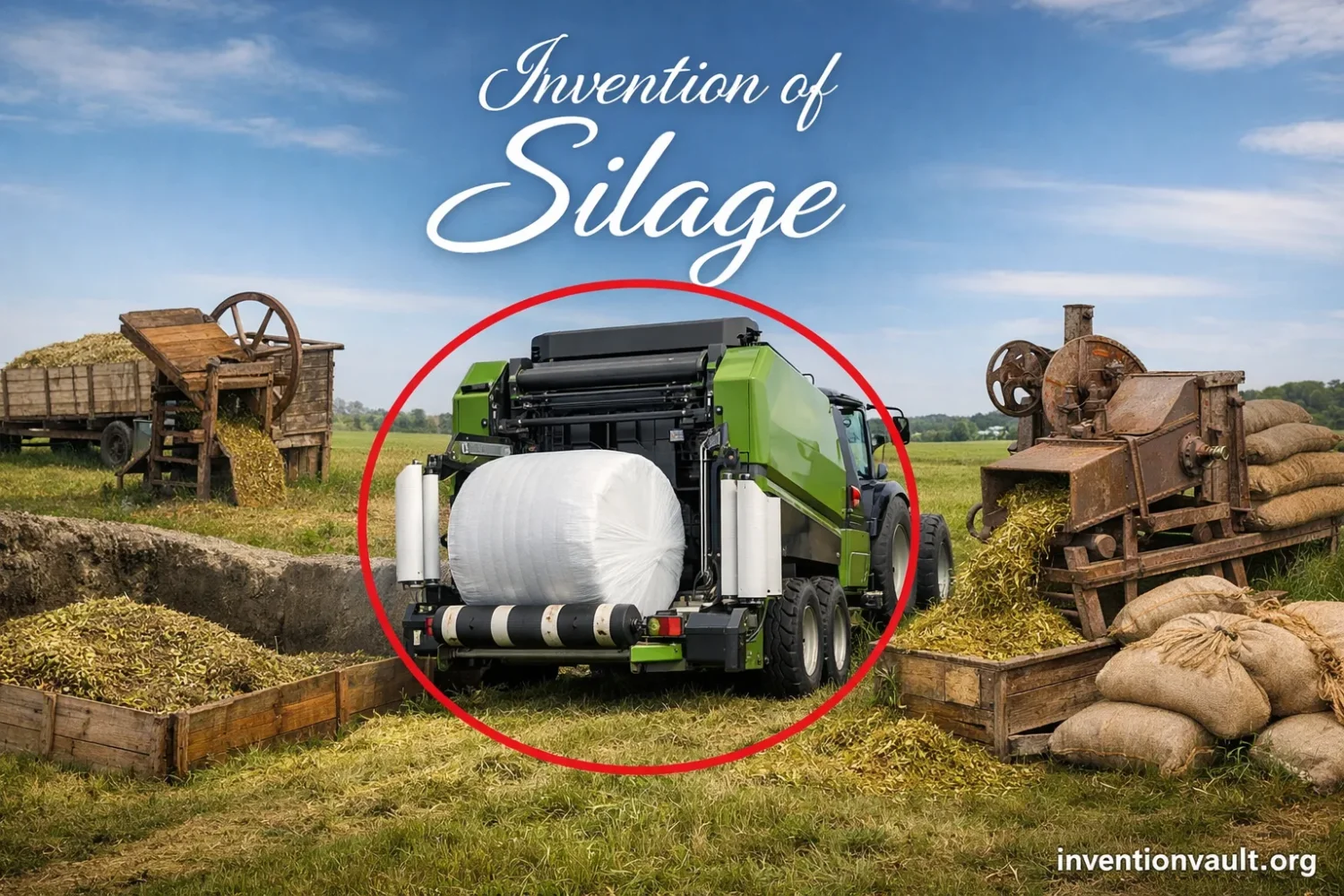
The mid-twentieth century brought heavier mechanization, and with it a tendency to treat silage as an equipment problem. That changed the farm look of silage production. Bunkers, mechanical unloading systems, and later bags widened the range of working options. Then another turn arrived: large-round and large-square baled silage, which dates to the late 1970s. Wrapped bales did not replace chopped silage, though they extended the old preservation idea into a form that suited many smaller or mixed operations.
Main Forms That Grew From the Original Idea
- Maize Silage: The best-known type in many dairy systems because maize combines useful sugars, good packing behavior, and high tonnage.
- Grass Silage: A long-standing form that remains common where pasture and cut grass dominate forage systems.
- Legume Silage: Often more demanding because legumes buffer pH change more strongly than cereals.
- Whole-Crop Cereal Silage: Made from crops such as oats, rye, or wheat harvested green at the right stage.
- Haylage: A drier silage, often associated with wilted forage and lower moisture than classic chopped silage.
- Baled Silage: Wrapped bales that preserve forage with less moisture than many bunker or bag systems, often around 45% to 55% moisture.
These are not separate inventions in the strict sense. They are later branches of the same original insight: fresh forage can be preserved through controlled fermentation when moisture, density, sugar supply, and air exclusion are balanced well enough.
Technical Markers Behind Stable Silage
| Marker | Typical Range or Sign | Why It Matters |
|---|---|---|
| Fresh-Forage pH | About 6.0 to 6.5 | Shows the crop has not yet entered its preservation phase. |
| Stable Silage pH | About 3.8 to 5.0 | Low pH slows spoilage organisms and protects feed value. |
| Moisture for Many Chopped Systems | 55% to 70%, depending on silo type | Too wet can cause seepage and poor fermentation; too dry reduces packing density. |
| Whole-Plant Corn Dry Matter | About 32% to 38% | A useful harvest target for many corn-silage situations. |
| Lactic Acid Share | Often 65% to 70% of total silage acids in good silage | Shows a fermentation pattern that usually limits dry-matter and energy loss. |
| Chop Length | Short enough for tight packing; modern ranges vary, older published methods could be very short | Shorter particles usually improve compaction and help air leave the mass. |
| Storage Stability | Months, and sometimes years, if air stays out | The seal matters almost as much as the first fermentation period. |
Those figures explain why silage should be treated as both a historical invention and a technical one. A farmer could know the name of Goffart or Virtanen and still make poor silage if moisture was wrong, sealing was weak, or fermentation stalled. The invention lasted because it worked in practice, not because it carried a memorable story.
Why Silage Lasted as an Agricultural Invention
Silage endured because it solved a stubborn farm problem. Livestock needed green, digestible feed beyond the moment of harvest. Hay solved that problem in one way, yet hay depends on drying weather and can lose quality in the field. Silage offered another route. It allowed farmers to cut forage earlier, preserve it while moist, and hold much of its feeding value through a sealed fermentation process. In places with wet harvest windows, cold seasons, or dense forage crops such as maize, that was a practical gain, not a small refinement.
Its staying power also comes from its flexibility. Silage can live in a pit, a trench, a tower, a bunker, a bag, or a wrapped bale. It can be made from maize, grasses, legumes, or whole-crop cereals. It can support small farm systems and highly mechanized ones. That range is why the invention of silage should be understood as a layered agricultural achievement: part biology, part engineering, part crop science, and part farm adaptation.
References Used for This Article
- Maryland Historical Trust — HO-576 Wilde Lake Barn (Oakland Manor Barn): Supports the 1876 Francis Morris milestone in American corn silage.
- Internet Archive — Ensilage of Green Crops: From the French of Auguste Goffart: Provides the translated nineteenth-century publication tied to Goffart’s method.
- UNESCO-EOLSS — Silage for Animal Feed: Supports early pit storage, maize ensiling in Europe, and the Goffart-Virtanen timeline.
- Nobel Prize — Artturi Virtanen: Facts: Confirms Virtanen’s fodder-preservation research and its chemical basis.
- FAO — Introduction to the Conference on Silage Making in the Tropics: Supports the definition of silage and the role of acids formed under airtight storage.
- FAO — Silage Fermentation Processes and Their Manipulation: Supports the four fermentation phases and the pH decline during ensiling.
- NC State Extension — Silage and Haylage Production: Supports fermentation stages, sealing, and storage stability.
- South Dakota State University Extension — Harvesting Silage on a Wet Year: Moisture Is Critical: Supports moisture and dry-matter ranges for major storage structures.
- University of Wisconsin Team Forage — Interpretation and Use of Silage Fermentation Analysis Reports: Supports the lactic-acid share expected in good silage.
- Oregon State University — Silage: Supports the distinction between silo, silage, and ensiling, plus storage forms and chop-length notes.