
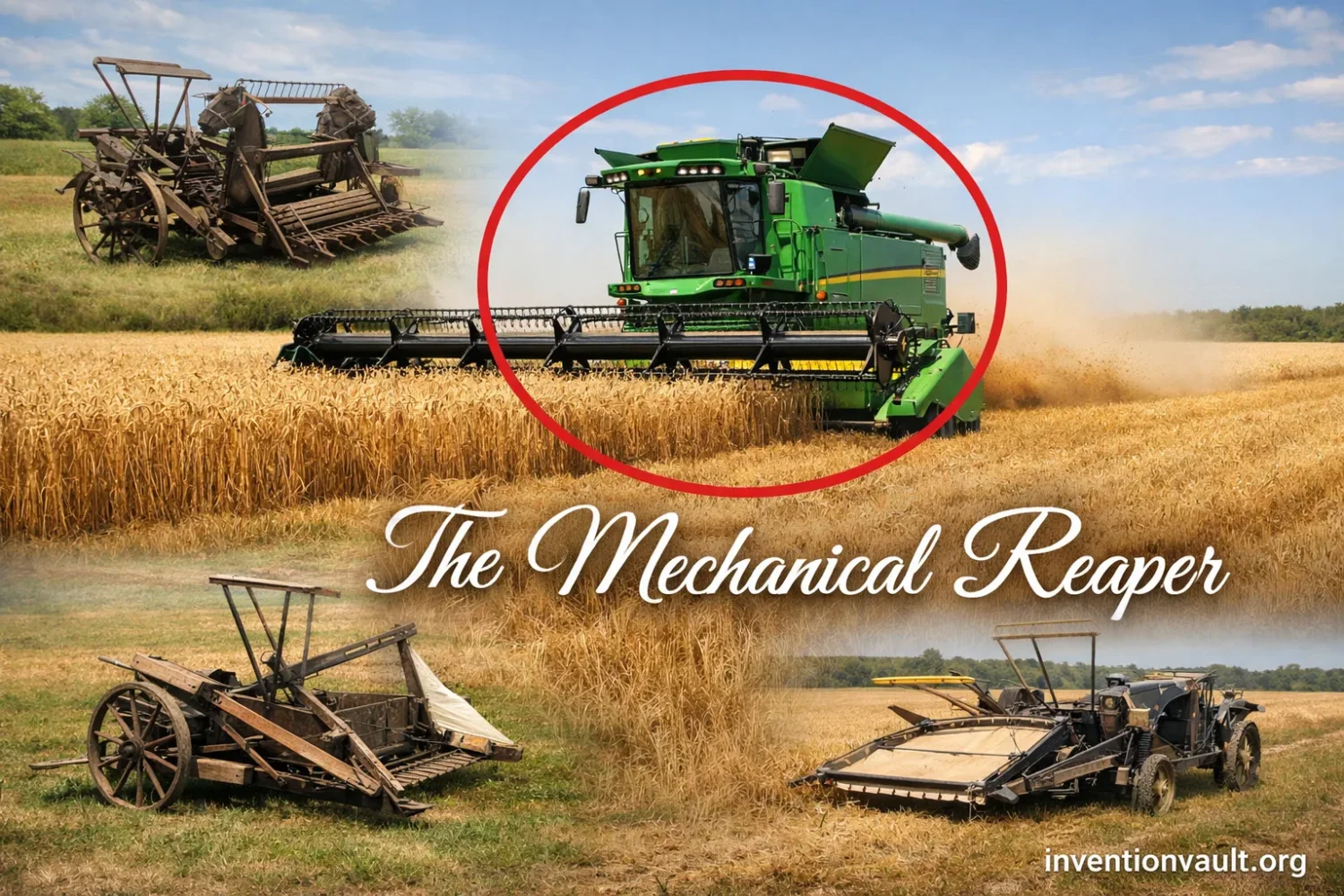
| Topic | Details |
|---|---|
| Invention | Mechanical Reaper |
| Common Attribution | Cyrus Hall McCormick is usually named as the inventor, though the story also involves Robert McCormick, Jo Anderson, and rival inventors working on similar harvest machines. |
| Earliest Successful Demonstration | 1831, in Rockbridge County, Virginia, where a working field trial showed that grain could be cut by machine rather than by hand. |
| Patent Milestone | June 21, 1834, followed by later improvements patented in 1845 and 1847. |
| Place of Development | Walnut Grove farm and workshop area, Virginia, before manufacturing later shifted west to Chicago. |
| Main Purpose | To cut standing grain faster than hand tools such as the sickle, cradle, or scythe. |
| Main Crops | Wheat first, then other small grains and grasses in suitable fields. |
| Power Source | Horse-drawn. |
| Core Working Parts | A reciprocating cutting blade, reel, divider, platform, wheels, and frame. |
| What the First Models Did Well | They cut grain in a more regular swath and reduced the time pressure of harvest. |
| What the First Models Did Not Do | They did not bind or thresh the grain; workers still had to rake it off, gather it, and tie it into sheaves. |
| Early Limits | Rough terrain, tangled or lodged grain, repair needs, price, and the fact that hand labor still handled several later harvest steps. |
| Later Forms Linked to It | Improved reapers, reaper-mowers, self-raking reapers, binders, and later the combine harvester. |
| Lasting Legacy | The machine helped turn grain harvesting into a mechanical process and helped push farm tool production toward factory scale. |
The mechanical reaper changed harvest work by attacking the hardest part of the grain season: cutting ripe stalks before weather, over-ripening, or labor shortages ruined the crop. That sounds simple now. It was not simple in the early nineteenth century. A grain farm could be planted with relative confidence, yet harvest still depended on human speed, steady weather, and many hands moving at the same moment. The reaper did not solve every harvest task at once, though it broke the old bottleneck. That single shift altered farm labor, machine making, and the geography of grain production.
What Made It New
- It cut grain with a moving blade rather than a hand swing.
- A reel pushed stalks toward the knife in a repeatable motion.
- A platform caught the cut grain instead of letting it fall at random.
- The machine could work over a wider swath than a single laborer.
What It Still Left to People
- Raking the cut grain off the platform in early versions.
- Binding stalks into sheaves.
- Shocking, hauling, threshing, and cleaning the grain.
- Repairing blades, guards, wheels, and drive parts in the field.
Origins and Shared Credit
The usual short version says that Cyrus McCormick invented the mechanical reaper in 1831 and patented it in 1834. That version is tidy, easy to remember, and incomplete. Mechanical harvesting had already attracted inventors in Britain and the United States before McCormick’s machine entered the story. His father, Robert McCormick, had spent years trying to solve the same problem. Other inventors, including Obed Hussey, were building rival reapers at nearly the same moment. The machine that reached the field in Virginia came out of that wider stream of experiments, not out of a single isolated flash.
That is why the reaper matters as both an invention and a process. Cyrus McCormick deserves attention for turning a difficult idea into a working field machine and then into a sellable product. Still, the early machine also reflects the work of people around him, including Jo Anderson, whose role is now discussed far more openly than many older textbook summaries allowed. For readers interested in the real history of invention, this matters. The reaper was not merely “thought up.” It was tested, adjusted, built, and rebuilt until the harvest itself accepted it.
How the Machine Worked
The early mechanical reaper used a straightforward logic. A horse drew the machine beside the standing grain. At the front, a divider separated the crop to be cut from the crop left standing. A reel pressed stalks inward. A vibrating knife moved back and forth across guard fingers, slicing the stems near ground level. The cut stalks then fell onto a platform, where they could be raked off in bunches. That sequence may look basic on paper, though it solved a stubborn physical problem: how to guide flexible plants into a moving blade without clogging the machine.
Its design also explains why the reaper spread step by step rather than all at once. The machine cut grain; it did not finish the harvest. Early users still needed labor for gathering and binding. Even so, cutting was the tightest choke point of the season. Once that first step sped up, the rest of the harvest chain could begin to change around it.
| Version | What Changed | What Still Needed Human Work | Why It Mattered |
|---|---|---|---|
| 1834 Reaper | Basic cutting system with reel, knife, divider, and platform. | Raking off, binding, threshing, cleaning. | Made mechanical grain cutting practical enough to patent and improve. |
| 1845 Improvement | Refined parts and operating details for steadier field use. | Most post-cut handling still remained manual. | Showed that the reaper was an evolving machine, not a finished object in 1831. |
| 1847 Improvement | Included changes associated with easier operation, including the raker’s seat in later legal discussion. | Binding and threshing still required separate labor. | Helped move the reaper toward more workable commercial versions. |
| Self-Raking Reapers | Added mechanisms to move cut grain off the platform more automatically. | Binding usually remained separate. | Reduced one more repetitive task at harvest. |
| Binders and Combines | Later machines gathered, tied, and eventually threshed grain as part of the same harvest flow. | Far fewer manual steps remained. | Extended the reaper’s logic into the full harvest chain. |
Why Adoption Took Time
Many popular articles treat the mechanical reaper as if farmers saw it and adopted it at once. The record is more interesting than that. Historians of agricultural technology have pointed out that there was a long delay between the first workable machines of the 1830s and the broader wave of acceptance in the mid-1850s. That delay makes sense once the machine is viewed as field equipment rather than as a simple patent drawing.
- Early machines were demanding. A reaper had to stay aligned, cut cleanly, and avoid clogging in grain that was uneven, damp, tangled, or bent over.
- Field shape mattered. Open land with long runs suited the machine far better than cramped or irregular plots.
- Harvest labor economics mattered. Where labor was available and relatively cheap, hand cutting could still compete.
- Ownership meant maintenance. Knives, guards, wheels, and fittings wore down. A machine without parts or repairs nearby could become an expensive problem.
- The first reaper did only one part of the harvest. Farmers still needed workers for binding and later handling, so the labor savings were real but not total.
This is one of the most overlooked parts of the reaper’s history. The machine did not triumph because people instantly loved novelty. It spread where its strengths matched local farming conditions. Large grain regions of the Midwest, with wider fields and rising harvest pressure, gave the reaper the environment it needed.
How the Reaper Changed Farming and Industry
The reaper changed farming first by changing timing. Grain ripens inside a narrow window. A machine that could cut faster lowered the risk that ripe fields would wait too long. Farmers could think on a different scale. That did not mean every farm became large overnight. It did mean that grain production no longer had to stop at the old limit set by hand cutters alone.
The machine also shifted the center of the story westward. McCormick’s move to Chicago in 1847 placed manufacturing closer to the expanding grain regions. That decision tied the reaper to the rise of the American wheat belt and to the growth of factory-made farm equipment. By the early 1850s the reaper was no longer just a Virginia workshop success. It had become part of a wider commercial system built on production, demonstrations, transport, sales, and repairs.
On the Farm
- Reduced the harvest bottleneck in wheat and other small grains.
- Made larger acreages more realistic in regions suited to machine cutting.
- Shifted attention from pure hand skill to machine handling and upkeep.
- Prepared the ground for later harvest systems that combined multiple tasks.
In Manufacturing and Trade
- Encouraged factory production of farm equipment rather than isolated shop work.
- Pushed makers to develop service networks and field demonstrations.
- Helped Chicago emerge as a machinery center tied to grain commerce.
- Won notice abroad, especially after the 1851 Great Exhibition in London.
The London exhibition matters for another reason. It signaled that the reaper was not merely a local farm tool. It stood as a visible American machine at a time when industrial reputation mattered. The reaper’s fame grew not only because it cut grain, but because it could be shown, compared, and exported.
From Reaper to Binder and Combine
The plain mechanical reaper sits at the start of a larger family of harvest machines. That lineage is easy to miss if the story stops with the 1834 patent. Early reapers cut. Later versions aimed to move the cut grain more neatly, then to rake it, then to bind it, and much later to thresh and clean it within one harvest system. The reaper’s history is, in that sense, a history of stacked improvements.
Reaper-mowers, self-raking reapers, and binders each removed another manual step. The combine pushed the process much further by handling cutting, threshing, and cleaning in one continuous operation. Even so, the core idea stayed familiar: guide the plant, cut it cleanly, control where the crop goes next, and reduce the delay between standing grain and stored grain. Today’s harvest headers still follow that same logic, only with far more precision and far less hand labor.
Why the Mechanical Reaper Still Deserves Attention
- It turned grain cutting into a repeatable mechanical action.
- It exposed how invention depends on field testing, revision, and local conditions.
- It linked farm work to factory production and distribution.
- It opened the path that later harvest machines followed.
References Used for This Article
- Library of Congress — Inventions and Discoveries: Notes the McCormick reaper’s presence at the Great Exhibition of 1851 and its early reach into Britain.
- Encyclopaedia Britannica — Cyrus McCormick | Biography, Invention, Reaper, & Facts: Summarizes McCormick’s life, the 1831 trial, the 1834 patent, and the move to Chicago.
- Smithsonian Institution — Agricultural Implements and Machines in the Collection of the National Museum of History and Technology: Lists model records for the 1834, 1845, and 1847 McCormick reapers and places them within a longer machine lineage.
- USDA — A Condensed History of American Agriculture 1776–1999 Timeline: Provides a federal timeline entry for the patenting of the McCormick reaper and its place in farm mechanization.
- Cambridge University Press — The Mechanization of Reaping and Mowing in American Agriculture, 1833–1870: Explains why adoption lagged after the first workable reapers and why diffusion depended on farm economics and field conditions.
- Lemelson-MIT Program — Cyrus McCormick: Describes how the reaper gained traction in the 1840s and how McCormick scaled production and sales.