
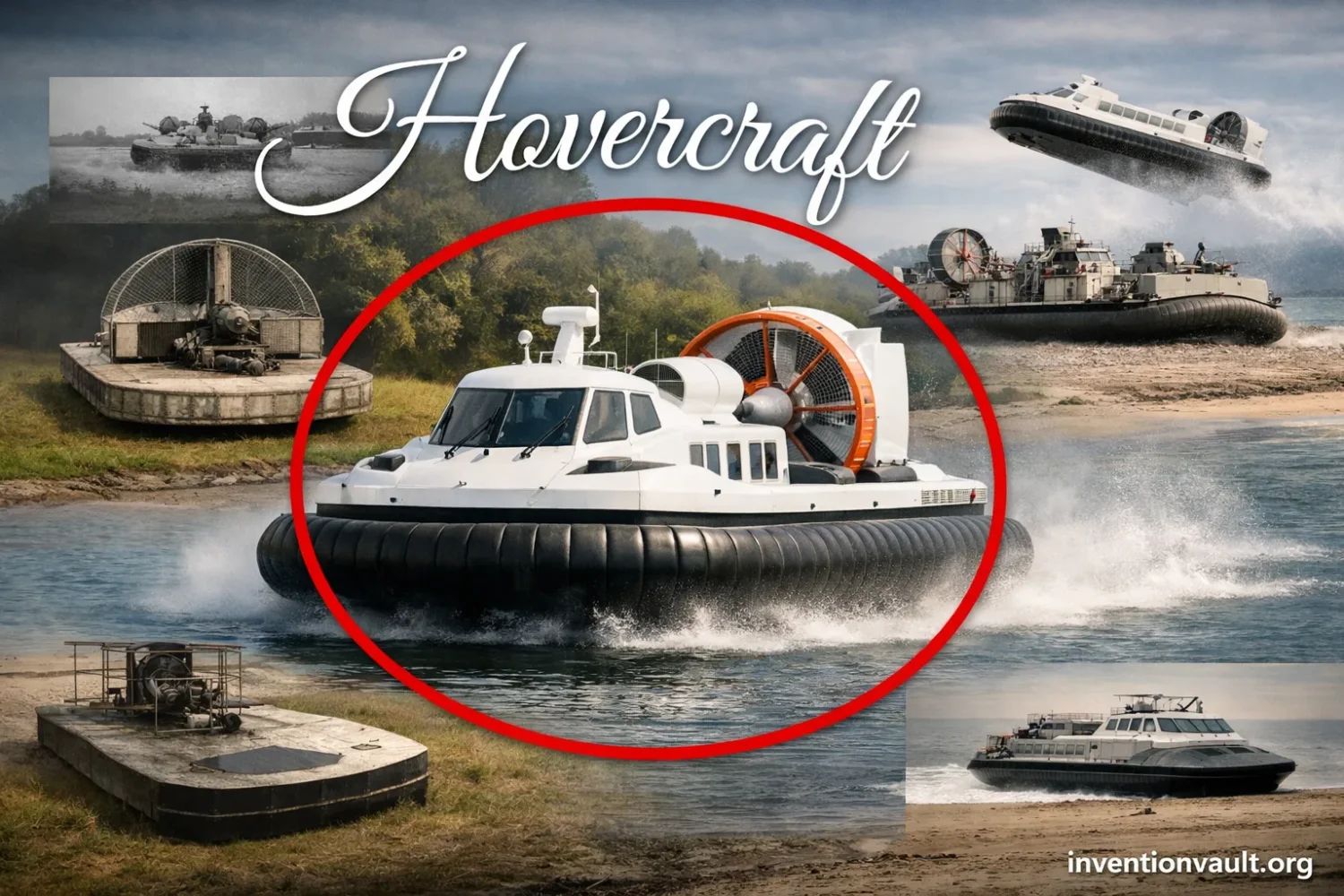
| Field | Details |
|---|---|
| Invention | Hovercraft, also called an air-cushion vehicle or ACV |
| Core Breakthrough | A stable pressurised air cushion retained by a perimeter jet, known as a momentum curtain, to reduce air leakage around the edges |
| Commonly Credited Inventor | Sir Christopher Sydney Cockerell of the United Kingdom |
| Early Proof Experiment | A mid-1950s tabletop demonstration using nested tins and an air source to show how a perimeter jet could help trap pressure under a platform |
| Development Pathway | Prototype work organised through Hovercraft Development Limited with NRDC funding, followed by full-scale construction by Saunders-Roe |
| First Full-Scale Prototype Widely Recognised | Saunders-Roe SR.N1, built at East Cowes on the Isle of Wight, England |
| First Public Flight | 11 June 1959 at the Saunders-Roe works on the Isle of Wight |
| Early Channel Milestone | 25 July 1959, when the SR.N1 travelled from Calais to Dover in just over two hours |
| Practical Upgrade | Flexible skirts, patented by Latimer-Needham in 1962, improved clearance over waves and obstacles and supported repeatable production |
| Earlier Precursors | Ground-effect and air-cushion experiments in the 1930s and 1940s, including work associated with Toivo J. Kaario and Vladimir Levkov |
A hovercraft is an amphibious vehicle supported just above the surface by a cushion of air. It can cross water, sand, mud, ice, and shoreline without relying on wheels in the usual way or keeping a hull fully in the water. Its history is not one isolated event. Experiments with trapped air, perimeter jets, full-scale prototypes, and flexible skirts gradually turned the idea into a vehicle that could be controlled and operated outside a test bench.
What Makes A Hovercraft Different
A true hovercraft is supported by lift generated from pressurised air beneath the craft. It does not need forward speed before the cushion can carry its weight. That separates it from several vehicles that can look similar from a distance.
- Airboats move across shallow water but their hulls remain in contact with the water.
- Hydrofoils raise a hull with underwater wings and require forward movement to produce lift.
- Ground-effect vehicles, also called WIG craft, gain aerodynamic lift mainly from motion close to the surface.
Two Jobs, Two Airflows
Hovercraft airflow has two separate jobs: lift supports the craft, while thrust moves it forward. These functions may use separate fans or divided airflow from one main system. Steering then depends on rudders, ducts, thrust control, or a combination of them.
Where The Idea Came From
Before the SR.N1 appeared, engineers in several countries had explored ways to use trapped or directed air to reduce drag and carry weight. Some machines were intended to skim close to water or ground. Others tested plenum chambers, enclosed spaces where supplied air could build pressure beneath a platform.
Finnish engineer Toivo J. Kaario is often associated with early surface-glider experiments and patents from the 1930s and 1940s. Soviet engineer Vladimir Levkov also tested air-cushion watercraft during the same broad period. Their machines differed from the later British development, but they show that air-supported transport had an international experimental history before Cockerell’s work reached full scale.
Why A “Modern” Invention Still Fits
The modern hovercraft is usually connected with Cockerell because his perimeter-jet method offered a workable way to retain cushion pressure. Instead of relying only on air pumped into an open space beneath a platform, the design directed a fast jet around the perimeter. This reduced edge losses and allowed the same air supply to produce more useful lift.
Christopher Cockerell And The Momentum Curtain
Christopher Cockerell examined where energy was being lost in fast water transport and tested whether air could reduce contact between a craft and the surface. During the mid-1950s, he used simple apparatus involving two tins of different sizes. Air passed through the gap between them and formed a narrow ring around the central area.
The experiment showed that a fast perimeter jet could limit sideways leakage and allow pressure to rise inside the ring. Cockerell called the effect a momentum curtain. The curtain did not create an airtight seal. Air still escaped beneath the craft, but it escaped in a more controlled pattern, allowing the cushion to support weight without demanding an unrestricted flow simply to replace losses.
This arrangement joined marine and aeronautical engineering. The vehicle remained close to the surface like a boat, while fans, ducts, and moving air supplied lift and directional control.
The Practical Meaning Of Air Leakage
- If air escapes freely from every edge, the lift system must replace it continuously and consumes more energy.
- If the perimeter flow is controlled, cushion pressure becomes steadier and the craft’s response is easier to predict.
- Steadier lift makes steering arrangements more useful because the vehicle behaves in a more repeatable way.
From Workshop To SR.N1
Turning the principle into a full-scale craft required test facilities, patent management, funding, and manufacturing skill. Cockerell’s research was declassified by 1958. In January of that year, Hovercraft Development Limited was established with funding from the National Research Development Corporation, and Cockerell became its technical director.
Saunders-Roe had already examined the idea through feasibility work and then joined the development programme. Its experience in aircraft and marine construction suited a vehicle that used a boat-like body together with fans, ducts, and aerodynamic controls. Model tests were followed by construction of the SR.N1, short for Saunders-Roe Nautical 1.
The SR.N1 made its first public flight on 11 June 1959 at East Cowes on the Isle of Wight. It hovered over land and was then tested on water. The machine used a central fan and a divided airflow system. About two-thirds of the air supplied the cushion, while the remaining flow passed through side ducts for propulsion and steering.
On 25 July 1959, the craft crossed the English Channel from Calais to Dover. Pilot Peter Lamb, navigator John Chaplin, and Christopher Cockerell were aboard, and the journey took just over two hours. The crossing demonstrated that the vehicle could operate beyond sheltered model trials and short public displays.
| Period or Date | Milestone | What Changed |
|---|---|---|
| 1930s–1940s | Air-cushion and surface-effect experiments were carried out in several countries | These projects tested how supplied air and close surface proximity could reduce contact or support weight |
| Mid-1950s | Cockerell demonstrated the perimeter-jet principle with simple apparatus | The experiment showed a practical method for retaining pressure while limiting edge leakage |
| January 1958 | Hovercraft Development Limited was established with NRDC funding | The project gained an organised route for patents, testing, funding, and industrial development |
| 11 June 1959 | The SR.N1 made its first public flight on the Isle of Wight | A full-scale craft demonstrated controlled movement over land and water |
| 25 July 1959 | The SR.N1 crossed the English Channel from Calais to Dover | The open-water journey tested the craft beyond the factory and sheltered demonstration area |
| 1962 | Flexible skirt patents associated with Latimer-Needham | Skirts improved clearance over uneven surfaces and made later production designs easier to standardise |
The Skirt That Made Hovercraft Practical
Early hovercraft could rise on an air cushion, but water and land are rarely smooth. Waves, ridges, and small obstacles opened larger gaps beneath a rigid lower edge. Air then escaped faster, lift fell, and the fan system had to replace the loss.
The flexible skirt provided a compliant boundary around the cushion. It could move with the surface while maintaining clearance between the main structure and the ground or water. The skirt was not an airtight bag. Its shape and openings controlled how air reached and left the cushion, allowing the craft to pass over irregular surfaces with less abrupt loss of lift.
Science Museum records connect the production-changing skirt design with a patent by Latimer-Needham in 1962. Flexible skirts allowed greater obstacle clearance and helped manufacturers build later craft around repeatable skirt arrangements rather than relying only on a rigid perimeter jet.
What The Skirt Does
- Reduces edge leakage so the cushion remains steady.
- Improves clearance over waves, ridges, and small obstacles without placing the main hull directly on the surface.
- Helps control spray and intermittent surface contact.
What The Skirt Does Not Do
- It does not carry the craft by itself; the fan system still supplies the air pressure.
- It does not remove drag entirely, because air, spray, and skirt contact still create resistance.
- It does not make the craft immune to wind, waves, loading changes, or steering delay.
References Used for This Article
- Science Museum Group — The Saunders-Roe Nautical 1: A Game-Changing Hovercraft: Used for Cockerell’s nested-tin experiment, Hovercraft Development Limited, Saunders-Roe’s role, the SR.N1 airflow arrangement, the 1959 demonstrations, the Channel crossing, and the 1962 flexible-skirt patent.
- Science Museum Group Collection — Hovercraft SR-N1: Museum record for the preserved prototype, Christopher Cockerell’s attribution, its 1959 construction, public flight, Channel crossing, and steering airflow.
- Science Museum Blog — Flying on a Cushion of Air: Supports the experimental model stage and the SR.N1 English Channel crossing.
- The Hovercraft Society — Air Cushion History and Books: Historical bibliography and technical reading on early air-cushion vehicles, Saunders-Roe, Cockerell, and later hovercraft development.
- British Patent GB893715A — Vehicles Supported by Gaseous Cushions: Patent record describing a vehicle supported by a gas cushion retained within a directed curtain of fluid.
- HLK — The Hovercraft’s Hovering Place in Transport History: Patent-history discussion of Cockerell’s momentum curtain and Hovercraft Development Limited’s filings.