
Machine-Tool Development Timeline
How the Drill Press Took Shape
Follow the surviving machines, feed systems, commercial forms, and later drive changes that turned stationary drilling into a recognizable drill press.
Surviving early machine
Nasmyth and Gaskell, circa 1840
Current stage
Documented construction
A surviving Manchester machine attributed to Gaskell and Nasmyth dates to about 1840 and resembles larger power drills made by Nasmyth, Gaskell & Co. from that period onward.
Guided spindle
A cast-iron frame carried the drill spindle, while bevel gearing supplied rotation. The structure fixed the cutting axis relative to the work instead of leaving alignment entirely to the operator.
Automatic advance
A ratchet, pawl, eccentric cam, and feed screw advanced the drill downward in small steps. The same screw could also be operated manually with a handle.
The machine joined rigid support, powered rotation, and controlled downward feed in one stationary drilling system.
Precision feed milestone
Whitworth Drilling Machine, 1846
Current stage
Self-acting motion
Joseph Whitworth’s 1846 machine used the self-acting feed motion he had patented in 1837, allowing spindle advance to be governed mechanically rather than only by hand pressure.
Feed mechanism
A threaded upper spindle engaged worm wheels. Braking those wheels made them act like a nut, advancing the rotating spindle along its axis while preserving controlled motion.
Work positioning
The T-slotted table could rotate and move transversely, letting the workpiece be brought to the drill axis and clamped rather than forcing the cutting head to chase each hole.
Whitworth’s machine shows how feed control and movable work support became part of precision drilling, not separate workshop tasks.
Recognizable machine form
Whitworth Pillar Drill, circa 1860
Current stage
Power-driven lineage
The Science Museum Group records that Whitworth & Co. developed its first power-driven drilling machine in 1847; a surviving pillar drill from about 1860 shows the form in mature workshop use.
Selectable speed
The surviving machine provided four drill speeds. Changing spindle speed made one machine more suitable for different drill diameters and cutting loads.
Adjustable table
A screw moved the table laterally so the work could be positioned beneath the tool. That column-spindle-table relationship remains familiar in later pillar and floor drill presses.
By the mid-nineteenth century, the upright pillar layout had acquired features still recognizable in drill presses today.
Commercial evidence
Drill Presses as Catalog Machinery, 1874
Current stage
Named product class
Lucius W. Pond’s 1874 machine-tool catalogue explicitly listed “Drill Presses,” showing that the term had become a commercial category rather than a later label applied to one experimental machine.
Workshop features
Catalogued machines included adjustable drilling heads and tables, back gearing, self-feeding arrangements, and countershaft equipment. Different sizes were offered for different classes of work.
What the catalog proves
A sales catalogue does not identify the first inventor. It does show that drill presses had reached a repeatable manufactured form with selectable configurations by the 1870s.
The drill press had moved beyond isolated development into a machine-tool family that manufacturers could specify, build, price, and sell.
Patent-language evidence
Euphrates A. Hare’s Upright Drill, 1882
Current stage
Improvement, not origin
Hare’s U.S. patent described “new and useful Improvements in Upright Drills.” That wording matters because it treats the upright drill as an existing machine class.
Vertical drill shaft
The patent describes a machine for drilling or boring holes in hard materials with a vertically operated drill shaft, a chuck for the drill, and a table that supported the work beneath it.
Human-powered option
Its mechanism used a lever, connecting rod, crank, and flywheel to rotate the drill shaft, showing that drill-press history cannot be reduced to electric motors.
Late-nineteenth-century patents document refinement of an established upright-drill idea rather than a single legal birth date for the machine.
Design branch
Alfred Box’s Radial Drill, 1883
Current stage
The large-work problem
An upright drill works well when the workpiece can be positioned beneath the spindle. Large castings create the opposite need: move the drilling head to the hole location.
Radial movement
Alfred Box’s 1883 patent improved an earlier 1876 radial drilling-machine design and transmitted power to a spindle that could occupy different positions on the radial arrangement.
Belt transmission
Box proposed belt drive in place of the bevel gears and shafting used in the earlier design, aiming for a simpler and quieter way to power the movable spindle.
Radial drills extended the drilling-machine principle by moving the tool toward large work instead of moving the work beneath a fixed head.
Production adaptation
Jacob N. Barr’s Multi-Drill Attachment, 1894
Current stage
Ordinary press as host
Barr’s patent described an attachment intended for the spindle of an “ordinary drillpress,” another clear indication that the base machine was already familiar by the 1890s.
Secondary spindles
The attachment carried several secondary drill spindles driven from the main spindle through gearing, allowing several drills to operate during the same machine cycle.
Adjustable hole patterns
The secondary drills could be repositioned relative to one another, allowing groups of holes to be produced in different arrangements without treating each hole as a separate setup.
Once the basic press was established, development shifted toward output per setup, repeatable hole patterns, and specialized production work.
Drive-system change
Direct-Drive Upright Drill, 1930
Current stage
Motor on the machine
David C. Klausmeyer’s 1930 patent placed an electric motor on the upright machine and connected it to the spindle through a compact gear train rather than relying on a remote shop drive.
Modular head arrangement
The patent described interchangeable spindle-supporting brackets and adjustable feed-head positions, allowing one upright standard to accept different drilling or tapping arrangements.
What electrification changed
Electric drive altered power delivery and machine layout. It did not create the rigid column, vertical spindle, controlled feed, or adjustable work support that defined earlier drill presses.
Twentieth-century electrification modernized the drive while preserving a mechanical architecture already developed across the previous century.
The drill press was not invented in one clean step by one universally accepted inventor. Stationary drilling machines existed before the familiar modern form, while surviving machines from Nasmyth and Gaskell around 1840 and Joseph Whitworth in 1846 document the decisive nineteenth-century shift toward rigid frames, guided spindles, controlled feed, and accurately positioned work. By the 1870s, “drill press” was already being used as a commercial machine-tool category. The best historical account is therefore a development story rather than a single-name invention claim.
| Field | Verified historical outline |
|---|---|
| Invention | Drill press; closely related historical terms include upright drill and pillar drill |
| Main development period | Early to mid-nineteenth century, with rapid refinement later in the century |
| Early documented machine | Gaskell and Nasmyth drilling machine, circa 1840, with hand or power automatic feed |
| Major precision-machine contributor | Joseph Whitworth, whose 1846 machine used a self-acting feed motion and a movable T-slotted table |
| Recognizable pillar form | Whitworth & Co. developed a power-driven drilling machine in 1847; a surviving circa-1860 pillar drill had four spindle speeds and an adjustable table |
| Defining mechanical idea | A rotating drill is guided on a fixed machine axis while feed and work position are controlled by the machine |
| Not the same invention as | The portable electric drill; drill presses were established before individual electric-motor drive became common |
Dating the First
A patent date is not automatically the invention date. Surviving machines, workshop practice, patent wording, and commercial catalogues document different stages, so naming one exact “first” requires a definition that the historical record does not supply consistently.
What Had to Change Before a Drill Became a Drill Press?
People could rotate cutting tools long before industrial machine tools appeared. The hard part was not merely making a drill spin. Accurate metalworking required the cutting axis, feed direction, and workpiece position to remain controlled while force passed through the tool.
A hand drill leaves several variables in the operator’s hands at once: angle, pressure, position, and often speed. A stationary drilling machine transfers much of that control into iron, bearings, screws, tables, and guides. Once the spindle is constrained by a rigid machine, the operator no longer has to hold the drilling axis by feel alone.
This shift matters most in metal. A hole intended for a pin, bolt, shaft, bearing location, or later machining operation must be more than an opening. Its position and direction must agree with the rest of the part. Repeat the same operation across several components and the value of a stable machine reference becomes even clearer.
Circa 1840: Nasmyth and Gaskell Combined Rotation with Automatic Feed
A surviving drilling machine in the Science Museum Group collection is dated to about 1840 in Manchester and attributed to Gaskell and Nasmyth. It had belonged to James Nasmyth and resembles larger power drills made by Nasmyth, Gaskell & Co. from about 1840 onward.
The machine’s construction shows why it belongs near the center of drill-press history. A cast-iron base and two columns supported a cross beam carrying the drill spindle. Bevel gears transmitted rotational power. A central screw provided downward feed, while a ratchet-and-pawl arrangement driven by an eccentric cam indexed that feed as the drill turned. The feed screw could also be moved by hand.
That arrangement separated two actions that a hand-held drill forces one person to manage together: rotation and axial advance. The drill could turn under power while the machine controlled how it entered the work.
- Transmit rotationPower reaches the drill spindle through gearing, turning the cutting tool around a fixed axis.
- Index the feedAn eccentric motion drives a pawl against a ratchet, converting repeated spindle motion into small feed increments.
- Turn the feed screwThe indexed mechanism rotates the screw that controls vertical movement of the drilling spindle.
- Advance the cutterThe spindle moves downward while continuing to rotate, producing a mechanically governed cutting feed instead of relying only on arm pressure.
The importance of this machine is not that it proves Nasmyth was the sole inventor of every drill press. It shows a documented early arrangement in which a rigid frame, powered spindle, and automatic feed worked as parts of the same drilling machine.
Whitworth’s 1846 Machine Made Feed and Position More Deliberate
Joseph Whitworth’s surviving 1846 drilling machine provides another unusually concrete piece of evidence. It was fitted with the self-acting feed motion that Whitworth had patented in 1837. The spindle was driven through bevel gearing, but the feed system did more than push the drill downward.
The upper part of the spindle carried a screw thread engaging two worm wheels on transverse shafts. When brake blocks restrained friction rollers connected to those shafts, the worm wheels acted like a nut and advanced the spindle. A handwheel provided rapid withdrawal. This was controlled machine motion rather than a simple lever forcing a rotating tool into metal.
The table is equally revealing. It had T-slots and could rotate as well as move transversely. That meant the workpiece could be clamped and brought into alignment with the spindle axis. The workpiece became part of the machine’s geometry.
Why the Table Was More Than a Support
A plain bench can hold a part, but an adjustable machine table helps establish where that part sits relative to the spindle. T-slots give clamps and fixtures defined places to grip the work. Transverse or rotating movement lets the machinist reposition the work without abandoning the machine’s reference axis.
This is one reason a drill press is not simply a hand drill mounted vertically. Its usefulness comes from the relationship among the spindle, feed, column or frame, table, and clamped workpiece.
Who Invented the Drill Press?
No single name fits every defensible definition. James Nasmyth and the firm of Nasmyth, Gaskell & Co. are tied to documented power drilling machinery around 1840, including a surviving automatic-feed machine. Joseph Whitworth is tied to a surviving 1846 drilling machine with a self-acting feed and to a power-driven drilling-machine lineage that his firm developed from 1847.
Calling either man the uncontested first inventor would go beyond what those records establish. Earlier stationary drilling and boring machinery already existed, while the familiar upright or pillar drill emerged through cumulative machine-tool development.
What Different Evidence Actually Establishes
- Surviving machineShows that a particular mechanical arrangement physically existed by the object’s documented date, though it may not have been the first example ever built.
- Patent recordShows what an inventor claimed as new or improved. A patent titled “drill press” can describe an improvement to a machine class that already existed.
- Commercial catalogueShows that manufacturers were offering named machine types with specified features, sizes, and drive arrangements; it does not identify the original inventor by itself.
- Later museum attributionLinks preserved objects to makers and dates using collection research, but must still be read alongside contemporary machines, patents, and trade literature.
The Pillar Drill Made the Architecture Familiar
The Science Museum Group records that J. Whitworth & Co. developed its first power-driven drilling machine in 1847. A surviving Whitworth pillar drill made around 1860 shows how recognizable the design had become: the machine stood on a rigid vertical structure, carried a power-driven drill, offered four spindle speeds, and used a screw-adjusted table for lateral positioning.
The four-speed arrangement addressed a practical cutting problem. A machine intended to drill different hole diameters cannot treat every operation as identical. Larger drills impose different cutting loads and generally require lower rotational speed than small drills. Mechanical speed selection let one drill handle a wider range of work without changing the entire machine.
The Six Machine Relationships That Defined the Press
| Machine element | Problem it solved |
|---|---|
| Base | Provided a stable foundation for the cutting forces generated above it |
| Column or rigid frame | Held the drilling head and work support in a controlled geometric relationship |
| Spindle | Rotated the drill on a defined axis rather than an operator-held line |
| Feed mechanism | Moved the rotating cutter axially into the work at a controlled rate |
| Adjustable table | Supported and positioned the work relative to the spindle |
| Drive and speed system | Supplied rotation and, in more developed machines, allowed the spindle speed or torque range to be changed |
Later drill presses changed the details of bearings, chucks, belts, gears, guards, motors, feed controls, and tables. Those six relationships explain why a nineteenth-century pillar drill can still look mechanically familiar beside a modern floor drill press.
By 1874, “Drill Press” Was a Commercial Machine Category
Lucius W. Pond’s 1874 illustrated catalogue of machinists’ tools listed Drill Presses alongside lathes, planers, boring mills, gear cutters, and other metalworking machines. The catalogue offered more than one drilling configuration and described features such as adjustable drilling heads, swing tables, back gearing, self feed, countershafts, and machines intended for bench work.
This evidence changes the dating question. By the 1870s, the drill press was not merely a one-off workshop experiment awaiting a name. Manufacturers could sell machines by size and configuration for different jobs. The basic idea had become a product family.
The commercial record also helps explain why later patents must be read carefully. A patent filed after this point may carry the title “Drill-Press” while claiming only a new feed, spindle arrangement, stop, attachment, or drive system.
Patent Records Show Refinement, Not a Late Invention Date
An 1882 U.S. patent by Euphrates A. Hare is a useful example. Hare described “improvements in upright drills” and defined the machine class as drilling or boring equipment with a vertically operated drill shaft. His design used a lever, connecting rod, crank, and flywheel, with the work supported on a table. The patent language itself treats the upright drill as pre-existing technology.
Jacob N. Barr’s 1894 drill-press patent is even more explicit. Barr proposed an attachment that could be fitted to the spindle of an ordinary drill press. The device carried several secondary drill spindles driven from the main spindle so multiple holes could be made during one operation. Their relative positions could be adjusted for different hole patterns.
Albert E. Newton’s drill-press patent, granted in 1906 from an application filed in 1901, focused on feed mechanism and a stop that checked drilling motion at a predetermined point. By then, invention activity was concentrated on making an established machine easier to control and more suitable for production.
| Date | Documented development | What it tells us |
|---|---|---|
| Circa 1840 | Gaskell and Nasmyth automatic-feed drilling machine | Rigid, geared drilling with mechanically indexed downward feed was already being built |
| 1846 | Whitworth drilling machine | Self-acting spindle feed and adjustable T-slotted work support were integrated in a precision machine |
| 1847 | Whitworth power-driven drilling-machine development | Power drilling continued into a recognizable pillar-drill lineage |
| Circa 1860 | Whitworth pillar drill | Multiple speeds and laterally adjustable work support appear in a surviving upright machine |
| 1874 | Pond catalogue lists “Drill Presses” | The term had become a commercial machine-tool category |
| 1882 | Hare upright-drill patent | Patent language describes improvements to an existing machine class |
| 1883 | Box radial drilling-machine patent | The drilling head could be brought to large work rather than moving the work beneath a fixed spindle |
| 1894 | Barr multi-drill attachment | Several drills could operate from one ordinary drill-press spindle for production hole patterns |
| 1906 | Newton drill-press feed patent | Feed control and stopping depth became targets for further refinement |
| 1930 | Klausmeyer direct-drive drill patent | Individual motor drive changed power delivery without replacing the established upright architecture |
Drill Press, Pillar Drill, and Upright Drill Are Overlapping Terms
The vocabulary changes with period and region. Drill press is especially common in American usage. Pillar drill is widely used in British contexts for a vertical machine supported by a pillar or column. Upright drill appears frequently in industrial and patent language.
These terms do not mark three unrelated inventions. They overlap around the same machine family: a stationary drilling head, a guided vertical spindle, a work-supporting table or base, and a controlled feed. Bench drills are smaller versions of the same general arrangement, while larger industrial machines may add power feed, geared heads, coolant, tapping functions, or specialized workholding.
Machine Type vs. Power Source
The drill press predates the portable electric drill. Adding an electric motor changed how a drilling machine received power; it did not originate the fixed spindle axis, machine feed, column, or worktable that already defined stationary drilling machines.
Drill Press and Boring Machine Should Not Be Collapsed into One Invention
Earlier boring machines are part of the wider machine-tool background, but they should not be renamed as drill presses. John Wilkinson’s cylinder-boring mill of about 1775, for example, used a rigidly supported boring bar to machine the inside of large cylinders with far better accuracy than earlier methods. That development belongs to boring-machine history.
Drill Press
A drill normally creates a hole by rotating a cutting tool and feeding it axially into solid material. The machine controls the spindle axis and the position of the work.
Boring Machine
Boring generally enlarges, trues, or finishes an existing opening with a boring tool or bar. Large historical boring mills often used layouts very different from an upright drill press.
The distinction matters because a chronology can become misleading if every stationary machine that removes metal from a hole is treated as the same invention. Boring machines contributed to the development of accurate machine tools, but their earlier dates do not by themselves establish an earlier drill press.
The Radial Drill Reversed the Positioning Problem
The upright drill assumes that the work can be brought beneath the spindle. That works for many plates, brackets, shafts, and small castings. Large or heavy work creates a different problem: moving the part for every hole can be harder than moving the drilling head.
Radial drilling machines addressed that problem with an arm that let the spindle reach different positions over the work. Alfred Box’s 1883 U.S. patent described an improvement to his own 1876 radial drilling-machine patent. The later design transmitted power to the movable spindle by belt instead of the bevel gears and shafting used earlier, with the stated aim of producing a simpler and quieter machine.
This branch did not replace the upright press. It extended stationary drilling to workpieces whose size and mass made ordinary table positioning inconvenient.
From One Hole to Several: Drill Presses Entered Production Work
Once the spindle, feed, and work support were dependable, developers could focus on production rate. Barr’s 1894 multi-spindle attachment demonstrates that shift clearly. The main drill-press spindle became the power source for several secondary spindles, and the secondary drills could be arranged to match different groups of holes.
The gain was not simply higher rotational speed. Several hole locations could be machined in one setup. That reduced repeated positioning and made the press more useful for parts requiring a recurring bolt pattern or other repeated geometry.
Feed controls moved in the same direction. Newton’s later mechanism used a clutch and stop arrangement to interrupt the feed at a predetermined position. Mechanical depth control reduced the need to judge every endpoint by eye or hand.
How the Drill Press Was Powered Before Individual Electric Motors
“Power-driven” does not mean “electric.” Nineteenth-century workshops commonly distributed mechanical power through shafts, pulleys, and belts. A drill press could receive motion from a countershaft or a shop line shaft driven elsewhere by a steam engine, water wheel, or another prime mover.
Historical shop records preserve this arrangement well into the twentieth century. A 1940–41 equipment inventory for the W. A. Young and Sons Foundry and Machine Shop in Pennsylvania lists a Sibley and Ware drill press as line-shaft driven, alongside lathes, a planer, a shaper, and a vertical mill using the same style of shop power distribution.
Individual electric motors changed the layout because each machine could carry its own drive rather than depend on overhead shafting. David C. Klausmeyer’s direct-drive upright-drill patent, granted in 1930, described an electric motor mounted on the machine standard and connected to the spindle through gearing. The machine could also accept different spindle-supporting and feed-head arrangements.
Electrification therefore belongs to a later chapter of drill-press development. The machine’s defining geometry had already been established.
Why the Drill Press Became a Basic Machine-Shop Tool
The value of the drill press came from repeatability. A machinist could clamp a workpiece, establish a position, select a suitable speed, bring the tool down on a guided axis, and repeat the operation with less dependence on hand alignment.
That capability supports many other manufacturing tasks. Holes locate bolts and rivets, accept pins and bushings, prepare parts for tapping or reaming, and establish positions that later operations depend upon. A badly located or angled hole can make an otherwise accurate part unusable.
The drill press also fit naturally into the machine shop because it could be scaled. Small bench machines handled light work; upright floor machines took larger parts; radial drills reached across heavy work; multi-spindle arrangements served repeated patterns. The underlying operation stayed recognizable while the machine architecture adapted to different production needs.
What Changed, and What Stayed the Same
| Nineteenth-century arrangement | Later and modern arrangement | Continuity |
|---|---|---|
| Hand, countershaft, or line-shaft drive | Individual electric motor; some machines use electronic or geared speed control | The spindle still needs controlled rotation |
| Mechanical ratchet, screw, lever, or self-acting feed | Manual quill feed, power feed, depth stops, or automated axis control | The cutting tool still advances along its axis |
| Cast-iron frame or pillar | Rigid column and head structures in bench, floor, and industrial machines | Rigidity still protects alignment |
| Movable or swinging table with clamps | Adjustable tables, vises, fixtures, coordinate positioning, or automated workholding | The work still must be located relative to the spindle |
| Stepped pulleys and back gears | Belts, gearboxes, variable-speed drives, or motor control | Cutting speed still has to match the operation |
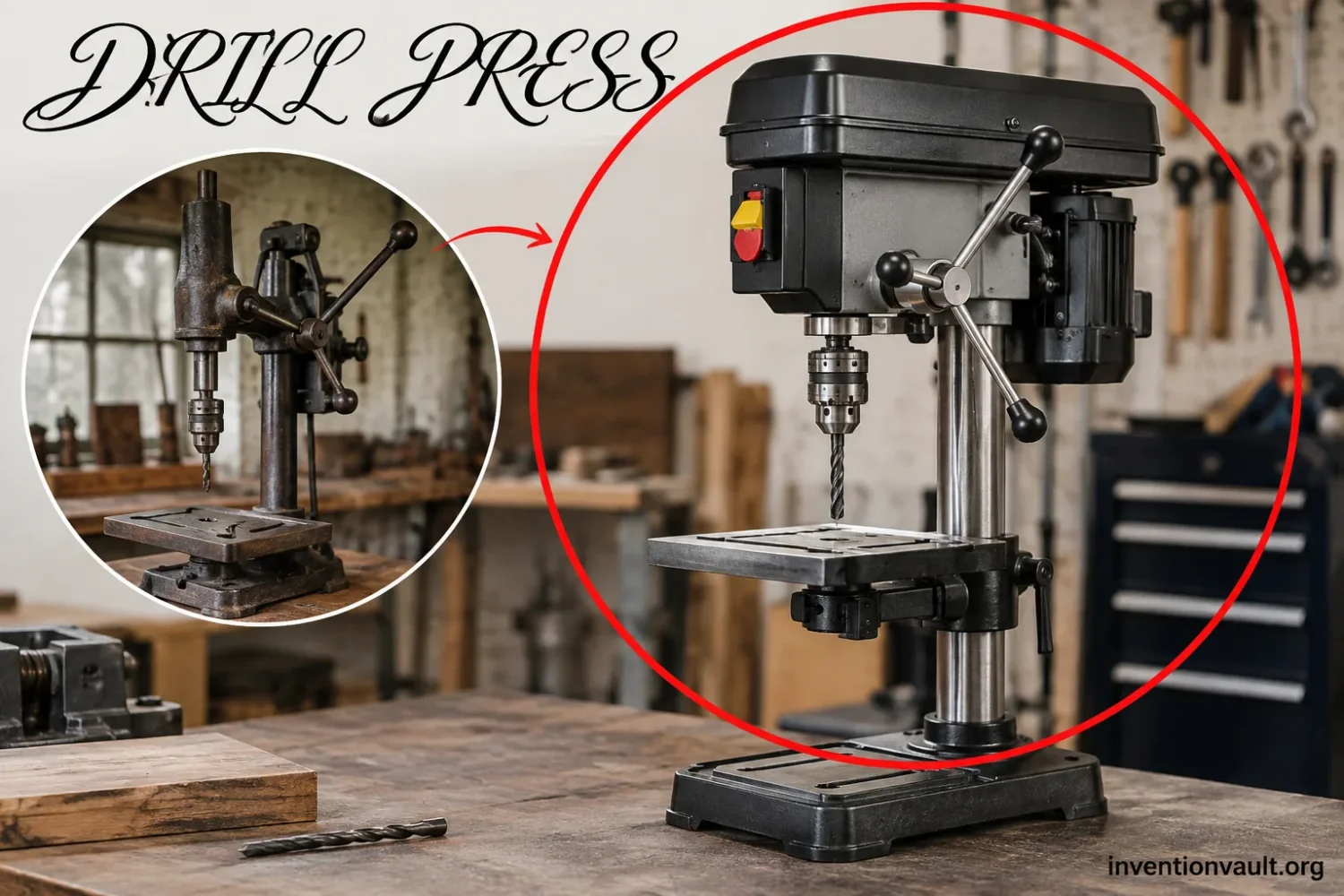
The visual resemblance between an old pillar drill and a modern floor drill is not accidental. Motors and controls evolved, yet the machine still depends on a rigid path for the spindle and a controlled relationship between tool and work.
What Was Actually Invented?
The drill press was not one isolated component. The lasting invention was the integration of several mechanical ideas into a stable drilling machine: a rigid structure, a guided rotating spindle, controlled axial feed, adjustable work support, and a drive system capable of supplying usable cutting motion.
Nasmyth and Gaskell provide strong surviving evidence for automatic-feed drilling machinery around 1840. Whitworth’s 1846 machine documents a more controlled self-acting feed and a movable T-slotted table, while his firm’s later pillar drills show selectable speeds and the upright layout in a mature form. Commercial catalogues and later patents then show the machine spreading into a family of upright, radial, multi-spindle, and eventually individually motor-driven designs.
That sequence is more accurate than attaching the entire invention to one late patent or to the arrival of the electric drill. The drill press emerged when machine builders transferred alignment and feed from the operator’s hands into the geometry and mechanisms of the machine itself.
Questions People Ask About the Drill Press
When was the drill press invented?
There is no universally accepted single year. Surviving automatic-feed drilling machinery is documented around 1840, Whitworth’s preserved machine dates to 1846, and power-driven pillar-drill development is documented from 1847. By the 1870s, drill presses were being sold as a named machine-tool category.
Was James Nasmyth the inventor of the drill press?
Nasmyth is an important early figure because a surviving Gaskell and Nasmyth machine from about 1840 combines a rigid drilling frame with automatic feed, and his firm built larger power drills from that period. The evidence does not justify treating him as the uncontested sole inventor of every form of drill press.
What did Joseph Whitworth contribute?
Whitworth integrated controlled feed and adjustable work positioning in documented drilling machines. His 1846 machine used a self-acting feed motion and a movable T-slotted table, while a later pillar drill from his firm had four spindle speeds and lateral table adjustment.
Is a drill press the same invention as an electric drill?
No. A drill press is a stationary machine-tool arrangement that controls the spindle and workpiece relationship. Electric motors later became a convenient way to power drilling machines, but the mechanical drill press existed before portable electric drills and before individual motors became the normal shop drive.
Why is a radial drill different from an upright drill press?
An upright drill usually brings the workpiece to a spindle carried in a fixed head. A radial drill lets the drilling head reach across a large workpiece, making it better suited to heavy parts that are difficult to reposition for every hole.
References Used for This Article
- Science Museum Group — Drilling machine for hand or power automatic feed: used for the circa-1840 Gaskell and Nasmyth machine, its frame, bevel drive, ratchet feed, and manual-feed option.
- Science Museum Group — Whitworth drilling machine, 1846: used for Whitworth’s self-acting feed mechanism, spindle arrangement, and movable T-slotted table.
- Science Museum Group — Whitworth Pillar Drilling Machine: used for the 1847 power-driven drilling-machine statement and the circa-1860 four-speed pillar drill.
- Lucius W. Pond — Illustrated Catalogue of Iron Working Machinery, 1874 scan: used for the commercial “Drill Presses” category and period descriptions of adjustable heads, tables, gearing, self feed, and countershaft arrangements.
- U.S. Patent 259,138 — Euphrates A. Hare, Upright Drill: used to distinguish an 1882 improvement patent from the earlier origin of upright drilling machines.
- U.S. Patent 283,857 — Alfred Box, Radial Drilling-Machine: used for the 1883 radial-drill improvement and its belt-driven movable-spindle arrangement.
- U.S. Patent 512,355 — Jacob N. Barr, Drill-Press: used for the 1894 multi-spindle attachment and adjustable hole-pattern concept.
- U.S. Patent 811,317 — Albert E. Newton, Drill-Press: used for feed control and predetermined stopping of spindle feed.
- U.S. Patent 1,746,263 — David C. Klausmeyer, Direct-Drive Drill: used for the 1930 motor-driven upright arrangement and modular spindle/feed-head construction.
- Science Museum Group — Cast iron boring bar and boring head: used to distinguish John Wilkinson’s circa-1775 cylinder-boring mill from the later upright drill-press lineage.
- Library of Congress, Historic American Engineering Record — W. A. Young and Sons Foundry and Machine Shop: used for the documented line-shaft-driven Sibley and Ware drill press in the shop’s 1940–41 equipment inventory.