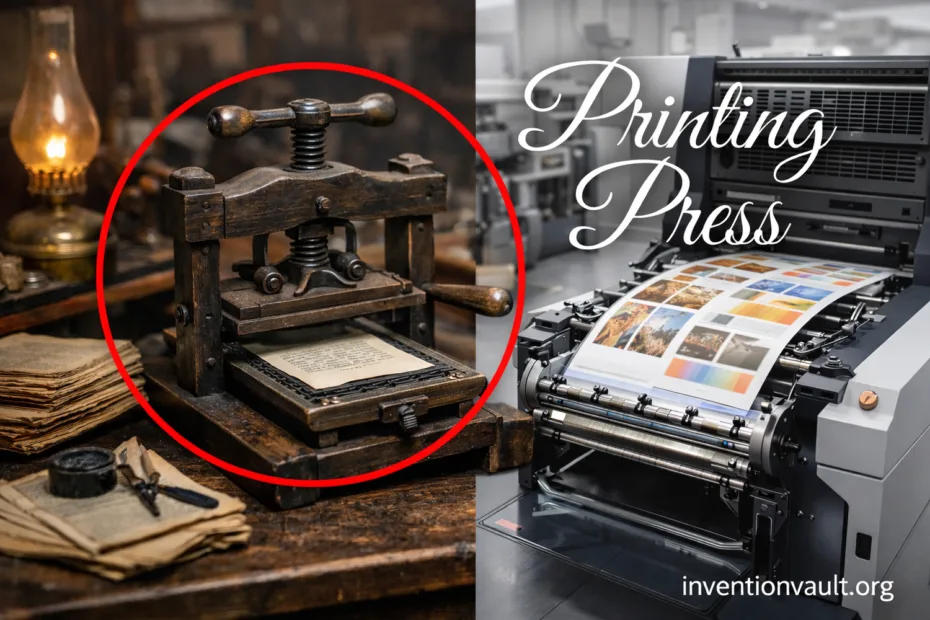
| Invention | Printing Press with movable type |
| Common Credit | Johannes Gutenberg (European movable metal type system) |
| Approximate Date | c. 1440 (development), with major outputs in the 1450s |
| Place | Mainz, in today’s Germany |
| Core Breakthrough | Reusable metal letters, fast composition, and repeatable printing on paper |
| Key Components | Hand mold for casting type, type metal alloy, oil-based ink, and a screw press |
| Early Landmark Work | Gutenberg Bible (often dated c. 1454–1455) |
| Important Precursors | Woodblock printing (East Asia), movable type by Bi Sheng (11th century China), and metal movable type in Korea (by the 13th–14th centuries) |
| Why It Scaled | Standardized letters plus rapid repetition turned pages into copyable infrastructure |
| What It Changed | Book costs, text consistency, and the speed of education, science, and skilled work |
| Common Confusion | Gutenberg did not invent “printing”; he engineered a complete production system that made large-scale print practical in Europe |
The printing press became a turning point because it changed how knowledge moved. When text could be copied with repeatable precision, books stopped being rare objects and started behaving like tools—something a student, craftsperson, or curious reader could actually use.
- What “Democratized Knowledge” Really Means
- Printing Before Gutenberg
- Woodblock Printing
- Movable Type In Asia
- Gutenberg’s Complete Production System
- Reusable Metal Type
- The Hand Mold And Type Metal
- Oil-Based Ink
- Press Mechanics
- How A Page Was Made
- Composition
- Inking And Pressing
- How Print Spread Across Europe
- What Changed For Readers And Workers
- Major Types Of Printing Presses And Related Methods
- How To Recognize Traditional Press Printing On A Page
- Visual Clues
- Book-Structure Clues
- Materials That Made Printing Practical
- Paper
- Type, Storage, And Maintenance
- A Short Timeline Of Press Evolution
- Key Terms Readers Still Meet Today
- References Used for This Article
What “Democratized Knowledge” Really Means
Democratized knowledge is not a slogan. It describes a practical shift: information became cheaper to copy, easier to standardize, and quicker to spread through schools, workshops, and libraries.
Once a text could be printed again and again, readers started expecting stable editions, page numbers, and reliable references. That expectation matters as much as the machine itself, because it turns reading into a repeatable habit.
- Lower unit cost: one setup could produce many copies, making book ownership more realistic for more people and institutions, not just elites. Access grew.
- Consistency: a printed page reduces drift that happens in hand copying, helping technical manuals and reference works stay dependable.
- Faster updating: printers could revise an edition and release a new run, so knowledge could be corrected and improved. That loop builds trust.
Printing Before Gutenberg
Printing existed long before Gutenberg. In East Asia, woodblock printing produced pages by carving an entire page into a block. It worked well for certain uses, and it supported wide circulation when resources and organization allowed.
Woodblock Printing
Woodblocks excel at repeat runs of the same page. The challenge is flexibility: revising text often means carving a new block. For large bodies of text, the labor can become heavy, even if the final printing step is efficient.
Movable Type In Asia
Movable type appears centuries earlier too. Bi Sheng is known for an 11th-century movable type approach, and Korea developed metal movable type later. These systems show the idea is powerful, yet scaling depends on materials, writing systems, labor, and production economics. It’s a systems problem, not a single trick.
Gutenberg’s Complete Production System
Gutenberg’s impact comes from combining multiple pieces into a repeatable workflow. The press, the type casting, the ink, the paper handling—each part reinforces the others. Together they turn writing into manufacturing without stripping away the care needed for quality.
Reusable Metal Type
Movable metal type means each letter is a durable unit. After printing, pieces can be redistributed and used again. That reuse is the core of scalability, and it supports long projects like books, not just short notices or labels. It also helps maintain consistent letterforms, which improves readability.
The Hand Mold And Type Metal
The hand mold enabled faster casting of letters at reliable sizes. Combined with a workable metal alloy, it produced type that held detail yet survived repeated pressings. Small improvements here create big results, because the whole shop depends on steady supply and uniformity.
Oil-Based Ink
Ink chemistry mattered. A suitable oil-based ink adheres well to metal type and prints crisply onto paper. If ink is wrong, you get blotches, weak lines, and uneven tone—issues that destroy legibility and waste time. Good ink helps each pull look intentional, not accidental.
Press Mechanics
The screw press applies pressure in a controlled way. That consistent force is what turns a prepared form of type into a clean page, again and again. With proper packing and careful inking, printers could reach a dependable rhythm—slow enough for precision, fast enough for volume, and respectful of materials.
How A Page Was Made
The workflow is elegant: compose, ink, press, repeat. It looks simple on paper, but each step contains craft. When it all clicks, you get consistent pages that carry the same words across many copies, preserving public knowlege with quiet power.
Composition
Compositors assembled letters into words, lines, and pages using type cases and setting tools. Spacing pieces matter as much as letters, because line length and alignment shape reading comfort.
Inking And Pressing
Ink was applied evenly to raised type, then paper was pressed onto it with controlled pressure. Even tiny variations change the result. A skilled shop aims for clear edges and steady tone, protecting both speed and quality.
How Print Spread Across Europe
The early press was a workshop technology, and that’s why it traveled. Printers trained apprentices, bought paper, sourced type metal, and shared techniques. Cities with trade routes and learning centers became natural hubs for printing houses, and the network effect did the rest. It’s a story of skills and infrastructure, not magic.
| Period | What Happened | Why It Matters |
|---|---|---|
| Mid-1400s | European movable type workshops prove books can be printed in runs | Proof of scale turns the press into a viable trade, not a curiosity |
| Late 1400s | Presses appear across many cities; book markets grow | Access widens as printers respond to demand for practical texts |
| By 1501 | “Incunabula” era ends (books printed before 1501) | Print culture is established enough to define an “early” period |
What Changed For Readers And Workers
The press didn’t just create more books. It changed how people trusted text. When editions are stable, readers can share a page number, a passage, a definition, a recipe, a measurement. That makes learning cumulative, not fragile. It also makes knowledge usable in daily life, which is the quiet heart of democratized knowledge and public education.
- Education: primers, grammars, and textbooks could be printed in steady runs, supporting shared curricula and consistent instruction.
- Skilled trades: manuals for navigation, agriculture, metalwork, and medicine helped spread best practices with repeatability.
- Reference culture: indexes, tables of contents, and errata lists became normal, boosting verification and careful reading.
A press is a machine, but printing is a discipline: standard letters, careful layout, repeatable pressure, and respect for the reader. That discipline is what scales.
Major Types Of Printing Presses And Related Methods
The phrase printing press covers a family of technologies. Some presses push ink from raised type, others rely on chemical attraction and repulsion, and later ones use photography and digital control. Seeing these as variants helps you understand why printing remained central even as machines changed. The thread is repeatable information delivered at scale.
| Type | Core Idea | Typical Strength |
|---|---|---|
| Letterpress (relief) | Raised surface transfers ink to paper | Crisp impression, strong text, durable for many prints |
| Rotary Press | Cylinders roll paper through printing surfaces | High speed for large volumes like newspapers and catalogs |
| Lithography / Offset | Planar method using chemical principles; offset transfers via a blanket | Efficient for images and long runs with consistent quality |
| Digital Printing | Direct data drives output without physical plates for each job | Short runs, customization, fast turnaround |
How To Recognize Traditional Press Printing On A Page
If you’ve ever held an old book and felt the page texture, you’ve met the physical side of letterpress. Traditional presses often leave subtle signs: a gentle impression, slight ink variation, and type that sits on the page with real presence. These clues help collectors and learners appreciate authentic craft and historical context.
Visual Clues
- Impression: a faint debossing where type pressed into paper, especially on thicker sheets. Touch matters.
- Ink character: slight variation in darkness can appear, since inking is physical. Uniform does not always mean better.
- Type wear: repeated use can round tiny edges, creating gentle changes that hint at production history.
Book-Structure Clues
- Signatures: small marks that help binders assemble folded sections. They support organized binding and efficient assembly.
- Colophons: notes about production sometimes appear, offering context without changing the main text. Provenance grows clearer.
- Pagination: stable page numbers transform reading into a shared experience and strengthen reference habits.
Materials That Made Printing Practical
A press needs more than moving parts. It needs paper supply, stable inks, and a way to maintain type. When these inputs are reliable, printing becomes predictable, and predictable systems invite investment. That’s how print shops became durable institutions and how reading culture expanded.
Paper
Paper was the quiet enabler. Its cost, availability, and quality shape everything: ink absorption, page durability, and even the feel of reading. Good paper supports sharp type and reduces failures that waste time and materials.
Type, Storage, And Maintenance
Type cases, sorting routines, and careful handling kept letters usable. Without order, movable type becomes chaos. With order, the shop can set pages quickly and keep edition consistency. It’s a mix of craft and logistics.
A Short Timeline Of Press Evolution
The original printing press idea kept evolving. Each step aimed at more speed, cleaner impressions, lower labor, or better images. The milestones below show how the same goal—reliable copying—kept finding new forms, keeping knowledge distribution strong and accessible.
| Era | Shift | What Improved |
|---|---|---|
| 1400s | Movable type letterpress workshops mature | Repeatability and stable editions for books |
| 1800s | Iron and steam-powered presses become practical | Speed and larger print runs |
| 1800s–1900s | Rotary systems spread | High-volume printing for frequent publications |
| 1900s | Offset printing grows | Image quality and efficiency in long runs |
| Late 1900s–Today | Digital printing expands | Customization and short-run flexibility |
Key Terms Readers Still Meet Today
Even if you never step into a print shop, you still encounter the language and logic of the printing press. These terms explain how print shaped modern reading. They also help you understand old books without needing specialist training, which keeps historical knowledge welcoming and usable.
| Term | Meaning | Why It Matters |
|---|---|---|
| Movable Type | Individual letters that can be rearranged and reused | Enables efficient composition and repeated editions |
| Letterpress | Relief printing from a raised surface | Creates crisp text and a distinctive page feel |
| Incunabula | Books printed before 1501 | Marks the early phase of European print culture |
| Typeface | A consistent design for letters (a “font family” idea) | Shapes readability and the visual identity of books |
| Edition | A specific release of a text, often revised or corrected | Supports version control and reliable reference |
References Used for This Article
- Library of Congress — The Gutenberg Bible (Library of Congress Bible Collection): Explains what the Gutenberg Bible is and describes its production features (e.g., 42-line layout) as a landmark of early European movable-type printing.
- Guinness World Records — Oldest mechanically printed book: Supports the claim that the Gutenberg Bible is widely accepted as the earliest mechanically printed full-length book and anchors its association with Mainz and the mid-1450s.
- UNESCO — Baegun hwasang chorok buljo jikji simche yojeol (Jikji), vol. II: Verifies that Jikji was printed with movable metal type in Korea in 1377, supporting the article’s “printing before Gutenberg” context.
- Bibliothèque nationale de France (BnF) — “Jikji”, a treasure of the world of printing: Provides library-backed context on Jikji and why it matters historically for movable metal type prior to Gutenberg.
- National Library of Korea (INKSLIB) — From Woodblock to Movable Metal Type: The Evolution of Korean Printing Technology: Summarizes the development of movable metal type in Korea and clarifies its historical significance relative to later European systems.
- Cambridge University Digital Library — Treasures of the Library: Gutenberg Bible: Offers a primary library collection entry for a Gutenberg Bible, supporting claims about the Bible’s status as a major early printed work.
- Bavarian State Library (BSB) — Gutenberg-Bibel (Digital Collections): About: Documents a fully digitized Gutenberg Bible copy and provides institutional context about surviving copies and provenance.
- CERL (Incunabula Short Title Catalogue) — ISTC Search: Confirms the definition and scope of incunabula as 15th-century European printing and supports the article’s reference to the incunabula era and early print cataloging.