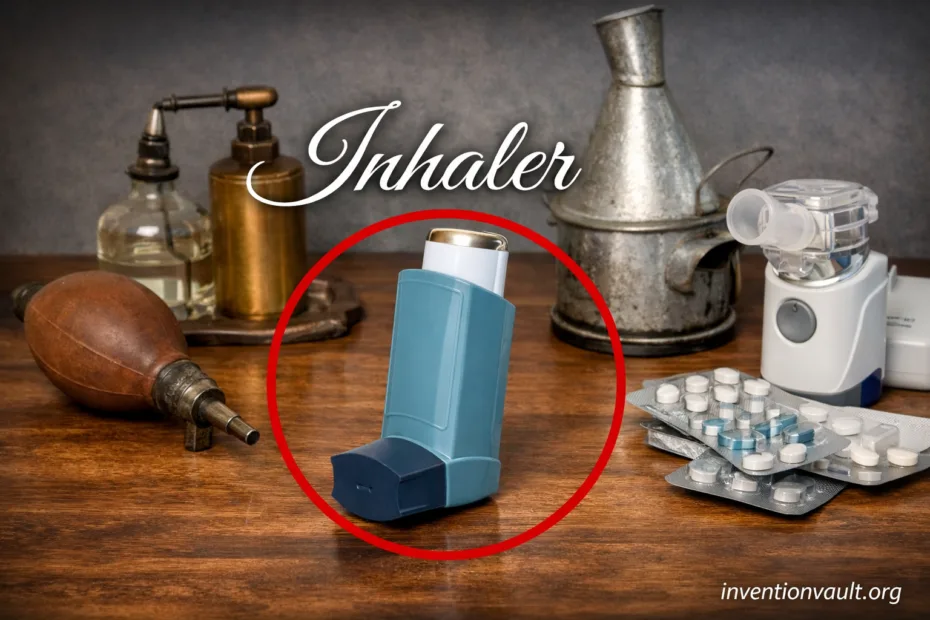
| Aspect | Historical Detail |
|---|---|
| What Was Invented? | A medical device family designed to deliver a drug or medicated vapor directly into the airways and lungs. |
| Single Inventor? | No. The inhaler is better understood as a chain of inventions, with different people solving different problems over time. |
| First Device Called an “Inhaler” | John Mudge described and named his steam device in 1778. |
| Early Dry-Powder Milestone | Ira Warren introduced an early dry-powder inhaler in 1852. |
| Portable Liquid Aerosol Milestone | Jean Sales-Girons developed a portable atomizer in 1858, helping establish the nebulizer branch. |
| Modern Breakthrough | The first pressurized metered-dose inhaler entered the market in 1956 through Riker Laboratories. |
| Later Usability Shift | Spacers, newer dry powder inhalers, and later soft mist inhalers aimed to make dosing easier and more consistent. |
| Main Modern Branches | Pressurized metered-dose inhalers, dry powder inhalers, and soft mist inhalers. |
| Why the Invention Mattered | It moved respiratory treatment away from bulky clinic equipment and toward portable, repeatable, patient-controlled care. |
Inhaler history does not belong to one person, one patent, or one dramatic year. The device took shape in stages. First came the idea that inhaled vapors could act on the breathing passages. Then came named devices, portable powder systems, hand-held atomizers, and finally the metered, pocket-sized inhaler that people now recognize. That layered story matters because it explains why the inhaler changed medicine: not just by delivering drugs, but by making respiratory care portable, repeatable, and personal.
- Who Invented the Inhaler?
- How the Idea Took Shape Before the Modern Device
- 1778: A Named Inhaler
- 1834 to the 1860s: Home and Clinic Use
- 1852 to 1858: Powder and Atomizer Branches
- 1956: The Portable Dose Era
- Why John Mudge Still Matters
- How Nineteenth-Century Designs Changed the Game
- Why the 1956 Breakthrough Still Stands Out
- What the pMDI Added
- How Later Designs Solved New Problems
- Main Inhaler Types and Their Subtypes
- Why the Inhaler Holds an Important Place in Medical History
- References Used for This Article
Who Invented the Inhaler?
The most accurate answer is simple: no single person invented the inhaler in its final form. Several figures deserve credit, but for different versions of the idea. John Mudge is often named because he used the word “inhaler” for a steam-based device in 1778. Ira Warren matters because he produced an early dry-powder inhaler in 1852. Jean Sales-Girons belongs in the story because his 1858 portable atomizer pushed liquid aerosol therapy forward. Then, in 1956, Riker Laboratories turned the inhaler into a truly modern consumer device by launching the first pressurized metered-dose inhalers.
That distinction is often blurred online. Many pages try to give one neat name and one neat date. The history is less tidy than that. A steam inhaler, a dry-powder inhaler, a portable atomizer, and a pressurized metered-dose inhaler are related, yet they are not the same object. They represent different technical answers to the same problem: how to move a therapeutic substance into the lungs with enough control to be useful.
The inhaler became truly modern when portability, dose control, and everyday patient use came together in one device.
How the Idea Took Shape Before the Modern Device
Long before the pocket inhaler, physicians and healers already understood that vapors could affect breathing. Early inhalation practices were not modern inhalers in the mechanical sense, though they established the basic route of delivery. The more familiar story starts in the eighteenth century, when John Mudge described a pewter vessel that turned heated liquid into inhaled vapor. It looked nothing like today’s devices, yet it introduced two lasting ideas: a dedicated respiratory device and a clear belief that the lungs could be treated directly.
In the nineteenth century, the design language widened. Steam inhalers stayed in use, but other branches appeared. Some devices focused on household simplicity. Others focused on finer droplets, stronger transport, or powder delivery. This is why the inhaler’s history is more mechanical than many summaries suggest. It is also why later success did not come from chemistry alone. Device shape, resistance, plume speed, refill style, and ease of use all mattered.
1778: A Named Inhaler
Mudge’s device gave the field a name and a recognizable form: a dedicated vessel with a breathing tube and medicated vapor.
1834 to the 1860s: Home and Clinic Use
Respiratory inhalers became more visible in outpatient life, especially for cough, asthma, and other chest complaints.
1852 to 1858: Powder and Atomizer Branches
Dry-powder and portable liquid aerosol devices appeared, showing that inhalation could be engineered in more than one way.
1956: The Portable Dose Era
The first pressurized metered-dose inhalers joined convenience with repeatable dosing and changed daily respiratory care.
| Device Branch | How It Worked | What It Added to the Story |
|---|---|---|
| Steam Inhaler | Used heated liquid to create inhaled vapor through a tube or mouthpiece. | Established the idea of a dedicated respiratory device and home use. |
| Dry-Powder Inhaler | Dispersed powdered medicine during inhalation. | Moved the field toward portable, propellant-free delivery. |
| Atomizer or Nebulizer | Converted liquid medicine into fine droplets through pressure or airflow. | Improved aerosol generation and supported clinic-based respiratory treatment. |
| Pressurized Metered-Dose Inhaler | Released a measured aerosol dose from a canister through an actuator. | Brought reliable dosing and real portability together. |
| Soft Mist Inhaler | Created a slower, propellant-free mist from a compact handheld device. | Reduced plume speed and improved delivery for some patients. |
Why John Mudge Still Matters
Mudge’s place in history is not just symbolic. He did more than offer a remedy. He described a physical device, attached respiratory treatment to a named instrument, and helped make inhalation something that could be standardized rather than improvised. That is a real inventive step. Even though the device relied on steam and now feels distant from a plastic inhaler canister, the conceptual move was plain: treatment could be delivered through a device built for breathing.
His influence also shows why the inhaler’s story should not be reduced to asthma alone. Early inhalers were linked with cough, throat complaints, chest diseases, anesthesia-related practice, and household respiratory care. The inhaler did not begin as one narrow tool for one diagnosis. It began as a flexible delivery idea that later became more precise.
How Nineteenth-Century Designs Changed the Game
The nineteenth century gave the inhaler two things that many modern summaries underplay: form diversity and patient-use thinking. Devices such as Ramadge’s inhaler and the widely used Nelson-type inhaler show that inventors were already thinking about cost, accessibility, maintenance, and home use. That thread matters. The inhaler did not become successful only when its medicine improved. It became successful when people could actually use it with less fuss.
This is also the period when the technology split into branches. Ira Warren’s 1852 powder inhaler pushed one path: a portable system for inhaled powder. Sales-Girons’ 1858 portable atomizer pushed another: fine liquid spray. Those branches never fully disappeared. You can still see their descendants today in modern dry powder inhalers and in nebulizer-based aerosol therapy.
Why the 1956 Breakthrough Still Stands Out
The inhaler turned into a modern mass-use device in 1956 with the arrival of the pressurized metered-dose inhaler, usually shortened to pMDI. This mattered for one reason above all: a measured dose could now be carried in a pocket and released quickly. That made outpatient care far easier. It also helped shift respiratory treatment away from bulky, awkward setups that had to be filled, assembled, or handled with extra care.
The oft-repeated story about George Maison’s daughter asking for asthma medicine “like hairspray” survives because it captures the real engineering change. The pMDI solved a daily-use problem. It was not merely a new chemical container. It joined metering, speed, and portability in one hand-held object. That combination made the inhaler feel less like a clinic instrument and more like ordinary medical equipment a patient could keep nearby.
What the pMDI Added
- A metered dose rather than an estimated puff.
- A portable canister that supported everyday use outside the clinic.
- A much clearer path toward large-scale manufacturing and standardization.
- A platform that could later be adapted, refined, and paired with add-on devices.
How Later Designs Solved New Problems
Once the pMDI succeeded, engineers and clinicians discovered that convenience alone was not enough. Timing mattered. Users had to coordinate pressing the device and inhaling at nearly the same moment. That is why later inhaler history is, in part, the history of usability. Spacers were commercialized to reduce hand-breath coordination problems and limit deposition in the mouth and throat. Later valved holding chambers refined that idea even more.
Dry powder inhalers addressed the same challenge from another angle. In many designs, the patient’s own inhalation helps actuate and disperse the drug. That can reduce coordination demands, though it creates a different design issue: the device has to work across varied inspiratory strengths. Some users can draw strongly; others cannot. So dry powder design became a balance between internal resistance, airflow, particle separation, and reliable dose release.
Soft mist inhalers represent another later step. They keep the hand-held format but release a slower plume, which can reduce harsh spray impact and improve deposition for some users. In other words, the history of the inhaler did not stop when the first pMDI appeared. The later decades kept refining the same question: how can a respiratory drug reach the lungs with less waste and less user error?
| Problem | Design Response | Effect on Inhaler History |
|---|---|---|
| Press and breathe at the same time | Spacer or valved holding chamber | Made pMDI use more forgiving, especially for children and people with poor coordination. |
| Need for a propellant-free handheld option | Dry powder inhaler | Expanded inhaler design beyond the canister model and revived the powder branch. |
| Fast plume and throat deposition | Soft mist inhaler | Favored slower aerosol release while keeping the device portable. |
| Environmental concerns about older propellants | HFA reformulation | Updated modern pMDIs after the phase-out of CFC-based products. |
Main Inhaler Types and Their Subtypes
If the inhaler is treated as one invention with several branches, its present-day families become easier to understand. The oldest recognizable modern family is the pressurized metered-dose inhaler. The second large family is the dry powder inhaler. The third is the soft mist inhaler. Nebulizers remain close relatives in the same aerosol-therapy lineage, though they are usually discussed as a separate device class rather than a pocket inhaler.
- Pressurized Metered-Dose Inhalers (pMDIs): Standard canister-based devices that release a measured aerosol dose. Some later forms became breath-actuated to reduce coordination demands.
- Dry Powder Inhalers (DPIs): Often divided into single-dose capsule devices, multi-unit blister devices, and multi-dose reservoir devices.
- Soft Mist Inhalers: Handheld devices that create a slower, propellant-free mist from a stored liquid formulation.
That subtype story matters because it shows that inhaler invention never really ended. It kept branching. Each subtype reflects a trade-off between dose control, moisture sensitivity, inspiratory effort, refill method, portability, and manufacturing complexity. The inhaler is not a frozen object. It is a continuing design category.
Why the Inhaler Holds an Important Place in Medical History
Many medical inventions changed what doctors could do. The inhaler also changed where treatment could happen and who controlled the moment of use. That is one reason it stands out. A patient did not always need a large setup, a bottle, a burner, or a clinic visit at the moment symptoms appeared. The more portable the device became, the more respiratory care moved into normal daily life.
Its historical reach is wider than many short summaries admit. The inhaler was tied at different times to cough, throat disease, asthma, pulmonary care, anesthesia-related practice, and outpatient self-management. It also sits at the meeting point of several histories at once: medical instrumentation, drug delivery, industrial manufacturing, and patient-centered design. Few devices show that mix so clearly.
Seen that way, the invention of the inhaler was not just the birth of a gadget. It was the slow construction of a new medical habit: delivering treatment directly to the lungs through a purpose-built device that could be used quickly, repeatedly, and with growing precision.
References Used for This Article
- Wood Library-Museum of Anesthesiology — Mudge Inhaler: Official museum record for the 1778 device that used the term “inhaler.”
- Science Museum Group Journal — “Great Ease and Simplicity of Action”: Dr Nelson’s Inhaler and the Origins of Modern Inhalation Therapy: Useful for nineteenth-century patient use, household access, and design continuity.
- National Library of Medicine / PMC — The History of Therapeutic Aerosols: A Chronological Review: Detailed review covering Mudge, Ira Warren, Sales-Girons, and the 1956 pMDI launch.
- Springer Nature — Inhalation Therapy: an Historical Review: Journal review of the major device shifts in inhalation therapy.
- National Library of Medicine / PMC — Inhalation Drug Delivery Devices: Technology Update: Explains dry powder inhaler mechanics, subtype differences, and soft mist design.
- National Library of Medicine / PMC — Mask Use with Spacers/Valved Holding Chambers and Metered Dose Inhalers among Children with Asthma: Supports the later history of spacers and coordination-focused design.
- U.S. Food and Drug Administration — Transition from CFC Propelled Albuterol Inhalers to HFA Propelled Albuterol Inhalers: Official explanation of the modern propellant shift after the CFC phase-out.