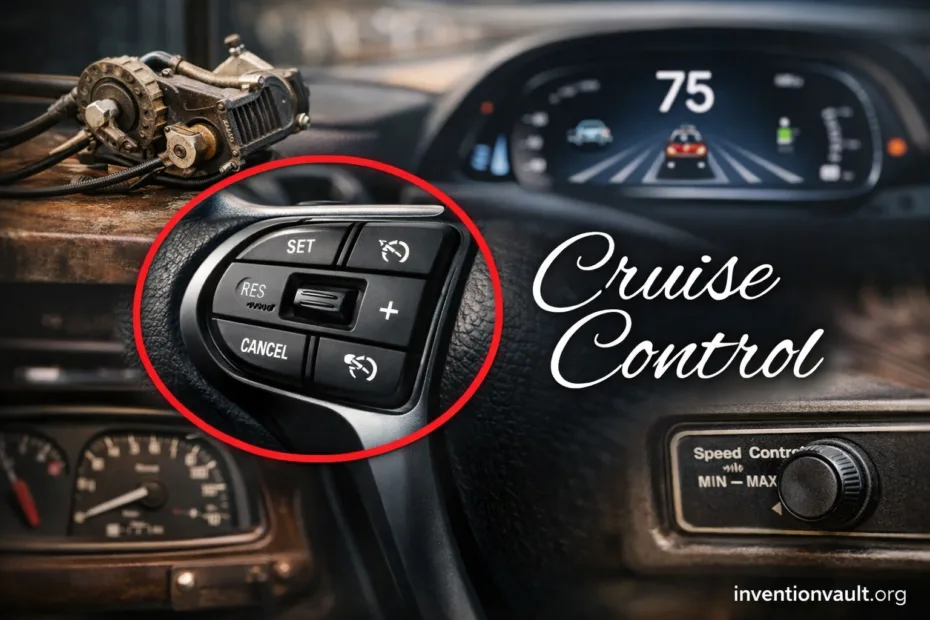
| Invention | Cruise Control (automotive speed control) |
|---|---|
| Original Name | Speedostat (trade name used by the inventor’s company) |
| Primary Inventor | Ralph R. Teetor (mechanical engineer) |
| Key Early Patent | U.S. Patent 2,519,859 — “Speed Control Device for Resisting Operation of the Accelerator” |
| Patent Timing | Application filed Aug. 11, 1948; patent granted Aug. 22, 1950 |
| What The Patent Emphasized | A set-speed signal to the driver through accelerator resistance, not a hard speed “lock” that prevents acceleration |
| Core Feedback Signal | Vehicle speed measured by a governor mechanically linked to the drivetrain/speed indication |
| Primary Actuation Method (Early Designs) | Engine intake-manifold vacuum used to create controlled force against throttle/accelerator linkage |
| Driver Overrides | Deliberate acceleration remains possible; later production systems also incorporate brake-triggered disengagement |
| First Factory Adoption (Verified) | Introduced in Chrysler luxury models for 1958 and marketed as Auto-Pilot |
| Modern Descendants | Electronic cruise control, drive-by-wire speed control, and Adaptive Cruise Control (ACC) with radar/camera support |
Cruise control is the quietly influential invention that turned “holding a steady speed” from a constant ankle task into a repeatable mechanical function. At its heart, it is a feedback system: you select a target speed, the vehicle compares actual speed to that target, and the throttle is adjusted to reduce the difference. The idea sounds obvious today. In the mid-20th century, bringing it into real cars demanded something harder than cleverness: it required a design that felt natural to drivers, behaved safely under changing road loads, and could be manufactured and serviced at scale.
- What Cruise Control Changed
- Why The Invention Was Nontrivial
- Mechanical Origins and Early Speed Governors
- Ralph Teetor and the Speedostat Concept
- The 1948–1950 Patent and a Detail Many Summaries Miss
- Pedal-Resistance “Speed Reminder” vs True Speed-Holding
- From Patent To Production
- How Early Cruise Control Worked
- The Essential Blocks
- Why Vacuum Was Useful
- Names, Branding, and the Rise of a Standard Term
- Cruise Control Variants and Related Systems
- Design Choices That Made Cruise Control Trustworthy
- Why “Easy To Override” Was a Breakthrough
- The Leap to Adaptive Cruise Control
- Common Questions About the Invention of Cruise Control
- Who Invented Cruise Control?
- When Did Cruise Control First Appear in Production Cars?
- Is Cruise Control the Same as a Speed Limiter?
- Does Cruise Control Always Improve Fuel Economy?
- What Makes Adaptive Cruise Control Different?
- References Used for This Article
What Cruise Control Changed
- Consistency: More uniform speed on long drives, with fewer unintentional fluctuations.
- Comfort: Reduced need to keep the accelerator at one exact position for extended periods.
- Control: A new category of driver assistance that still leaves the driver fully in charge.
Why The Invention Was Nontrivial
- Road load changes: Hills and wind push a car off its set speed unless the throttle responds.
- Human factors: The system must be predictable, easy to override, and simple to disengage.
- Hardware reality: Early cars relied on mechanical linkages and vacuum behavior, not sensors and software.
Mechanical Origins and Early Speed Governors
Long before cruise control appeared as a dashboard feature, engineers already knew how to keep machines running at steady speeds. Industrial engines commonly used governors—mechanisms that respond to rotational speed and adjust fuel or air flow. The principle is straightforward: when speed rises, the mechanism reacts to reduce input; when speed falls, it allows more input. Translating that into the driver’s world, however, created a new challenge: a passenger car is not a fixed-load machine. It is an environment with frequent speed changes, driver intent, and safety-critical moments where immediate acceleration is useful.
This is where cruise control’s origin story becomes more interesting than a single “aha” moment. The invention is best understood as a careful compromise between automation and freedom—an approach that offered assistance without turning speed into a rigid constraint.
Ralph Teetor and the Speedostat Concept
Ralph R. Teetor is widely credited with the modern form of automotive cruise control. He developed the idea that became known as the Speedostat, and his work moved from prototype thinking into patented engineering. A detail often mentioned—and worth emphasizing for what it reveals about process rather than personality—is that Teetor relied heavily on touch-based reasoning to understand and refine mechanical designs. That focus on feel maps neatly onto cruise control itself, which ultimately had to “feel right” in a driver’s foot and hands.
The earliest patented approach did not aim to “trap” the driver at a single speed; it aimed to signal a selected speed through controlled pedal resistance.
That design choice is one of the most misunderstood parts of cruise control history. Many modern explanations skip directly to a system that fully maintains speed. The early patent that anchors the story is more nuanced—and arguably smarter for its era.
The 1948–1950 Patent and a Detail Many Summaries Miss
In Teetor’s well-known early patent—granted as U.S. 2,519,859—the device is described as a “speed control” that provides resistance to further accelerator movement once the chosen speed is reached. The mechanism uses a governor responsive to vehicle speed and applies engine intake-manifold vacuum to a vacuum cylinder, which then creates controlled opposing force at the accelerator linkage.
Pedal-Resistance “Speed Reminder” vs True Speed-Holding
The patented “resistance” approach can be read as a bridge between older governors and modern cruise control. It supports the driver instead of replacing the driver. You can maintain speed by holding the pedal against a stable “rest,” and you can still accelerate past the set speed by pressing more firmly. This is a subtle but important distinction because it demonstrates an early awareness of override priority: the driver remains the final authority.
Later production cruise control systems evolved toward more active speed-holding behavior, but the early patent’s emphasis on an assistive feel explains why the concept could be introduced without demanding a cultural leap from drivers.
From Patent To Production
Cruise control’s path into real cars is not a single date; it is a sequence of engineering and market steps. What matters is the verified timeline of the core milestones and the names attached to them.
| Time Period | Milestone | Why It Matters |
|---|---|---|
| Aug. 11, 1948 | Patent application filed for Teetor’s speed control concept | Formalizes the design as a manufacturable mechanism rather than a one-off prototype |
| Aug. 22, 1950 | U.S. patent granted (2,519,859) | Locks in an early technical blueprint: governor + vacuum-actuated resistance at the accelerator |
| 1958 Model Year | Chrysler introduces the system in luxury models, marketed as Auto-Pilot | Moves cruise control from engineering novelty to factory-offered consumer technology |
| 1959 | Chrysler expands availability across its lineup | Signals that the feature is viable beyond a narrow luxury niche |
| Late 20th Century | Electronic control becomes common | Improves stability, adds smarter logic, and integrates with modern engine management |
| 1999–2000 | Radar-based Adaptive Cruise Control (ACC) reaches series production and broader launches | Adds distance-keeping, bringing cruise control into the sensor era |
How Early Cruise Control Worked
Early cruise control systems were built from components that made sense for the era: mechanical rotation, vacuum behavior, and linkages that could be repaired with familiar tools. While implementations varied, the architecture follows a consistent pattern that still resembles modern systems in concept.
The Essential Blocks
- Speed sensing: A governor or drivetrain-linked mechanism detects vehicle speed.
- Setpoint selection: A driver control selects the target speed.
- Control action: The system decides when to resist or adjust throttle movement.
- Actuation: Vacuum or later electric actuation applies force to linkage/throttle.
- Disengagement: A clear, immediate way to return full manual control.
Why Vacuum Was Useful
Using engine manifold vacuum gave designers a readily available “power assist” source. It could create smooth force without bulky motors, and it fit naturally into an engine bay already filled with hoses and mechanical interfaces. Vacuum-based actuators also tend to apply force progressively, which supports stable control rather than abrupt changes.
Names, Branding, and the Rise of a Standard Term
“Cruise control” feels like an obvious name, but early commercialization used several labels. Teetor’s company used Speedostat, while Chrysler marketed the feature as Auto-Pilot when it introduced the system in its 1958 luxury models. This naming matters because it explains why older brochures and early documentation may not use the phrase “cruise control” even when the functionality is recognizable.
In practice, the technology’s value proposition was stable and easy to communicate: maintain a chosen road speed with less effort, reduce needless speed variation, and keep driving feel calm and consistent.
Cruise Control Variants and Related Systems
Cruise control is now a family of systems rather than a single invention. Understanding the variants clarifies why two cars can both “have cruise control” yet behave very differently.
| System Type | What It Does | Typical Inputs | Typical Actuation |
|---|---|---|---|
| Speed Reminder / Pedal-Resistance | Signals the selected speed by adding controlled resistance past that point | Drivetrain speed + setpoint dial | Vacuum or mechanical force on linkage |
| Classic Cruise Control | Maintains a selected speed on open roads by adjusting throttle | Vehicle speed + driver set/resume/cancel | Vacuum servo or electronic actuator |
| Electronic Cruise Control | Uses electronic logic for smoother control and better stability | Speed sensors + control-module logic | Electronic throttle control or actuator motor |
| Speed Limiter | Helps prevent exceeding a chosen maximum speed while allowing normal driving below it | Speed sensor + driver-set cap | Throttle limiting via electronic control |
| Adaptive Cruise Control (ACC) | Maintains speed and adjusts to keep a gap from vehicles ahead | Radar/camera + speed + set following distance | Throttle + brakes under supervision logic |
| Stop-and-Go ACC | Extends ACC behavior into slower traffic, sometimes down to a stop | Enhanced sensing + low-speed control logic | Integrated braking and acceleration control |
| Predictive / Assisted Cruise | Anticipates speed changes using additional data sources where available | Vehicle sensors plus optional map/road cues | Electronic throttle and braking coordination |
Design Choices That Made Cruise Control Trustworthy
For cruise control to become widely accepted, it had to behave in a way drivers could predict instantly. The most important design features are not flashy; they are the quiet safeguards and interaction rules that prevent surprises.
- Immediate cancel: A single action (commonly the brake) must disengage the system with no hesitation.
- Clear states: Drivers need to know if the system is set, actively controlling, paused, or off.
- Resume logic: Returning to the prior set speed should be smooth, not abrupt.
- Override priority: Driver input must always be able to exceed the system when needed.
Why “Easy To Override” Was a Breakthrough
A strict mechanical governor that prevents acceleration can feel restrictive. Teetor’s early emphasis on allowing the driver to press past resistance pointed toward the modern philosophy: assistance without authority. Even as cruise control later became more active at holding speed, the expectation remained the same—driver intent wins instantly.
The Leap to Adaptive Cruise Control
Classic cruise control only watches one thing: your own speed. Adaptive Cruise Control (ACC) adds a second mission—managing space. By using sensors such as radar and cameras, ACC estimates the position and speed of vehicles ahead and adjusts acceleration and braking to maintain a selected following distance.
Series-production ACC emerged in premium vehicles around the turn of the millennium, with suppliers and manufacturers refining long-range radar and control logic. This shift changed cruise control from a comfort feature into a foundational building block for modern driver-assistance packages.
Common Questions About the Invention of Cruise Control
Who Invented Cruise Control?
The modern automotive concept is widely credited to Ralph R. Teetor, whose Speedostat work and related patents shaped the feature as it entered mainstream vehicles.
When Did Cruise Control First Appear in Production Cars?
Verified sources describe Chrysler introducing the system in 1958 luxury models and marketing it as Auto-Pilot, with broader availability following soon after.
Is Cruise Control the Same as a Speed Limiter?
No. Cruise control aims to maintain a target speed when conditions allow. A speed limiter helps you avoid exceeding a chosen maximum while you still control speed normally below that cap. Some vehicles offer both, and the controls can look similar.
Does Cruise Control Always Improve Fuel Economy?
It can help in steady conditions because it reduces unnecessary speed fluctuations, but fuel use depends on terrain, traffic, and how smoothly the system and driver operate. The most reliable benefit is consistency—fuel savings vary by situation.
What Makes Adaptive Cruise Control Different?
Adaptive Cruise Control keeps a set speed when the lane ahead is clear, and it also slows and speeds up to maintain a chosen following gap. It extends the original cruise-control idea from “hold speed” to “hold speed and distance,” using radar and/or camera sensing.
References Used for This Article
- USPTO — A brilliant touch: Official historical profile connecting Teetor’s Speedostat to modern cruise control.
- Google Patents — US2519859A Speed control device for resisting operation of the accelerator: Patent record showing the filing and grant dates and the device’s design intent.
- National Inventors Hall of Fame — Ralph Teetor: Biographical overview documenting Speedostat, Chrysler’s Auto-Pilot branding, and early model-year adoption.
- Penn Engineering Magazine — The Big Picture: ‘Blind Logic’: University publication noting Teetor’s engineering background and Speedostat’s place in automotive history.
- Continental AG — 20 Years of Continental Long-range Radar in Series Production: Manufacturer statement describing early long-range radar series production and its role in adaptive cruise control.
- Bosch — Development of Bosch ACC: Engineering history account describing a radar-based ACC launch and the system’s core function.