| Aspect | Details |
|---|---|
| Discoverer | Wilhelm Conrad Röntgen, a German physicist working in Würzburg |
| Discovery Date | 8 November 1895 |
| Place of Discovery | Physical Institute in Würzburg, Germany |
| What Was Found | A previously unknown form of ionizing electromagnetic radiation able to pass through many materials |
| Why They Were Called X-Rays | Röntgen used the letter “X” to mark the rays as unknown |
| Original Experimental Setting | Discharge-tube research on cathode rays, fluorescence, and photographic effects |
| First Famous Image | A hand radiograph made in late December 1895, commonly associated with Anna Bertha Röntgen |
| First Published Report | “On a New Kind of Rays,” submitted in late December 1895 |
| Early Medical Uptake | Clinical use began within weeks in early 1896 |
| Technical Leap That Made X-Rays More Practical | The Coolidge tube of 1913, which made output more stable and easier to control |
| Fields Shaped by X-Rays | Medicine, surgery, dentistry, materials testing, crystallography, security imaging, and astronomy |
| Historical Importance | X-rays changed how people could inspect the inside of a body or object without opening it |
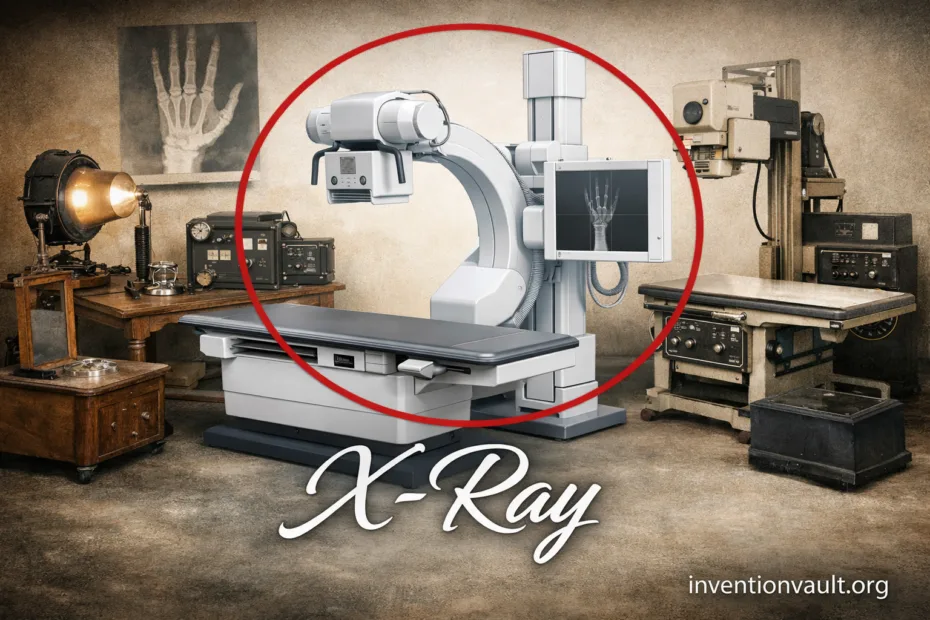
The phrase invention of X-ray sounds neat, though the real story has two layers. In 1895, Wilhelm Conrad Röntgen discovered a new kind of ray while studying discharge tubes. After that, physicians, physicists, engineers, and instrument makers turned that discovery into the dependable X-ray systems later generations would use in hospitals, laboratories, and factories. That distinction matters because it gives the X-ray a wider place in history. It belongs to medicine, yes, but also to physics, photography, electrical instrumentation, and the study of hidden structure.
- What the Discovery Actually Involved
- Discovery of the Rays
- Invention of Practical X-Ray Technology
- How the News Moved From Lab to Clinic
- Why the First Images Mattered
- From Experimental Tubes to a Practical Machine
- Early Risks and the Rise of Safer Practice
- What the Invention Changed in Science and Daily Practice
- People and Developments Linked to the Invention
- Wilhelm Conrad Röntgen
- John Hall-Edwards
- William David Coolidge
- Marie Curie
- References Used for This Article
One point is easy to miss: the X-ray was not born as a finished machine. The ray itself was discovered first. The more stable, safer, and more practical equipment came later.
What the Discovery Actually Involved
Röntgen was working with a discharge tube covered in dark material while studying cathode-ray effects in a darkened room. A nearby fluorescent screen still glowed. That odd glow told him that something unseen was escaping the apparatus and passing through space. He then tested how the new rays behaved when paper, wood, metal, and parts of the human body stood in their path. In plain terms, the discovery was not just a lucky glance. It became a real scientific finding because he followed the glow with controlled experiments, image-making, and written evidence.
- The experimental world behind X-rays already included vacuum tubes, high voltage, fluorescence, and photographic plates.
- Röntgen’s breakthrough came from noticing an effect that others could easily have dismissed.
- He then showed that the new rays could create shadows of internal structure, not only shadows of surfaces.
- That changed the value of the discovery at once. The rays were not just curious. They were useful.
Discovery of the Rays
This part belongs to 1895. It concerns the finding of a new physical phenomenon: penetrating rays produced during tube experiments.
Invention of Practical X-Ray Technology
This part unfolded over the years that followed. It includes better tubes, steadier current, shorter exposures, shielding, dose control, and more reliable image capture.
How the News Moved From Lab to Clinic
Many short articles stop at the night of discovery. The wider historical picture is more interesting. Röntgen submitted his first report in late December 1895, and the news spread with striking speed in early 1896. Physicians and experimenters quickly copied the method. That fast movement from laboratory observation to public demonstration and medical use is one reason the X-ray holds such a special place in invention history. Few discoveries crossed that distance so quickly.
| Date | Event | Why It Mattered |
|---|---|---|
| 8 November 1895 | Röntgen observed the new rays in Würzburg | The starting point of X-ray history |
| Late December 1895 | He submitted his first paper on the new rays | The discovery entered the scientific record |
| Late December 1895 | Early hand radiographs were produced | The medical promise became visible to others |
| January 1896 | Doctors and experimenters across Europe began repeating the method | X-ray work left the original laboratory almost at once |
| 11 January 1896 | John Hall-Edwards used X-rays under clinical conditions in Birmingham | The discovery entered real patient care within weeks |
| 14 February 1896 | X-rays were used to help direct a surgical procedure | The technology proved useful beyond simple demonstration |
That fast uptake also explains why the history of X-rays is not a one-man story after the discovery itself. Röntgen made the finding. Others extended it almost immediately into diagnosis, surgery, publishing, manufacturing, and teaching. The invention spread through a network of experimenters who recognized, very quickly, that a new way of seeing had arrived.
Why the First Images Mattered
The famous hand radiograph became iconic because it made the value of X-rays instantly understandable. A body part could be recorded from the inside without a cut, without dissection, and without destroying the object under study. That was a new kind of evidence. Not a drawing. Not a guess. Not a symptom report alone. An image.
“I have seen my death.”
Often attributed to Anna Bertha Röntgen after viewing the hand radiograph
There is another detail that deserves more attention. Early X-ray work was not limited to medicine. Surviving radiographs from Röntgen’s own archive include not only hands, but also a rifle image used to examine material damage. That matters because it shows the invention’s wider identity from the start. The X-ray was born as a way to inspect hidden structure inside both living tissue and manufactured objects.
From Experimental Tubes to a Practical Machine
Early X-ray apparatus could work, though it was often temperamental. Output shifted. Exposure control was awkward. Tube behavior could vary from one session to the next. So when people ask who invented the X-ray machine, the answer is not exactly the same as who discovered X-rays. The discovery belongs to Röntgen in 1895. The move toward a more dependable machine belongs to later technical work, above all the Coolidge tube introduced in 1913.
The Coolidge design used a hot cathode and high vacuum to make X-ray production steadier and easier to control. That change helped shorten the road from experimental novelty to everyday medical instrument. Modern X-ray tubes still rest on the same broad principle: electrons are accelerated and then slowed at a target, producing X-rays.
- Before 1913: early tubes could produce images, but consistency was a problem.
- After 1913: steadier output made X-ray work more practical in medicine and other fields.
- Long-term result: the invention became a repeatable system rather than a fragile laboratory event.
Early Risks and the Rise of Safer Practice
The first wave of X-ray work moved so fast that safety knowledge lagged behind. Early operators sometimes worked with long exposures and little protection because the biological effects of radiation were not yet fully understood. Burns, dermatitis, hair loss, and later occupational injury forced the field to learn hard lessons. This part of the story belongs inside the history of the invention because it shaped the equipment itself. Shielding, distance, exposure control, and measurement did not appear as decoration. They appeared because practice demanded them.
John Hall-Edwards stands as a vivid example of that early cost. He helped bring X-rays into clinical work in Britain, and later suffered severe radiation injury. Stories like his pushed the field toward safer habits and better apparatus. So the invention of X-ray technology was never only about seeing more. It was also about learning how to see with restraint and control.
What the Invention Changed in Science and Daily Practice
Most people associate X-rays with broken bones. That is only one branch of the history. Once dependable apparatus became available, the same basic idea spread into many kinds of work. A ray that can reveal internal structure without opening the object is useful almost anywhere hidden form matters.
| Field | How X-Rays Are Used |
|---|---|
| Medical radiography | To record bones, chest structures, teeth, and many internal changes |
| Fluoroscopy | To watch internal motion in real time with continuous or pulsed imaging |
| Computed tomography | To build cross-sectional images from many X-ray measurements |
| Mammography | To image breast tissue with specialized X-ray technique |
| Industrial radiography | To inspect welds, castings, pipes, and hidden defects inside manufactured parts |
| Crystallography | To study atomic arrangement in crystals and later in many biological molecules |
| Security screening | To inspect luggage and other closed items without opening them |
| X-ray astronomy | To observe high-energy processes in space that cannot be seen in ordinary visible light |
Seen this way, the invention of X-ray was not merely the birth of a medical image. It was the birth of a new inspection method. That broader reading fits the historical record better than the narrower broken-bone version repeated in many short summaries.
People and Developments Linked to the Invention
Wilhelm Conrad Röntgen
He discovered the rays, named them with the letter X, and turned a strange glow into documented science.
John Hall-Edwards
He showed how quickly X-rays could move into clinical medicine and surgery in early 1896.
William David Coolidge
He improved X-ray production with a hot-cathode tube in 1913, helping make the apparatus steadier and more usable.
Marie Curie
She helped take X-ray work into mobile wartime practice through radiology vehicles, showing that the invention could travel where it was urgently needed.
The history also survives in documents and images. Röntgen’s early radiographs are preserved as documentary heritage, which feels fitting. The invention changed the way people looked through matter, and the first proof of that change still remains visible.
References Used for This Article
- UNESCO — Representative Radiographs from the Wilhelm Conrad Roentgen Estate: Records surviving early radiographs and explains their value in medicine and material study.
- Nobel Prize — Wilhelm Conrad Röntgen Facts: Summarizes the discovery and its early scientific meaning.
- PubMed — On a New Kind of Rays: Lists Röntgen’s original 1896 paper that introduced the new rays to the scientific record.
- PubMed — Wilhelm Conrad Röntgen and the Discovery of X-Rays: Gives a concise historical account of the discovery and its rapid reception.
- PubMed — A Brief History of X-Rays: Traces how X-rays moved from mystery to routine scientific and medical use.
- Roentgen-Memorial — Place of Discovery of the X-Rays: Identifies the Würzburg site where Röntgen made the discovery.
- University of Dundee Museum — The History of X-Rays in Dundee: Describes tube development and the 1913 Coolidge improvement.
- American Institute of Physics — Marie Curie: War Duty (1914-1919): Documents the mobile radiology vehicles later called petites Curies.
- Birmingham Civic Society — Blue Plaque: Major Dr. John Francis Hall-Edwards: Notes the early clinical and surgical use of X-rays in Birmingham in 1896.