| Aspect | Details |
|---|---|
| Modern Form Most Often Linked to | Jethro Tull, whose horse-drawn seed drill is commonly tied to the influential British version perfected around 1701. |
| Earlier Recorded Lineage | Ancient Near Eastern seed-placement plows appear by about 2000 BCE, and multi-tube drills in China were known many centuries before Tull. |
| Problem It Addressed | It reduced the waste and unevenness of broadcast sowing by placing seed in rows at a more repeatable depth. |
| Core Parts | A hopper, a metering device, seed tubes or funnels, a furrow opener, and a covering element such as a harrow or trailing closer. |
| Early Technical Advance | Measured delivery, steadier row spacing, and seed covering in a single pass. |
| Documented Early Capacity | Tull’s improved design is described as sowing three rows at once. |
| Why It Mattered | It made row cultivation easier, improved control over seed placement, and turned sowing into a more repeatable mechanical process. |
| Adoption Pattern | The idea was influential early, yet wide use came later as machine-making, farm scale, and field equipment improved. |
| Later Descendants | Grain drills, press drills, hand-pushed garden drills, direct drills, and modern air seeders. |
| Long Historical Value | The seed drill did more than plant seed; it helped redefine how farmers thought about spacing, depth, and field order. |
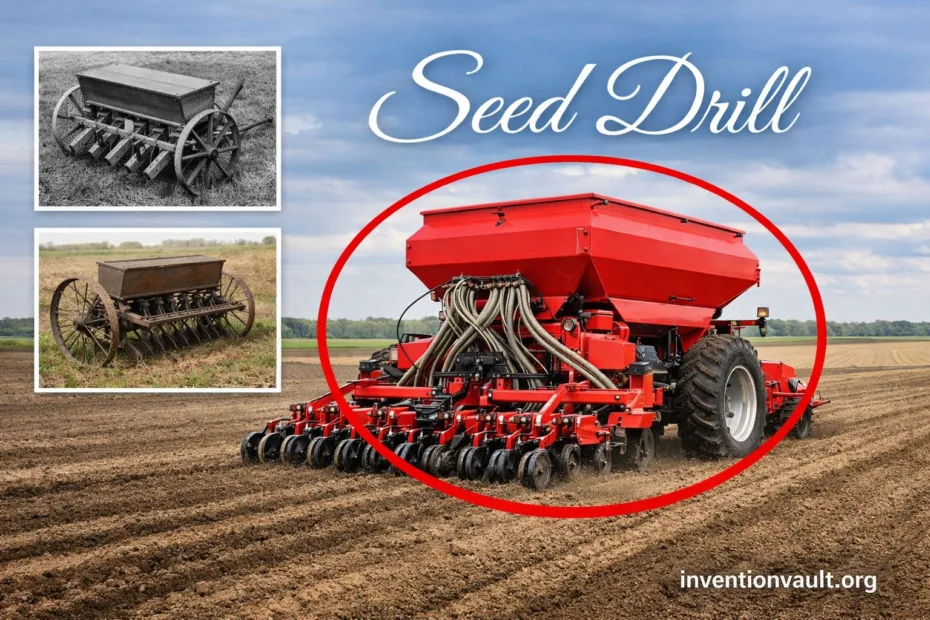
The seed drill is often presented as a single English invention from 1701. That version is the one most readers remember, and for good reason: Jethro Tull’s machine gave sowing a measured rhythm that hand broadcasting could not match. The longer story starts earlier and reaches farther. Older seed-placement devices appeared well before eighteenth-century Britain, while Tull’s real achievement was to turn an old agricultural idea into an influential mechanical system for controlled row planting.
- Origin and Attribution
- How the Seed Drill Worked
- Mechanical Sequence
- Field Effect
- Why the Seed Drill Changed Farming Practice
- Why Rows Mattered
- Why Adoption Took Time
- Why Early Adoption Was Slow
- What Opened the Door Later
- Major Types and Later Variants
- From Row Sowing to Direct Drilling
- References Used for This Article
The lasting idea was simple: place seed where it should grow, cover it at once, and make the result repeatable.
Origin and Attribution
The earliest known grain drill is traced to Mesopotamia, and museum material on early farming points to seed-placement tools in Babylonia roughly four millennia ago. Chinese agriculture later used multi-tube seed drills, showing that the principle of guided seeding had already moved beyond a single furrow and into multi-row placement long before the British Agricultural Revolution.
This matters because the seed drill was not born in one isolated flash. It developed through experiments in seed placement, row culture, and mechanical delivery across different regions and eras. Tull remains the central historical name because his 1701 drill became the best-known working form in Britain and helped define the machine’s later path. He is best understood as the figure most closely tied to the influential modern European form, not as the only point where the story begins.
The usual short version of this history leaves readers with a neat but incomplete claim: “Jethro Tull invented the seed drill.” A better phrasing is more useful. Tull perfected and popularized a highly influential design in Britain, while the underlying idea of guided sowing had much older roots.
How the Seed Drill Worked
Tull’s drill followed a clear mechanical sequence. Seed sat in a hopper, a rotating metering element released it in measured amounts, and a tube or funnel guided it into a furrow opened at the front of the machine. A trailing device then covered the seed. That sounds ordinary today. In the early eighteenth century, it was a sharp move away from sowing by hand across the soil surface. Tull’s improved version could sow three rows simultaneously, which helps explain why it stood out.
Mechanical Sequence
- Seed rested in a hopper.
- A metering part released seed in controlled amounts.
- Seed moved through a tube into the opened furrow.
- A harrow or covering action closed the soil over it.
Field Effect
- More even row spacing
- Steadier sowing depth
- Better seed protection after placement
- Easier follow-up hoeing between rows
The technical idea was not merely “machine planting.” It was measured delivery. Once sowing became a controlled sequence rather than a scattering motion, a farmer could think in terms of rows, spacing, and repeatability rather than chance and correction.
Why the Seed Drill Changed Farming Practice
Broadcast sowing left too much to chance. Some seeds sat too shallow. Some landed too close together. Some never settled properly into the soil at all. The seed drill changed that by placing seed in defined lines, at a more repeatable depth, and covering it immediately. That lowered waste and gave young plants a steadier start.
Its value went beyond germination. Straight rows made hoeing between crops easier. Fields became easier to inspect. Seed use became easier to estimate. Crop growth looked less random and more manageable. This is one of the most overlooked parts of the invention: the seed drill did not just improve sowing; it helped reorganize the whole pattern of field work.
Why Rows Mattered
- They turned sowing into a form of field planning.
- They made inter-row cultivation more practical.
- They linked the drill to Tull’s wider interest in horse-hoeing and tillage.
- They gave later machinery a pattern to follow rather than replace.
Tull’s larger agricultural thinking was mixed. He argued forcefully for tillage and row culture, yet he was wrong about plant nutrition and dismissed manure more than he should have. That debate often distracts from a plainer truth. The machine endured because the placement method worked, even when parts of the theory around it did not.
Why Adoption Took Time
The seed drill was not an instant universal success. Early machines asked for better parts, more money, and more confidence in mechanical regularity than many farms could easily provide. Hand sowing was familiar, flexible, and cheap. Even after Tull, many fields continued to be sown by broadcasting, especially where local habits and farm conditions favored older practice.
Why Early Adoption Was Slow
- Machine parts needed greater precision than many workshops could yet supply.
- Small farms did not always gain enough from the extra mechanism.
- Broadcast sowing demanded less equipment and less upfront expense.
- Farmers had to trust regular spacing and depth rather than old habit.
What Opened the Door Later
- Better iron and steel parts
- Improved machine-making and metal stamping
- Larger-scale farming systems
- Later traction from horses, steam power, and tractors
That slow uptake is part of the invention’s real history. The seed drill belongs as much to the story of diffusion as to the story of invention. The idea arrived early. Broad use took longer.
Major Types and Later Variants
The phrase seed drill refers to a family of machines rather than one frozen design. Some were simple seed tubes attached to plows. Others became larger field implements with press wheels, residue-cutting parts, and pneumatic delivery. That range helps explain why the invention kept evolving instead of remaining a museum piece after Tull.
| Type | Typical Period | Defining Feature | Historical Role |
|---|---|---|---|
| Single-Tube Drill | Ancient Near East | One tube dropping seed behind a plow | Early controlled placement into a furrow |
| Multi-Tube Drill | Ancient China | Several tubes sowing more than one row | Extended the idea from single-line placement to multi-row sowing |
| Horse-Drawn Grain Drill | Early modern to nineteenth century | Hopper, metering action, furrow opener, covering pass | Made drilled sowing practical on larger British and European fields |
| Press Drill | Nineteenth century onward | Added firmer closing or pressing action | Improved seed-to-soil contact after placement |
| Hand-Pushed Garden Drill | Nineteenth century onward | Light manual frame for smaller plots | Brought drilled sowing into gardens and market-scale production |
| No-Till or Direct Drill | Twentieth century onward | Places seed with minimal soil disturbance | Linked precise sowing to conservation agriculture |
| Air Seeder | Modern era | Pneumatic seed distribution across wide working widths | Scaled the drilling principle for broadacre farming |
Modern farm language also split the older tradition into related categories. Grain drills usually handle many small seeds in narrower rows, while later planting systems for larger individual seeds moved toward precision planters and air-based distribution. The family resemblance remains obvious: meter seed, place it accurately, and close the furrow with as little waste as possible.
From Row Sowing to Direct Drilling
Modern direct-drilling and no-till machines did not abandon the old logic of the seed drill. They extended it. Many current systems add row cleaners, cutting discs, dedicated furrow openers, and press or closing wheels so seed can be placed through crop residue with minimal soil disturbance. The machinery is newer, wider, and far more refined. The operating idea is still familiar.
- Open the soil only where needed.
- Meter seed in a controlled way.
- Place it at a predictable depth.
- Restore seed-to-soil contact.
- Preserve as much field surface cover as the system allows.
This continuity gives the seed drill a longer reach than its early wooden and iron forms might suggest. A machine first remembered for making neat rows became part of the technical ancestry of direct drilling, grain drilling, and later precision seeding. Once sowing could be judged by depth, spacing, and coverage rather than by gesture alone, later agricultural machinery had something firm to refine.
References Used for This Article
- The Museum of English Rural Life — Farming: The First 12,000 Years: Museum overview covering early seed machines and hand sowing.
- Encyclopaedia Britannica — Grain Drill: Reference entry on the machine, its function, and ancient Mesopotamian origins.
- Encyclopaedia Britannica — Jethro Tull: Biographical entry on Tull’s drill, horse hoe, and agricultural writing.
- ASME — Jethro Tull: Engineering summary of the 1701 horse-drawn drill and its working parts.
- ScienceDirect — The Pre-History of Soil Science: Jethro Tull, the Invention of the Seed Drill, and the Foundations of Modern Agriculture: Scholarly abstract on Tull’s role, limits, and later influence.
- Cambridge University Press — China: From Kingdoms to Unification: Chapter summary noting the multi-tube seed drill in early China.
- Cambridge University Press — Revolutions of the Past: Academic chapter emphasizing how agricultural change spread slowly over time.
- FAO STI Portal — Direct Seeding Equipment for Tractors (Conservation Agriculture): FAO description of modern direct drilling and no-till seeding components.