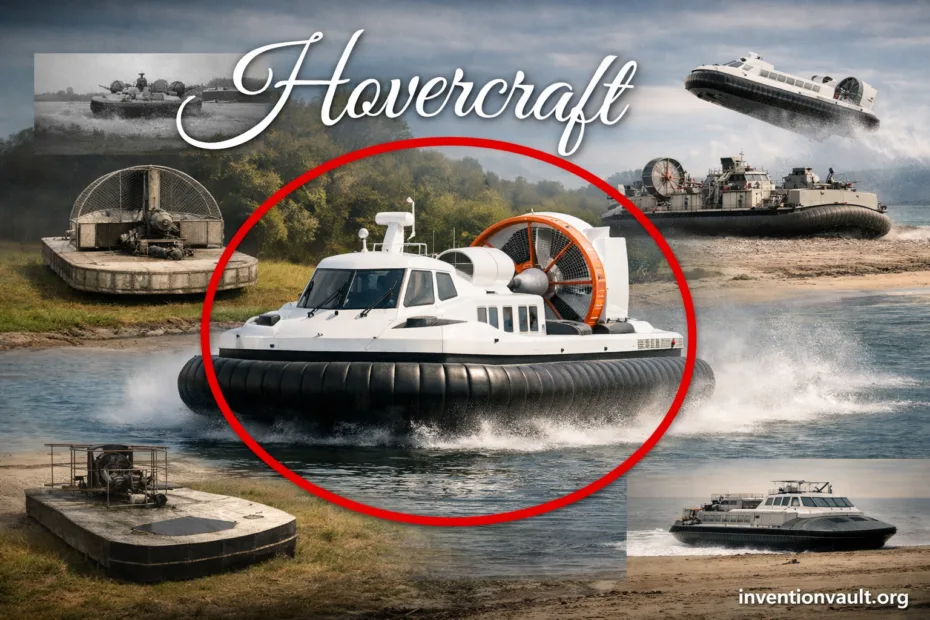
What The Skirt Does
- Reduces edge leakage so the cushion stays steady.
- Improves clearance over small obstacles without losing lift.
- Helps manage spray and surface contact in a controlled way.
| Field | Details |
|---|---|
| Invention | Hovercraft (also called an air-cushion vehicle, ACV) |
| Core Breakthrough | A stable pressurised air cushion retained by a perimeter jet (“momentum curtain”) to reduce air leakage at the edges |
| Commonly Credited Inventor | Sir Christopher Sydney Cockerell (United Kingdom) |
| Early Proof Experiment | Mid-1950s tabletop demonstration using nested tins and a vacuum source to show how a perimeter jet can trap pressure under a platform |
| Development Pathway | Prototype work coordinated through Hovercraft Development Limited with support from the UK’s NRDC, leading to a full-scale craft built with Saunders-Roe |
| First Full-Scale Prototype Widely Recognised | Saunders-Roe SR.N1 (built on the Isle of Wight, England) |
| First Public Flight | 11 June 1959 (Isle of Wight) |
| Signature Early Milestone | 25 July 1959 English Channel crossing from Calais to Dover (journey a little over two hours) |
| Key Practical Upgrade | Flexible skirts (patented in 1962) improved clearance over waves and obstacles and helped standardise production |
| Important Precursors | Earlier ground-effect and air-cushion research in the 1930s–1940s (including work linked to Toivo J. Kaario and Vladimir Levkov) helped shape the broader field |
A hovercraft is an amphibious vehicle that “floats” just above the surface on a cushion of air. That single idea unlocked something engineers had been chasing for generations: reliable travel across water, sand, mud, ice, and shoreline without needing wheels in the usual sense or a hull fully in the water. The invention of the hovercraft is not one neat moment; it is a chain of experiments, patents, and test runs that turned an elegant principle into a machine people could actually operate.
What Makes A Hovercraft Different
A true hovercraft is supported by lift generated from pressurised air under the craft. It does not need forward motion to “take weight” off the surface. That sets it apart from many look-alikes.
- Airboats skim shallow water but still ride on the water’s surface.
- Hydrofoils lift a hull using underwater wings and forward speed.
- Ground-effect vehicles (WIG craft) gain lift mainly from motion and proximity to the surface.
The practical hovercraft emerged when engineers learned to keep air from escaping at the edges—turning wasted airflow into dependable lift.
Two Jobs, Two Airflows
Most hovercraft separate what the air is doing: lift holds the craft up, while thrust pushes it forward. Early designs proved that mixing those roles without control made performance unpredictable.
Where The Idea Came From
Long before the SR.N1 made headlines, engineers in several countries explored how trapped air could reduce drag or even carry weight. Some projects aimed at skimming close to the surface; others tested plenum chambers—enclosed spaces where pressurised air could build under a platform.
Academic work preserved in university repositories credits Finnish engineer Toivo J. Kaario with early ground-effect experiments and patents in the 1930s–1940s, including concepts that resemble later air-cushion thinking. Separately, museum documentation notes that Soviet engineer Vladimir Levkov carried out extensive air-cushion research in the same broad era, testing watercraft ideas that could move across challenging surfaces.
Why A “Modern” Invention Still Fits
Those earlier efforts mattered, but the hovercraft became a widely recognised invention when one design choice made the physics scalable: instead of only pumping air underneath, the system used a perimeter jet to hold pressure in place. That is the hinge between an interesting experiment and a practical vehicle.
Christopher Cockerell And The Momentum Curtain
Christopher Cockerell approached the problem with a builder’s eye: where is energy being wasted, and how can it be guided instead of spilled? In the mid-1950s he demonstrated a striking effect with simple equipment—two tins of different sizes and a vacuum source. The lesson was clear: a fast-moving ring of air can behave like a barrier, limiting sideways leakage and letting pressure rise inside the ring.
That perimeter “curtain” did two things at once. It created lift by building pressure under the craft, and it improved efficiency because the system no longer needed to brute-force huge airflow just to replace what escaped. This is why the hovercraft is often described as sitting between ship and aircraft: it uses airflow engineering to solve a marine transport problem, without requiring wings or buoyancy to carry the load.
The Practical Meaning Of “Air Leakage”
- If air escapes freely from the edges, lift becomes expensive in power.
- If the edge is controlled, the cushion pressure becomes predictable.
- Predictable pressure makes control surfaces and steering worth designing, because the craft’s behaviour repeats.
From Workshop To SR.N1
Turning a clever principle into a full-scale craft required test facilities, manufacturing skill, and a route for patents and licensing. Institutional support arrived through Hovercraft Development Limited, established with NRDC backing, and industrial capability came through Saunders-Roe—an organisation comfortable working at the overlap of aeronautical and marine engineering.
The result was the SR.N1. It achieved its first public flight on 11 June 1959 on the Isle of Wight. Within weeks it completed a milestone that made the concept real to a wide audience: on 25 July 1959 it crossed the English Channel from Calais to Dover in a little over two hours.
One detail often lost in short summaries is how carefully airflow was managed on early craft. The SR.N1 used a ducted arrangement that supported the cushion while also providing propulsion and steering. In other words, not every litre of air was “spent” on lift; some flow was routed to control the vehicle’s movement.
| Period / Date | Milestone | Why It Matters |
|---|---|---|
| 1930s–1940s | Ground-effect and air-cushion research documented in multiple countries | Established key ideas about surface proximity and pressurised air support |
| Mid-1950s | Cockerell demonstrates the perimeter-jet principle with simple apparatus | Shows a practical way to retain pressure without excessive airflow |
| 1958 | Hovercraft Development Limited formed with NRDC involvement | Creates a pathway for patents, funding, and industrial build |
| 11 June 1959 | SR.N1 public flight on the Isle of Wight | First broad proof that a full-scale hovercraft can be operated and demonstrated |
| 25 July 1959 | SR.N1 crosses the English Channel (Calais to Dover) | Validates the concept in open-water conditions and strengthens public confidence |
| 1962 | Flexible skirt patents associated with Latimer-Needham | Improves clearance and comfort over rougher surfaces; supports repeatable manufacture |
The Skirt That Made Hovercraft Practical
Early hovercraft could hover, but real-world surfaces are not perfectly smooth. Waves, ridges, and minor obstacles created gaps where air rushed out, forcing lift systems to work harder and reducing stability. The key improvement was the flexible skirt: a compliant barrier that follows the surface while still allowing the craft to float above it.
Science Museum documentation highlights the role of skirt patents in 1962, credited to Latimer-Needham. The significance was not only performance. Flexible skirts encouraged standardised designs and manufacturing methods, moving hovercraft from bespoke experiments toward a technology that could be built and maintained with consistent results.
What The Skirt Does
- Reduces edge leakage so the cushion stays steady.
- Improves clearance over small obstacles without losing lift.
- Helps manage spray and surface contact in a controlled way.