| Item | Details |
|---|---|
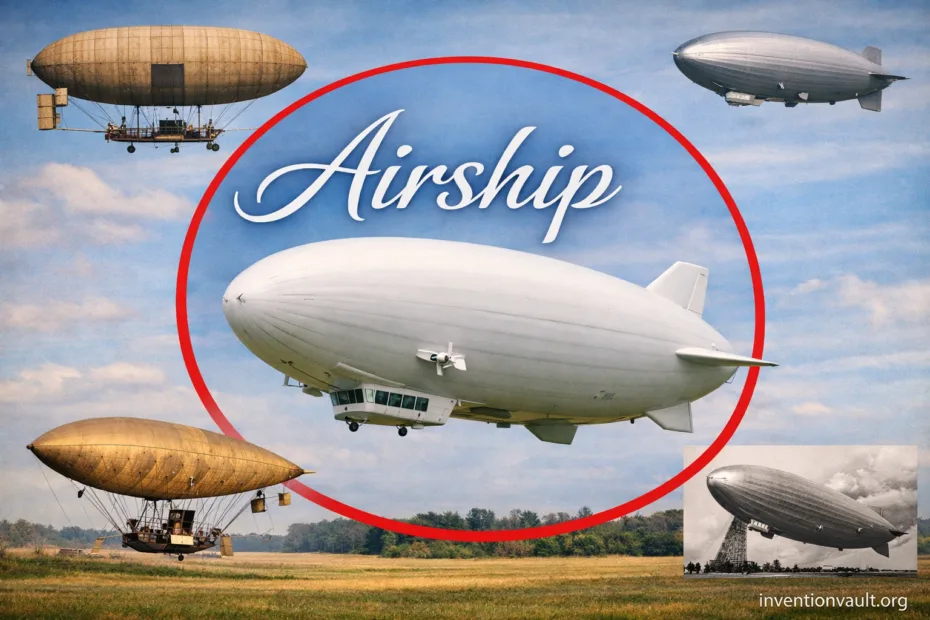
| What The Invention Is | An airship is an engine-driven, lighter-than-air aircraft that can be controlled in flight. |
| Defining Breakthrough | Turning a drifting balloon into a steerable craft by combining buoyant lift with propulsion, steering surfaces, and stable structural support. |
| Earliest Successful Powered And Steerable Flight | 1852 — Jules Henri Giffard’s steam-powered, hydrogen-lift dirigible demonstrated controlled flight (Paris area, France). |
| Often-Cited Flight Date | 24 September 1852 (commonly recorded for Giffard’s demonstration flight). |
| Primary Figure Most Often Credited | Jules Henri Giffard (France): widely credited with the first successful powered, steerable airship. |
| Early Power Source | A compact steam engine driving a propeller; later experiments used internal-combustion and electric motors. |
| Early Lift Gas | Hydrogen was common early on for strong lift; helium became the preferred lift gas for many modern airships due to nonflammability. |
| Core Flight Controls | Thrust (propellers), yaw/pitch control via rudders and fins, and buoyancy/trim management (including internal air bags called ballonets in many designs). |
| Main Airship Families | Nonrigid (blimp/pressure airship), Semirigid (keel-supported), Rigid (internal framework; often called a zeppelin in popular speech). |
| Key Milestones After 1852 | 1884 — “La France” achieved controlled flight that returned to its starting point; 1900 — Zeppelin LZ 1 marked a major step in rigid-airship engineering. |
| Why It Still Matters | Airships remain valuable where long endurance, gentle flight, and heavy-lift potential are priorities, with ongoing work in certification and low-emission concepts. |
The invention of the airship did not arrive as a single “aha” moment. It arrived when buoyant flight learned a new skill: control. An airship is not just a big balloon; it is a powered aerostat that can choose a heading, manage its trim, and stay stable enough to be useful. Once that combination became practical in the mid-19th century, lighter-than-air flight stepped into a new era of engineering.
- What Counts As An Airship
- Three Structural Families
- From Balloon To Dirigible
- Why 1852 Worked When Earlier Attempts Did Not
- Key Milestones That Shaped The Invention
- How An Airship Works
- Four Main Parts You Can Point To
- The Quiet Detail Many Pages Skip
- Airship Types And Notable Variants
- Materials And Power That Made Airships Practical
- Modern Airships And Certification
- References Used for This Article
What Counts As An Airship
An airship is defined by two traits working together: buoyant lift and powered steering. If a craft cannot meaningfully steer, it stays in the balloon family, even if it carries people. If it can steer under its own power, it belongs to the airship family, even if it looks balloon-like.
- Balloon: buoyant lift, no true steering.
- Airship: buoyant lift plus engines and control surfaces for navigation.
- Dirigible: a common synonym for airship; the word points to the idea of being directable.
- Zeppelin: commonly used for rigid airships; technically linked to the Zeppelin tradition of rigid-frame design.
Three Structural Families
| Family | How The Shape Is Held | Typical Notes |
|---|---|---|
| Nonrigid | Envelope shape relies on internal pressure; if gas is lost, the envelope can slacken. | Often called a blimp. Many include ballonets to manage pressure and trim. |
| Semirigid | Envelope pressure plus a structural keel that carries major loads. | Supports a heavier gondola and improves handling without a full internal framework. |
| Rigid | A full internal framework carries loads; gas cells sit inside a shaped hull. | Often associated with zeppelin designs and large-scale engineering. |
A balloon becomes an airship when buoyancy stops being the whole story and steering becomes reliable.
Engineering Perspective
From Balloon To Dirigible
Early balloons proved that humans could rise into the sky, yet they were guests of the wind. The airship’s invention began when inventors tried to solve a stubborn triad: enough power to move forward, enough stability to keep the hull predictable, and enough control to steer without fighting the envelope itself.
In 1852, Jules Henri Giffard demonstrated what many attempts before him could not: an airship that flew under its own power and could be guided rather than merely drift. His solution combined a long, streamlined envelope, a suspended gondola, and a propeller driven by a steam engine. That “steam plus buoyancy” marriage was fragile, but it was a turning point that showed controlled lighter-than-air flight could be real, not just hopeful.
Why 1852 Worked When Earlier Attempts Did Not
- Propulsion that could actually turn a propeller without overwhelming the craft’s weight budget.
- Envelope shapes that reduced drag enough to make forward motion meaningful.
- Steering surfaces that could yaw and stabilize without tearing or twisting the hull.
- Operational precautions around lift gases, especially when hydrogen was used.
Key Milestones That Shaped The Invention
| Year | Milestone | Why It Mattered |
|---|---|---|
| 1852 | Giffard demonstrates a powered, steerable airship. | Established the practical definition of an airship: buoyancy plus controlled navigation. |
| 1872 | Early internal-combustion experimentation appears in airship design. | Signaled a shift toward lighter powerplants and improved operational range. |
| 1883 | Electric propulsion is demonstrated in powered airship work. | Showed that different energy systems could drive propellers in lighter-than-air craft. |
| 1884 | “La France” completes a controlled flight and returns to its starting point. | Proved repeatable navigation, not just one-way demonstration. |
| 1897 | Rigid concepts advance with metal-based structural thinking. | Helped unlock larger hulls and better payload organization. |
| 1900 | Zeppelin LZ 1 makes its first ascent. | Marked a major step in rigid-airship scale and structural sophistication. |
| 1901 | Santos-Dumont popularizes practical nonrigid airships with controlled flights. | Made airship handling and repeatable performance visible to the public imagination. |
How An Airship Works
An airship stays aloft through aerostatic lift: the envelope contains a gas less dense than surrounding air, creating an upward buoyant force. The “invention” part is what happens next: engines, fins, and trim systems turn that floating lift into a controllable aircraft.
Four Main Parts You Can Point To
- Envelope: the outer hull holding lift gas (or containing internal gas cells).
- Gondola: the car carrying crew, passengers, and systems.
- Propulsion: engines driving propellers or fans to create thrust.
- Control Surfaces: vertical and horizontal fins to steer and stabilize.
The Quiet Detail Many Pages Skip
Many nonrigid designs use ballonets, internal air bags that can be inflated or deflated. They help maintain envelope shape as the lift gas expands or contracts with altitude and temperature. That single feature often decides whether a “blimp” feels stable and responsive, or soft and unpredictable.
Airship Types And Notable Variants
Airships evolved by experimenting with structure. Some designs pursued simplicity, others pursued scale. The categories below are still the most useful way to understand “what kind of airship” a design is.
| Type | Defining Feature | Engineering Tradeoff |
|---|---|---|
| Pressure Airship (Blimp) | Shape held by internal pressure, typically with ballonets for control. | Efficient and practical, yet size and stiffness are limited by envelope pressure management. |
| Semirigid | A structural keel carries loads under a pressurized envelope. | More payload support than a blimp, while remaining lighter than a full rigid framework. |
| Rigid | An internal frame defines the hull; gas cells sit inside. | Enables large scale and organized internal volume, while raising manufacturing complexity. |
| Hybrid (Semi-Buoyant) | Combines buoyancy with some dynamic lift from the hull or propulsion. | Seeks higher payload efficiency and modern mission flexibility, while requiring careful certification and control design. |
Materials And Power That Made Airships Practical
The airship’s history often gets told as a parade of famous names. The deeper story is more mechanical: the airship became possible when materials, engines, and propeller efficiency improved together. If even one of those lagged, the design either could not move, could not steer, or could not survive normal operations.
- Envelope Fabrics: early rubberized textiles improved gas retention; later synthetics increased durability and predictability.
- Lightweight Power: better power-to-weight made steady thrust realistic without sacrificing lift margin.
- Streamlined Hull Thinking: drag reduction mattered because airships trade speed for endurance.
- Ground Handling And Mooring: a workable airship needs a complete system—aircraft, procedures, and infrastructure.
Modern Airships And Certification
Airships never stopped being engineered; they simply shifted into narrower roles where their strengths shine. Modern development focuses on endurance, quiet operation, and the promise of lower-emission aviation pathways. That ambition also brings a practical reality: airships are aircraft, and aircraft must be certified.
Regulators describe an airship in straightforward terms: an engine-driven, lighter-than-air vehicle that can be controlled in flight. That definition shapes how modern projects approach airworthiness, structural analysis, and systems safety. When designers explore hybrid airships, the work often expands into advanced control methods, power distribution questions, and careful performance modeling.
- Endurance: staying aloft for long periods with efficient propulsion.
- Gentle Logistics: low-speed handling that can suit delicate payloads.
- New Lift Strategies: combining buoyant lift with aerodynamic effects for mission flexibility.
- Standards And Guidance: certification pathways and design criteria shape what reaches the sky.
References Used for This Article
- Federal Aviation Administration — Airships: Defines airships and outlines certification-related entry points.
- Encyclopaedia Britannica — Airship: Summarizes types, core parts, and key historical milestones in airship development.
- Fédération Aéronautique Internationale — Jules Henri Giffard (1825–1882) Inducted 2002: Provides a vetted historical profile of Giffard’s 1852 powered, steerable flight.
- Musée de l’Air et de l’Espace — Nacelle du dirigeable La France: Describes the 1884 La France milestone and its return-to-start controlled flight.
- Zeppelin Museum Friedrichshafen — A vision becomes reality: LZ 1 – The world’s first Zeppelin: Documents the LZ 1 as a landmark in rigid airship engineering and early operations.
- Embry-Riddle Aeronautical University — Airships, Blimps, & Aerostats: Explains lighter-than-air principles, parts, and classification with engineering terminology.
- NASA Technical Reports Server — Effect of buoyancy and power design parameters on hybrid airship performance: Discusses performance sensitivity in hybrid airship design using modeling parameters.
- International Civil Aviation Organization — Environmental Reports 2022 (Airships section): Reviews modern interest in hybrid and lighter-than-air aircraft within aviation technology pathways.