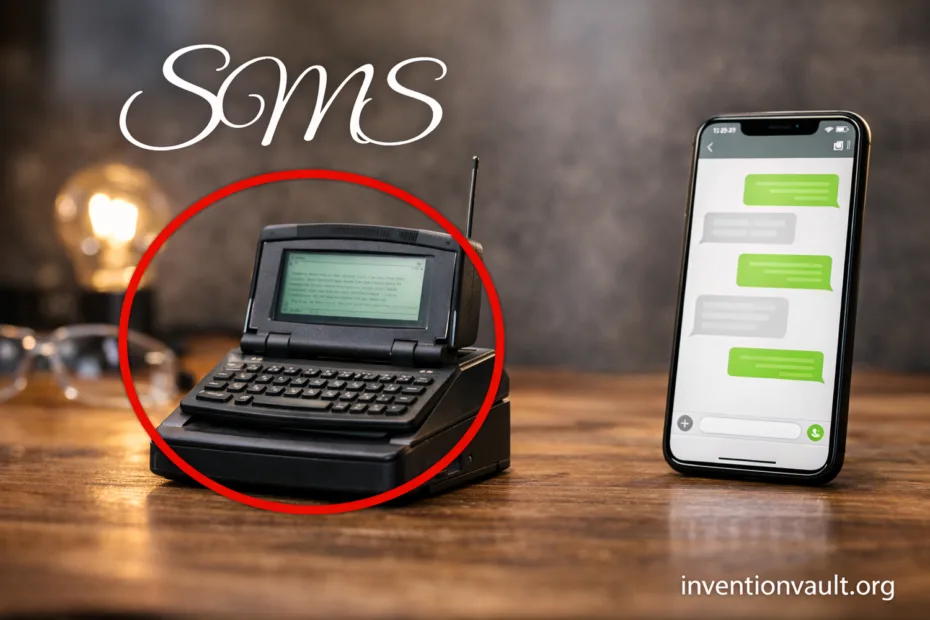
SMS Facts and Origins
| Invention Name | Short Message Service (SMS) |
| Main Idea | Short, reliable text messages delivered via a phone number, using mobile network signaling. |
| Concept Shaped By | Friedhelm Hillebrand and Bernard Ghillebaert during early GSM service planning (mid-1980s). |
| Standardization Began | Work on SMS in the GSM program began in February 1985 (as part of defining non-voice services). |
| Radio Interface Specification | ETSI Phase 1 published a Point-to-Point SMS radio-interface support standard on May 31, 1992. |
| First Known SMS Sent | December 3, 1992: “Merry Christmas” sent by Neil Papworth on the Vodafone network. |
| Why the Limit Feels “Short” | Classic SMS carries up to 140 bytes of user data, often packing 160 characters with the GSM 7-bit alphabet. |
| Typical Character Counts | 160 (GSM 7-bit), 70 (UCS-2/Unicode), or 140 bytes (8-bit data), depending on encoding. |
| Core Network Element | SMSC (Short Message Service Center): a store-and-forward relay that retries delivery when a phone is offline. |
| Still Relevant Because | Works on basic coverage, reaches nearly any phone number, and integrates easily with carrier-grade routing. |
SMS stands for Short Message Service, and it remains the simplest form of mobile text messaging that “just works” across networks. It was engineered for reliability, not for fancy formatting, and that restraint is exactly why it lasted.
- SMS Facts and Origins
- What SMS Really Is
- Core Parts
- Two Directions
- Why SMS Was Built to Be Small
- The 160-Character Story
- How an SMS Travels
- What “Store-and-Forward” Means for You
- SMS Variants and Subtypes
- Why Long Texts Sometimes Split
- SMS Beyond 2G: LTE and 5G
- What SMS Is Still Used for
- Common Questions About SMS
- References Used for This Article
What SMS Really Is
At its core, SMS is a standardized way to move a small payload between phones using a service center and phone-number addressing. The network treats each text like a compact packet, and the SMSC handles routing and retries.
Core Parts
- Mobile Station (your phone) with an SMS app.
- Radio + MSC (mobile switching) that carries SMS signaling.
- SMSC for store-and-forward delivery.
- Subscriber database lookups so the SMS finds the right destination.
Two Directions
- Mobile-Originated: a text you send goes to the SMSC via network control paths.
- Mobile-Terminated: a text to you is delivered from the SMSC when your phone is reachable.
Why SMS Was Built to Be Small
The original GSM designers wanted messages that could ride along with signaling traffic and still arrive when the user was moving between cells. That goal pushed SMS toward compact size and predictable structure.
Short was never a limitation by accident; it was a design choice that made delivery dependable on early mobile networks.
The 160-Character Story
An SMS carries up to 140 bytes of user data. When the text uses the GSM 7-bit alphabet, those bits can be packed into about 160 characters—a tidy fit for the formats GSM already handled.
Switch to Unicode (commonly UCS-2), and each character typically needs two bytes, so a single SMS drops to around 70 characters. The system is doing the same job, just carrying a heavier encoding load.
| Encoding | Typical Single-SMS Capacity | What It’s Good For |
|---|---|---|
| GSM 7-bit | 160 characters | Standard Latin letters, numbers, common symbols |
| UCS-2 (Unicode) | 70 characters | Many world scripts and richer character sets |
| 8-bit data | 140 bytes | Binary payloads used by certain services |
How an SMS Travels
SMS delivery looks simple on-screen, yet it follows a precise store-and-forward path. The SMSC is the traffic manager, and it keeps trying until the network says the handset is reachable.
- Your phone submits the text with a destination number.
- The message reaches the mobile switching side and is passed to the SMSC for handling.
- The SMSC checks routing and reachability, then schedules delivery attempts based on availability.
- If the recipient is offline, the SMSC keeps the messege and retries within a configured validity period in a controlled way.
- When the recipient becomes reachable, the SMS is delivered and the handset can return a receipt if requested.
What “Store-and-Forward” Means for You
- Better reach in patchy conditions because SMS can use control channels and retry logic.
- Predictable delivery behavior through the SMSC with queueing.
- Small payload keeps the service fast and lightweight.
SMS Variants and Subtypes
“SMS” is a family of closely related behaviors. Some are user-visible, others are invisible plumbing that still relies on the same message format and SMSC routing with strict size limits.
| Type | What Changes | Common Use |
|---|---|---|
| Person-to-Person | Human sender to human receiver, number-to-number | Everyday texting |
| Application-to-Person | Automated sender with high volume patterns | Alerts, confirmations, reminders |
| Concatenated SMS | Splits a long text into parts, linked with a header | Long messages without MMS |
| Flash SMS (Class 0) | Displays immediately; often not saved by default | Urgent notices in some systems |
| Binary SMS | Uses 8-bit payloads instead of text characters | Service data in specific deployments |
Why Long Texts Sometimes Split
A “single” SMS has a hard payload ceiling, so longer content is often sent as multiple parts joined by a User Data Header. With GSM 7-bit text, each part typically holds about 153 characters instead of 160.
Single SMS payload: 140 bytes (user data)
- GSM 7-bit packing: ~160 chars
- With concatenation header: ~153 chars per part
- Unicode (UCS-2): ~70 chars (or fewer when split)
SMS Beyond 2G: LTE and 5G
SMS began in circuit-switched GSM, yet it adapted as networks evolved. In modern systems, SMS can be carried through IMS for VoLTE environments, while still preserving the familiar SMSC and number-based addressing.
This continuity matters: a text message does not need a contact list sync or an app account. A phone number and carrier reach are the identity layer, and SMS keeps that friction low with backward compatibility.
What SMS Is Still Used for
Even with modern chat apps, SMS stays valuable for situations that reward universality. It reaches nearly any handset, works with basic service, and fits neatly into carrier-grade delivery with measurable status.
- Account notifications and one-time codes sent to a phone number.
- Delivery updates and appointments that benefit from reach.
- Device alerts in certain machine messaging setups using small payloads.
Common Questions About SMS
Is SMS the same as “texting”?
SMS is the technical service, while texting is the everyday action. Many phones also send texts through other systems, but SMS specifically means the standardized carrier service.
Why do some texts arrive as multiple messages?
Because a single SMS has a strict payload cap. When a message exceeds it, the sender uses concatenation so parts can be reassembled, using headers inside the payload.
What happens if the receiver’s phone is off?
The SMSC keeps the message and retries delivery within a configured validity period. That store-and-forward behavior is a defining feature of SMS.
Does SMS support “delivery receipts”?
Yes. Many SMS systems can request a status report, which is a network-confirmed delivery signal returned through standard SMS mechanisms.
References Used for This Article
- ETSI — Short Message Service (SMS): Official overview of SMS within GSM and later mobile standards.
- 3GPP — SMS Specifications: Describes how SMS is defined and maintained across generations of mobile networks.
- ITU — Recommendation E.123: Explains international telephone numbering and addressing used by SMS delivery.
- GSMA — History of GSM: Summarizes the development of GSM services, including non-voice features like SMS.
- The National Archives (UK) — Evolution of Communication: Provides historical background on modern digital communication systems.
- IEEE — Mobile Communication Standards Overview: Academic-level summary of mobile network signaling and messaging principles.