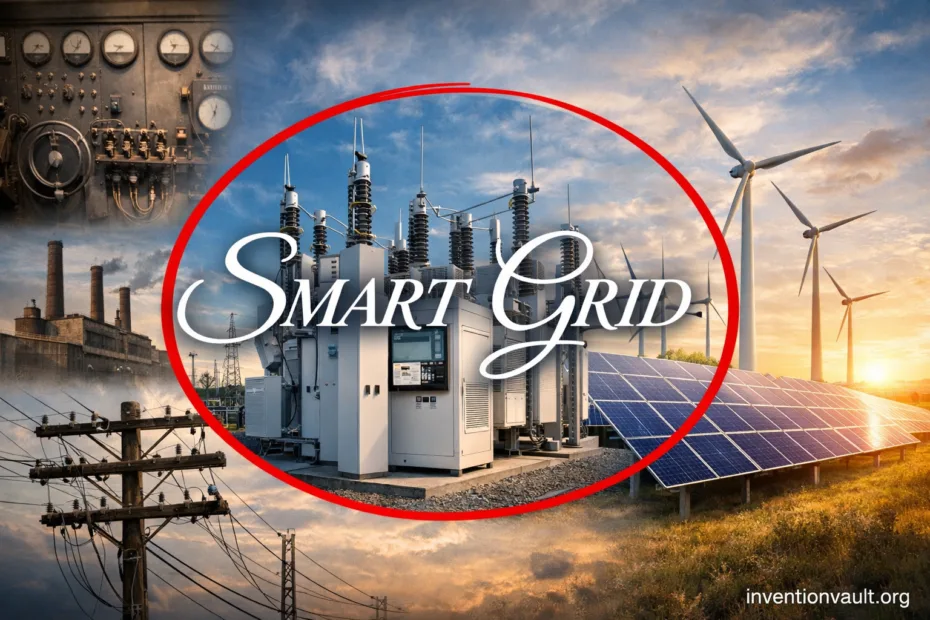
| Invention Name | Smart Grid |
|---|---|
| What It Is | An electricity network that uses digital sensing, automation, and software to coordinate generation, networks, and end users with higher reliability and flexibility. |
| Core Idea | Move from one-way power delivery to two-way information flow and faster control decisions across the grid. |
| Key Building Blocks | Sensors and meters, secure communications, control systems (SCADA/EMS/DMS), analytics platforms, distributed energy integration, and customer-facing interfaces. |
| Major Subsystems | Advanced Metering Infrastructure (AMI), distribution automation, wide-area monitoring, DER management, microgrids, and flexibility programs. |
| What It Enables | Faster outage awareness and restoration, improved power quality, higher hosting capacity for renewables, and more responsive demand-side participation. |
| Interoperability Foundations | Framework-driven standards alignment (e.g., NIST Smart Grid Framework), automation and substation communications (e.g., IEC 61850), and information models (e.g., IEC CIM). |
| A Key Policy Milestone | The concept was formally described in energy-policy terms in 2007, with defined characteristics for “smart grid” functions in U.S. federal legislation. |
| Primary Stakeholders | Utilities and grid operators, regulators, technology providers, standards bodies, large customers, and households with smart devices or distributed generation. |
| Typical Data Signals | Usage and voltage readings, equipment status, disturbance measurements, transformer loading, feeder conditions, and operational telemetry from grid assets. |
A smart grid is not a single device or a single “upgrade.” It is an operating model for electricity networks where measurement, communication, and control work together so the grid can sense, decide, and respond with far more precision than legacy systems.
- What Smart Grids Change
- Traditional Grid vs Smart Grid
- Core Building Blocks
- Sensing and Measurement
- Communications and Timing
- Automation and Control Systems
- Data Platforms and Analytics
- Smart Grid Functions You Can Recognize
- Key Subtypes and Related Systems
- Advanced Metering Infrastructure (AMI)
- Distribution Automation
- Microgrids
- DER Management and Virtual Power Plants
- Wide-Area Monitoring
- EV Integration
- Interoperability and Standards
- Why Interoperability Matters
- Cybersecurity and Trustworthy Operations
- How Smart Grid Progress Is Measured
- Common Misunderstandings
- References Used for This Article
What Smart Grids Change
Traditional grids were built for one dominant pattern: large power plants feeding electricity outward through transmission and distribution lines to customers. Smart grids keep the same physical mission—deliver power safely and reliably—while modernizing the “nervous system” of the network: data, secure communications, and automation.
- Visibility: more frequent, more granular measurements across the network.
- Control: automated actions that adjust voltage, reroute power, or isolate faults faster.
- Coordination: the grid can accommodate distributed energy resources (solar, storage, flexible loads) without losing stability.
- Participation: customers can become active contributors through smart devices, demand response, and distributed generation.
A practical definition: a smart grid uses digital technologies, sensors, and software to better match electricity supply and demand in real time while maintaining stability and reliability.
Traditional Grid vs Smart Grid
| Capability | Traditional Grid | Smart Grid |
|---|---|---|
| Measurement | Limited sensing; periodic readings in many locations | High-frequency telemetry; more points monitored in near real time |
| Outage Awareness | Often detected via customer reports and field checks | Automated detection and faster localization through sensor networks |
| Control Speed | Manual switching and slower operational feedback loops | More automation, including self-healing switching in supported feeders |
| DER Integration | Designed primarily for centralized generation | Built to manage distributed solar, storage, EV charging, and flexible loads |
| Data Exchange | Siloed systems; custom integrations | More structured interoperability using standards and common information models |
Core Building Blocks
Sensing and Measurement
Smart grids depend on trustworthy signals from the field—meters, line sensors, substation instrumentation, and disturbance measurements. The goal is not “more data” for its own sake; it is better operational visibility where it changes decisions.
- Smart meters and AMI for interval usage and service status
- Distribution sensors for feeder conditions and fault indicators
- Wide-area monitoring tools such as synchrophasors in applicable systems
Communications and Timing
Measurements become useful only when the right information reaches the right system at the right time. Smart grids rely on layered communications (field networks, backhaul, control center links) and disciplined timing where needed for grid-wide coordination.
- Utility-grade networking plus secure device authentication
- Latency-aware data paths for time-sensitive control signals
- Reliable links for operational technology environments
Automation and Control Systems
Control is where smart grids earn their name. Supervisory systems and distribution management platforms coordinate switching, voltage regulation, and feeder operations. When designed well, automation improves speed while keeping operators in charge of strategy and oversight.
- SCADA for real-time supervisory control
- EMS and DMS for operational planning and grid-state awareness
- Field automation for switching, reconfiguration, and voltage support
Data Platforms and Analytics
Smart grids generate data at a scale that demands disciplined governance: data quality, lifecycle management, and role-based access. Analytics then supports forecasting, asset health, and operational decision support.
- Meter data management and event processing
- Asset monitoring and condition-based maintenance signals
- Load forecasting and flexibility estimation
Smart Grid Functions You Can Recognize
Many smart grid capabilities are invisible until something changes—an outage, a voltage issue, a surge in local solar production. The value shows up as fewer interruptions, better power quality, and higher operational agility.
- Fault location, isolation, and service restoration: quicker detection and more targeted switching to reduce affected areas.
- Voltage and reactive power optimization: tighter voltage control to keep service within acceptable ranges and reduce losses.
- Demand response: structured ways for flexible loads to support system balance during peaks or constraints.
- DER coordination: managing distributed solar and storage so the local network stays stable.
- Operational forecasting: combining telemetry with models to anticipate loading and constraints.
Smart grids are built on feedback: measure, interpret, act—then measure again. The loop is technical, operational, and organizational.
Key Subtypes and Related Systems
“Smart grid” is an umbrella term. In practice, it often appears as a portfolio of subsystems—each modernizing a different layer of the electricity value chain.
Advanced Metering Infrastructure (AMI)
AMI connects smart meters, communications networks, and data systems so utilities and customers can exchange usage and service information. It underpins billing accuracy, outage detection, and customer-facing energy insights, without turning the meter into “the whole smart grid.”
Distribution Automation
Automation on feeders and substations supports faster switching, better voltage regulation, and more resilient local operations. This is where the “self-healing” idea appears: isolate a faulted section and restore service to unaffected areas when the network design supports it.
Microgrids
A microgrid is a localized network with generation and possibly storage that can operate connected to the wider grid and, in certain designs, operate independently for limited periods. Microgrids are often used for campuses, critical facilities, and industrial sites seeking resilience and controllability.
DER Management and Virtual Power Plants
As distributed energy resources grow, coordination matters. DER management systems aggregate or orchestrate local resources, while virtual power plant concepts focus on combining many small assets into a controllable portfolio for grid services.
Wide-Area Monitoring
Wide-area monitoring supports system-wide awareness using time-synchronized measurements in applicable transmission contexts. It is particularly valuable for understanding disturbances, oscillations, and conditions that cannot be seen from isolated local measurements.
EV Integration
Electric vehicle charging adds new load patterns and, in some designs, new flexibility. Smart grids account for charging behavior, local constraints, and the need for coordinated scheduling so charging growth remains compatible with distribution capacity.
Interoperability and Standards
Smart grids succeed when systems from different vendors, eras, and operators can exchange information without fragile one-off integrations. This is why interoperability sits at the center of modern grid programs.
| Standard or Framework | What It Supports | Where It Commonly Appears |
|---|---|---|
| NIST Smart Grid Framework | Conceptual models, interoperability guidance, and cybersecurity considerations | Program-level architecture and standards coordination |
| IEC 61850 | Communications for power utility automation and substation environments | Substations, protection and control, automation engineering |
| IEC CIM (IEC 61970-301, IEC 61968-11) | Common information models for utility operational and enterprise data exchange | Data integration across EMS/DMS and enterprise systems |
| IEEE 1547 | Interconnection criteria and requirements for distributed energy resources | DER integration and interface requirements |
Why Interoperability Matters
- It protects long-lived infrastructure from short technology cycles.
- It reduces integration risk when new devices or platforms are introduced.
- It improves system resilience by avoiding single points of vendor dependency.
- It makes testing and certification more meaningful across ecosystems.
Cybersecurity and Trustworthy Operations
Smart grids expand the digital surface area of the electricity system. That creates new opportunities for monitoring and control, and it also raises the stakes for protection. A credible smart grid program treats cybersecurity as a core engineering requirement, not a later add-on.
- Identity and access control: only authorized people and devices can issue commands.
- Data integrity: operational data must remain accurate from sensor to control room.
- Segmentation: networks are separated so a problem in one zone does not spill everywhere.
- Monitoring and response: anomalies are detected early, with clear procedures for containment and recovery.
- Compliance alignment: where reliability standards apply, smart grid deployments are engineered to maintain compliance.
In North America, the Critical Infrastructure Protection (CIP) family of reliability standards illustrates how cybersecurity requirements can be formalized around bulk electric system reliability. In other regions, similar expectations appear through national grid codes, sector regulations, and utility security baselines.
How Smart Grid Progress Is Measured
“Smarter” is measurable when goals are defined. Utilities and system operators commonly evaluate progress through reliability metrics, operational performance, and the grid’s ability to host new resources without compromising service.
| Measurement Area | What It Indicates | Typical Signals |
|---|---|---|
| Reliability | Frequency and duration of interruptions, restoration speed | Outage events, switching logs, AMI “last gasp” alerts where supported |
| Power Quality | Voltage performance and disturbance exposure | Voltage profiles, disturbance monitors, equipment alarms |
| Flexibility | Ability to shift load or dispatch distributed resources | DER telemetry, response program performance, dispatch records |
| DER Hosting Capacity | How much distributed generation can be integrated without violations | Feeder models, sensor data, interconnection studies |
| Interoperability | Ease of integrating new devices and systems | Standards conformance tests, integration effort and defect rates |
Common Misunderstandings
- Smart meters equal a smart grid: meters are important, yet they represent only one layer of sensing and customer interface.
- Automation removes people from operations: successful systems keep operators central, using automation to reduce routine friction and accelerate safe decisions.
- More data automatically improves reliability: reliability improves when data leads to actionable control and improved maintenance choices.
- All smart grids look the same: design differs by grid topology, resource mix, reliability targets, and interoperability requirements.
References Used for This Article
- National Institute of Standards and Technology — NIST Framework and Roadmap for Smart Grid Interoperability Standards, Release 4.0 (SP 1108r4): Official guidance on smart grid interoperability and related practices.
- U.S. Department of Energy — Smart Grid: High-level overview of smart grid modernization and objectives.
- International Energy Agency — Smart Grids: Clear definition and system-level explanation of smart grid capabilities.
- U.S. Department of Energy — Energy Independence and Security Act of 2007, Title XIII (Smart Grid): Legislative description of smart grid characteristics and functions.
- Federal Register — Smart Grid Policy (FERC): Primary document outlining smart grid interoperability priorities and policy framing.
- IEEE Standards Association — IEEE 1547-2018: Authoritative source on DER interconnection criteria and requirements.
- International Electrotechnical Commission — IEC 61970-301:2020 (CIM Base): Official description of the Common Information Model for utility operations data exchange.
- North American Electric Reliability Corporation — CIP Reliability Standards: Official overview of cybersecurity reliability standards relevant to bulk electric system protection.