| Item | Detail |
|---|---|
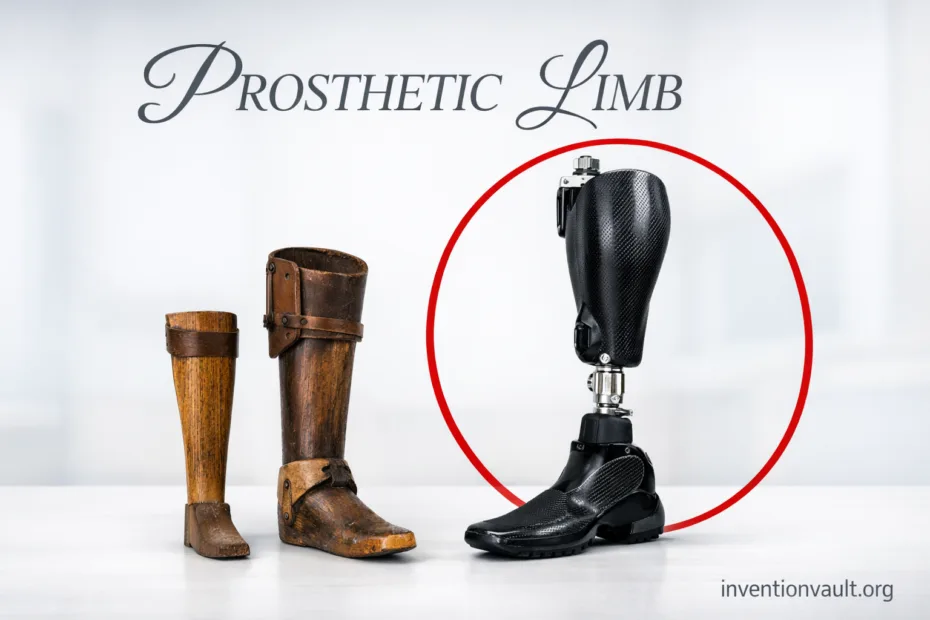
| Name of the Invention | The prosthetic limb, meaning an external device made to replace part of a missing arm or leg and restore some mix of function, balance, grip, or appearance. |
| Inventor | No single inventor can be named with confidence. The prosthetic limb developed across many cultures, with early practical evidence in ancient Egypt and a major mechanical design leap recorded by Ambroise Paré in 1579. |
| Earliest Surviving Evidence | Two ancient Egyptian artificial toes: the Greville Chester toe and the Cairo toe. |
| Earliest Likely Practical Example | The Cairo toe, a wood-and-leather device dated to roughly 2,700 to 3,000 years ago and refitted more than once for use in life. |
| Earliest Well-Known Full Leg Example | The Capua leg, dated to about 300 BC, built from bronze, hollowed wood, and leather straps. |
| Earliest Written Mechanical Breakthrough | Ambroise Paré’s 1579 publication describing functional artificial limbs with articulated joints and locking mechanisms. |
| Main Early Materials | Wood, leather, linen-based composites, iron, bronze, and later rubber. |
| Main Modern Materials | Aluminum alloys, titanium, laminated composites, polymers, silicone liners, carbon-fiber structures, sensors, batteries, and embedded electronics. |
| Main Engineering Problems | Fit at the socket, weight transfer, joint control, durability, ease of repair, skin protection, and sensory feedback. |
| Main Branches Today | Passive cosmetic limbs, body-powered limbs, myoelectric upper-limb systems, powered ankle-foot systems, microprocessor-controlled knees, and osseointegrated designs. |
A prosthetic limb was not born in one workshop, one patent, or one famous name. It emerged when makers, healers, and later engineers kept returning to the same hard question: how do you replace a lost body part with something a person can actually use, trust, and wear for long stretches of daily life?
- What Counts as the Invention of a Prosthetic Limb
- The Earliest Evidence That Still Holds Up
- Egypt and the First Practical Lower-Limb Devices
- The Capua Leg and the Move to Full-Leg Construction
- How Mechanical Limbs Became Wearable Devices
- Lower-Limb and Upper-Limb Design Took Different Paths
- Lower-Limb Design
- Upper-Limb Design
- Why the Socket Mattered So Much
- Control Systems and the Rise of Bionic Function
- Materials and Custom Fabrication
- Current Directions in Prosthetic Design
- References Used for This Article
The oldest surviving evidence points to ancient Egypt, where artificial toes were shaped not only to complete the foot visually but also to work with sandals and walking. A few centuries later, the Capua leg shows that larger lower-limb replacement was already a skilled craft. By the 16th century, Ambroise Paré turned that craft into written mechanical design. After that, the story split into two paths: legs built for load and walking, and arms built for grip and control.
What Counts as the Invention of a Prosthetic Limb
If the question is “Who invented the prosthetic limb?”, the most accurate answer is: no one person did. Historians still debate whether the first prostheses were meant mainly for appearance, ritual wholeness, or day-to-day function. That uncertainty matters. It shifts the discussion away from a tidy inventor story and toward a more honest one, where usefulness decides what counts as a true prosthetic device.
This is why the ancient Egyptian toe restorations matter so much. A lost big toe is not a small issue. It helps with forward push during walking and can bear a large share of body weight. Once that fact is kept in view, the early toe prostheses stop looking like side notes. They become central evidence in the history of lower-limb replacement.
The prosthetic limb is best understood as a long chain of solutions, not a single flash of invention.
The Earliest Evidence That Still Holds Up
Egypt and the First Practical Lower-Limb Devices
The two best-known early examples are the Greville Chester toe and the Cairo toe. The Greville Chester piece was made from cartonnage, a linen-glue-plaster composite, and likely served a cosmetic role. The Cairo toe, built from wood and leather, is more persuasive as a working prosthesis. Researchers have noted its flexibility, repeated refitting, and wear pattern. In replica gait testing, one volunteer reached 87% of normal toe flexion with one design and nearly 78% with the three-part wood-and-leather version while wearing replica sandals. The same study found no excessive pressure points, which is exactly the kind of detail that separates a symbolic object from a wearable device.
The Capua Leg and the Move to Full-Leg Construction
The Capua leg, dated to about 300 BC, marks another step. It was made from bronze, hollowed wood, and leather straps. Even in copy form, it makes one fact very clear: prosthetic design had already moved beyond small appendages and into full lower-limb structure. By that point, builders were dealing with alignment, attachment, and load transfer, not just outward shape.
- Early prosthetics were already balancing function and appearance.
- Refitting mattered from the beginning, which hints at repeated real-world use.
- Materials were chosen for what they could do under load, not only for what they looked like.
- The oldest practical story is about walking, not decoration alone.
| Period | Milestone | Why It Mattered |
|---|---|---|
| Ancient Egypt | Artificial toes made from cartonnage, wood, and leather | Showed that prosthetic design began with wearability, sandal use, and toe-off support. |
| c. 300 BC | Capua leg in Italy | One of the earliest known full-leg prostheses, proving that larger limb replacement had already become a skilled craft. |
| 1579 | Ambroise Paré published mechanical limb designs | Brought articulated joints, locking knees, and written design thinking into the record. |
| 1818 | Peter Baliff’s body-powered upper-limb design | Used trunk and shoulder motion to drive a terminal device, making movement more fluid. |
| 19th century | Rubber ankles, cushioned heels, lighter materials | Comfort and shock handling became part of engineering, not a side issue. |
| 1948–1957 | EMG control entered prosthetic research and commercial myoelectric hands followed | Opened the path from cable pull to electrically interpreted user intent. |
| 2007 | Powered ankle-foot prosthesis reported by MIT-led team | Showed that a lower-limb prosthesis could add active power during walking rather than only store and release energy. |
| 2014 onward | Advanced multi-movement arms, osseointegration studies, and sensor-rich knees and ankles | Pushed the field toward better control, less reliance on the socket, and stronger embodiment. |
How Mechanical Limbs Became Wearable Devices
Ambroise Paré is often the closest thing this history has to a named inventor, though even that label is too narrow. What makes Paré stand out is not that he created the very first prosthesis. It is that he described functional artificial limbs in print, treated them as engineered tools, and designed joints that could lock for standing and bend when needed. That changed the tone of the field. Prosthetics were no longer only handmade substitutes. They became mechanical problems that could be studied, revised, and copied.
Between the late 15th century and the 19th century, makers in France and Switzerland built limbs with cables, gears, springs, cranks, and catches. Some could rotate or grip. Some could hold utensils. Many still had a flaw that is easy to miss in simple history pieces: they often needed the user’s other hand to set them in place. That means they looked advanced on paper while remaining awkward in life.
A better step came in 1818, when Peter Baliff introduced an “automatic” body-powered upper-limb design that used trunk and shoulder movement through straps. That shift was huge. Motion no longer had to be imposed from outside. The body itself could drive the device. Later 19th-century designs also paid more attention to comfort. The Hanger limb, for example, used rubber in the ankle and heel cushioning, showing that inventors had learned a plain truth: a limb that hurts will not be worn for long.
Lower-Limb and Upper-Limb Design Took Different Paths
Lower-Limb Design
- Primary job: support body weight and keep gait stable.
- Main design targets: stance safety, shock absorption, push-off, and symmetry.
- Big leap points: articulated knees, dynamic feet, powered ankles, and microprocessor knees.
- Main user test: can the person walk farther, more safely, and with less effort?
Upper-Limb Design
- Primary job: reach, grasp, hold, rotate, and release objects with control.
- Main design targets: dexterity, grip choice, low weight, and intuitive command.
- Big leap points: body-powered harness systems, EMG control, multi-articulating hands, and sensory feedback research.
- Main user test: does the device feel useful enough to compete with the intact side?
This split explains why lower-limb prostheses often advanced first in daily reliability, while upper-limb systems kept running into harder control problems. Walking can be broken into repeating phases. Hand use changes from task to task. A leg must be dependable. A hand must also be adaptable. That is a much tougher standard.
| Design Question | Lower Limb | Upper Limb |
|---|---|---|
| Main Goal | Safe, efficient walking | Useful grasp and manipulation |
| Hardest Problem | Weight transfer and timing through stance and swing | Control, dexterity, and feedback |
| What Users Notice Fast | Instability, fatigue, poor toe-off, knee trust | Delay, awkward grip choice, weight, lack of sensation |
| Common Modern Solutions | Microprocessor knees, energy-storing feet, powered ankles | Myoelectric control, multi-grip hands, haptic or neural feedback research |
| Why Devices Are Abandoned | Pain, poor socket fit, low confidence, high effort | Low comfort, weak function, low sensory feedback, repair burden |
Why the Socket Mattered So Much
Many popular history pages barely mention the socket. That is a mistake. The socket is the real border between body and machine. It has to hold shape, manage pressure, allow motion, and protect skin at the same time. When it fails, even a fine foot or a smart hand can become nearly useless.
Modern reviews make the point bluntly. Residual limbs change volume over time. A transtibial residual limb can shrink by up to 35% after amputation as swelling settles, and short activity periods can still shift volume by up to 6.5%. Poor fit leads to tissue stress, skin breakdown, weak mechanical coupling, and loss of confidence. In lower-limb users, skin damage has been reported in 36% to 63% of users. That is not a minor fitting issue. It sits near the center of prosthetic history because comfort decides whether invention reaches everyday life.
The hard part was never only the hand or foot at the end. It was the place where the device met skin, motion, sweat, and time.
This is also why adjustable sockets keep returning across centuries. They are not a modern fad. They answer an old problem: the body does not stay the same shape all day, all year, or across the whole course of recovery. A prosthetic limb that can adapt to that fact is usually more realistic than one fixed forever to a single cast.
Control Systems and the Rise of Bionic Function
Body-powered devices remain important because they are durable, easier to repair, and often lighter than advanced electric systems. Hooks and prehensors still do many jobs very well. Yet upper-limb design kept pushing toward more natural control. EMG-based prosthetic work entered the field in 1948, and commercial myoelectric hand production began in 1957 in Moscow. That changed the logic of control. Instead of pulling a cable alone, the user’s muscle signals could be interpreted and translated into movement.
Modern myoelectric hands can offer several grip modes, but the sensory gap remains large. About 90% of upper-limb peripheral nerve axons carry sensory information, and clinically available devices still transmit only a thin slice of that lost input in a meaningful way. This helps explain why upper-limb abandonment has stayed stubbornly high. A recent cohort paper, drawing on earlier review data, reported mean adult abandonment rates of 26% for body-powered devices and 23% for myoelectric ones. The usual reasons were familiar: comfort, function, and the feeling that the device never quite became part of the user.
- Body-powered control: strong, repairable, and still very practical.
- Myoelectric control: reads muscle signals for more varied movement.
- Powered lower-limb systems: add active assistance rather than only passive spring behavior.
- Sensory feedback systems: aim to return touch, pressure, or position cues, though no single method has solved the problem yet.
Lower-limb systems took a different route. In 2007, a powered ankle-foot prosthesis from an MIT-led team showed that active ankle power could improve metabolic walking economy by 7% to 20% compared with conventional passive-elastic devices in a small clinical test. Microprocessor knees pushed that logic further. They use onboard sensors and real-time adjustment to improve stance stability and swing behavior, especially when the user changes speed or terrain.
Upper-limb research has moved toward closed-loop systems, where control and feedback travel both ways. That work is promising, though it is still uneven. Reviews on sensory restoration are clear on one point: there is no single solution yet. Some methods use vibration or pressure on the skin. Others use implanted electrodes around or inside nerves. The best results so far come from designs that improve several things at once: control accuracy, comfort, skeletal attachment, and the user’s sense that the limb belongs with the body.
Materials and Custom Fabrication
The material story is often told as a neat march from wood to metal to electronics. Real practice was messier. Each change solved one problem and exposed another. Wood was workable and familiar. Leather allowed fastening and flexibility. Metal improved durability but could add weight. Rubber improved shock handling. Modern composites cut mass and store energy well. Silicone liners improved skin interface in many cases. Titanium made bone-anchored systems more feasible.
3D printing added another shift, though not in the simplistic way many headlines suggested. The best clinical use has been in diagnostic sockets, flexible inner sockets, cosmetic covers, and selected custom parts. The lesson is plain: digital fabrication helps most when it supports prosthetist skill, not when it tries to replace it. Prosthetic care still depends on fit, alignment, feedback from the user, and repeated adjustment.
Current Directions in Prosthetic Design
Today’s prosthetic limb sits at the meeting point of biomechanics, electronics, surgery, and daily habit. Osseointegration tries to reduce socket problems by anchoring the prosthesis directly to bone. Advanced arms keep pushing for smoother multi-joint control. Sensory systems are trying to restore touch, temperature, pressure, and position in forms the brain can use. Lower-limb devices are becoming better at real-time adjustment, especially at the knee and ankle.
Even so, the oldest lesson has not changed. A prosthetic limb succeeds when it fits human life well enough to be worn without constant negotiation. The first Egyptian makers already understood part of that. Paré understood more. Modern engineers are still working on the same equation, only with finer tools.
References Used for This Article
- NIH MedlinePlus Magazine — Prosthetics through the ages: Useful for the early timeline, Paré, and the Hanger limb.
- The University of Manchester — Mummies’ false toes helped ancient Egyptians walk: Supports the gait-testing data and practical use of the Egyptian toe prostheses.
- PubMed Central — Ambroise Paré IV: The early history of artificial limbs: Covers Paré’s 1579 designs and the move toward mechanical function.
- Science Museum Group — Copy of Roman artificial leg, London, England, 1905–1915: Confirms the Capua leg as an early full-leg prosthesis from about 300 BC.
- PubMed Central — The evolution of functional hand replacement: From iron prostheses to hand transplantation: Used for Peter Baliff’s 1818 body-powered design and upper-limb control history.
- PubMed Central — Myoelectric control of prosthetic hands: state-of-the-art review: Supports the early EMG and commercial myoelectric timeline.
- PubMed — Powered ankle-foot prosthesis for the improvement of amputee ambulation: Used for the 2007 powered ankle-foot results and metabolic economy data.
- PubMed Central — Adjustable prosthetic sockets: a systematic review of industrial and research design characteristics and their justifications: Supports the socket-fit discussion, limb-volume change, and skin breakdown data.
- PubMed Central — Prevalence and predictors of unmet need for upper limb prostheses: Supports abandonment data and user-centered outcome points.
- PubMed Central — Upper limb prostheses: bridging the sensory gap: Used for the sensory-feedback limits and current closed-loop directions.