| Aspect | Details |
|---|---|
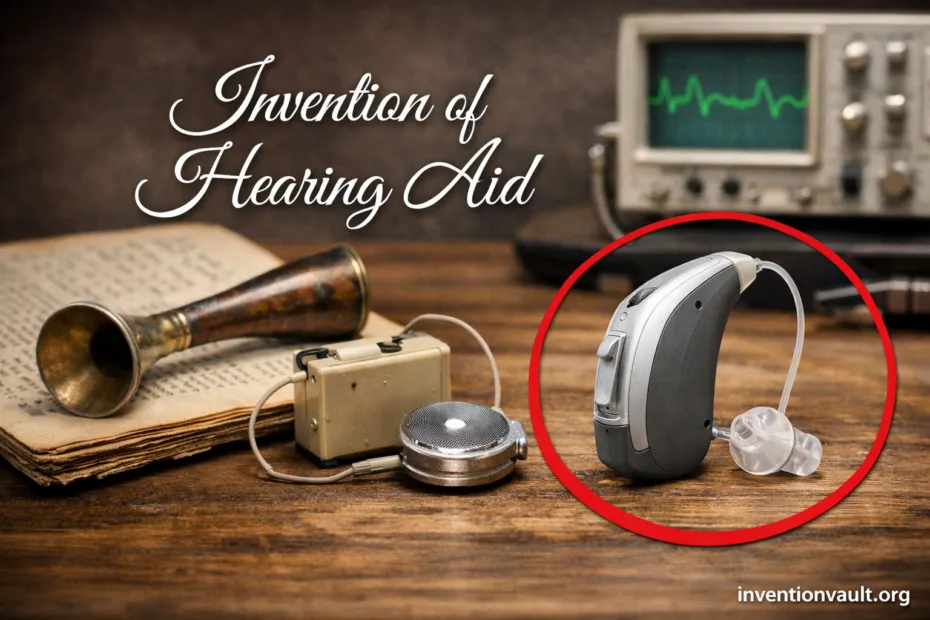
| Earliest Devices | Before electricity, people used ear trumpets, speaking tubes, and other acoustic aids that collected sound and directed it toward the ear. |
| Technical Turning Point | The telephone era opened the door to electrical control of sound. That change made it possible to boost speech more actively than any passive funnel could. |
| First Electric Hearing Aid | Akouphone, introduced by Miller Reese Hutchison in 1898, is widely credited as the first electric hearing aid. |
| First More Practical Wearable Form | Hutchison’s Acousticon followed in 1902, moving the invention closer to a device people could actually wear and use in daily life. |
| Early Industrial Production | In 1913, Siemens launched the Phonophor, one of the earliest industrially produced electric hearing aids. |
| Hardware Milestones | Vacuum tubes raised amplification in the 1920s, transistors shrank devices after 1948, and digital processing reshaped fitting and sound control in the late twentieth century. |
| Design Pressure | Users wanted more than volume. They also wanted devices that were lighter, less visible, and easier to live with in public. |
| Present Access Shift | The hearing aid is now also a software story: OTC regulation arrived in 2022, and the first FDA-authorized OTC hearing aid software followed in 2024. |
| Main Function | A hearing aid captures sound, shapes or amplifies it, and delivers a more usable signal to the listener. Modern devices also manage feedback, frequency balance, and listening environments. |
| Broader Meaning | This invention changed everyday communication, education, work, and social participation by making speech more reachable for many people with hearing loss. |
The invention of the hearing aid was not one neat flash of genius. It was a long attempt to make speech and daily sound usable again for people whose ears could no longer gather or boost enough information on their own. The story starts with acoustic funnels, turns electric in the late nineteenth century, becomes more wearable in the early twentieth, shrinks after the transistor, and now extends into software-based hearing support.
- Why This Invention Still Matters
- What a Hearing Aid Actually Does
- From Ear Trumpets to Electric Hearing Aids
- Why 1898 Is Only Part of the Story
- What Each Technical Leap Changed
- Hearing Aid Forms That Grew From the Original Idea
- Conventional Styles
- Where the Line Branches
- The Social Pressure Behind Smaller Devices
- How the Invention Connects to Today’s Devices
- References Used for This Article
Why This Invention Still Matters
Hearing loss remains a large public-health issue. The World Health Organization reports that more than 430 million people require rehabilitation for disabling hearing loss, and it projects that more than 700 million may need it by 2050. That ongoing need helps explain why the hearing aid keeps changing: users want devices that hear more clearly, fit more comfortably, and reach more people.
What a Hearing Aid Actually Does
- It captures sound through one or more microphones.
- It boosts or reshapes that sound so speech becomes easier to hear.
- It sends the altered signal to the ear through a receiver.
- In digital models, it can also adjust gain, limit feedback, and respond to different listening settings.
From Ear Trumpets to Electric Hearing Aids
Before electricity entered the picture, hearing aids were purely mechanical. Trumpets, collapsible cones, conversation tubes, and similar objects tried to collect more sound and push it toward the ear. Some helped people with mild hearing loss, but they could not target speech very well, and they could not adapt to different patterns of hearing loss. They were also hard to hide, awkward to carry, and easy to associate with disability in public.
The real turn came when telephony changed how inventors thought about sound. Alexander Graham Bell’s telephone did not itself become a hearing aid, yet it introduced an electrical path for shaping loudness and transmitted speech. That made a new type of device possible. In 1898, Miller Reese Hutchison introduced the Akouphone, the electric hearing aid most often named as the first of its kind.
The hearing aid did not arrive as one finished object. It moved in stages: acoustic collection, electric amplification, wearable miniaturization, and then digital control.
Why 1898 Is Only Part of the Story
Many history pages flatten the subject into one sentence: Hutchison invented the hearing aid in 1898. That version is tidy, but it leaves out the part that matters most to readers who want the real invention story. The hearing aid was not just a first patent or a first public claim. It was a sequence of advances that turned an idea into a usable product and then into a manufactured device.
- 1898: The Akouphone marks the first electric step.
- 1902: The Acousticon gives the invention a more practical wearable form.
- 1913: Siemens launches the Phonophor, showing that hearing aids had moved into organized industrial production.
That distinction matters. When a reader asks who invented the hearing aid, the honest answer has layers. Hutchison is central to the first electric hearing aid. The Acousticon made the concept more workable. Industrial firms then helped turn hearing aids into repeatable products rather than one-off devices for a narrow few.
| Technical Stage | What It Added | What It Still Could Not Solve Well |
|---|---|---|
| Ear Trumpets and Acoustic Aids | Passive sound collection with no batteries or electronics. | Little control over speech clarity, loud background sound, or user-specific hearing patterns. |
| Carbon Microphone Electric Aids | Active amplification and a direct move away from simple funnels. | Bulky batteries, limited fidelity, and awkward daily use. |
| Vacuum-Tube Devices | Stronger amplification and broader help for users with more hearing loss. | Large body-worn parts, heat, and short battery life. |
| Transistor Hearing Aids | Smaller size, less heat, lower power demand, and a path toward on-ear wear. | Early models still had narrow adjustment options and modest personalization. |
| Digital Hearing Aids | Programmable channels, better fitting logic, and finer control of gain and sound shaping. | Early digital systems were expensive, power-hungry, and not always easy to wear. |
| Current OTC and Software-Led Devices | Wider retail access, self-fitting paths for some adults, and hearing support functions delivered partly in code. | They do not suit every kind or degree of hearing loss, and many users still need professional assessment and fitting. |
What Each Technical Leap Changed
The vacuum-tube era in the 1920s raised amplification enough to help people with more serious loss than ear trumpets or early carbon devices could handle. The trade-off was size. Users often had to carry batteries and other parts on the body. That was a gain in hearing, but not yet a gain in comfort.
After 1948, the transistor changed the picture. Smaller components and smaller batteries made one-piece, ear-level devices more realistic. This was not only an electronics win. It changed how the device fit daily life. A hearing aid could start to become lighter, quicker to put on, and less visually dominant.
Digital work in the early 1980s pushed the device into another category. Research systems proved that sound could be processed in real time, and later commercial devices built on that shift. Once hearing aids became digital, the invention stopped being just an amplifier. It became a tiny computer for speech audibility, frequency balance, and listening adaptation.
Hearing Aid Forms That Grew From the Original Idea
Conventional Styles
- Behind-the-Ear (BTE): A case sits behind the ear and connects to an earmold or tube. This form can serve a very wide range of hearing loss.
- Open-Fit and Mini BTE: These keep the canal more open and reduce the plugged sensation some users dislike.
- In-the-Ear (ITE): The shell sits in the outer ear and offers a larger custom surface for controls and features.
- In-the-Canal (ITC) and Completely-in-Canal (CIC): These push the hearing aid deeper into the ear canal, trading size for less visibility.
Where the Line Branches
The original hearing-aid line still centers on air-conduction devices: they pick up sound, process it, and deliver it through the ear canal. Yet hearing technology did not stop there. Bone-conduction systems and cochlear implants developed for different anatomical needs and different degrees of loss. That wider family matters historically, because it shows the hearing aid was never one fixed object. It became a class of solutions.
The Social Pressure Behind Smaller Devices
Many articles explain miniaturization as if engineers simply wanted better hardware. That is only half the story. Users and advertisers also pushed hard toward discretion. Interwar advertising often sold hearing aids by stressing that they were hard to notice, easy to conceal, or shaped to blend into ordinary dress. That pressure influenced cords, cases, placement, and later the move toward in-ear and near-invisible forms.
That design pressure never really disappeared. Mid-century devices borrowed ideas from fashion and personal accessories. Current digital models often borrow a cleaner, more industrial look from consumer electronics. The point is simple: the history of the hearing aid is also a history of social visibility. People did not just want to hear better. Many wanted to do it without the device announcing them first.
One overlooked truth: smaller hearing aids were not only better engineered. They were also easier to wear, easier to accept, and easier to keep private in societies that often treated hearing loss as something to hide.
How the Invention Connects to Today’s Devices
Older history pages often stop at Bluetooth and end there. That misses a newer shift with real historical weight. In 2022, the U.S. Food and Drug Administration created an over-the-counter hearing aid category for adults with perceived mild to moderate hearing loss. That changed who could buy some devices, where they could buy them, and how hearing support could reach people who had delayed care for years.
Another step followed in 2024, when the FDA authorized the first OTC hearing aid software for use with Apple AirPods Pro. In the agency’s clinical review, the self-fitting strategy was studied in 118 subjects and showed perceived benefit similar to professional fitting of the same device. That does not erase the value of audiology or make every device suitable for every user. It does show, though, that the hearing aid has entered a new phase: part medical device, part personal audio system, part software platform.
- First phase: collect more sound.
- Second phase: amplify sound electrically.
- Third phase: shrink the device enough for daily wear.
- Fourth phase: process sound digitally and fit it more precisely.
- Current phase: widen access and place part of the hearing-aid function inside mainstream consumer hardware.
That long arc is why the hearing aid deserves to be treated as more than a small accessory. It links medicine, telecommunications, industrial design, personal electronics, and everyday human communication. Few inventions moved so clearly from a visible mechanical aid to an almost hidden digital companion, while still keeping the same basic aim: helping a person catch more of the spoken world.
References Used for This Article
- Smithsonian National Museum of American History — Hearing Aid, Acousticon Type 8394: Museum record for Hutchison’s 1902 Acousticon and its early commercial history.
- Library of Congress — Inventor and Scientist: Official summary of Bell’s 1876 telephone invention and later hearing-related work.
- Siemens Healthineers MedMuseum — 175 Years of Innovations: Official museum timeline noting the 1913 Phonophor hearing-aid launch.
- World Health Organization — Deafness and Hearing Loss: Current global figures on hearing loss, rehabilitation needs, and public-health impact.
- NIDCD — Hearing Aids: Styles/Types & How They Work: Official overview of common hearing-aid forms and basic device function.
- U.S. Food and Drug Administration — FDA Authorizes First Over-the-Counter Hearing Aid Software: Official notice on the 2024 software milestone and the OTC path noted by the agency.
- PubMed Central — A Historical Perspective on Digital Hearing Aids: Scholarly history of digital research devices, wearable prototypes, and later commercial change.
- PubMed Central — The Categorisation of Hearing Loss Through Telephony in Inter-War Britain: Academic study of stigma, concealment, and the social language around hearing aids.