| Detail | Information |
|---|---|
| Invention Name | Eyeglasses, also called early spectacles |
| Most Accepted Place of Origin | Northern Italy, especially the Pisa–Florence–Venice orbit of medieval glassmaking and reading culture |
| Most Accepted Time of Origin | Late 13th century, usually placed around the 1280s to 1290s |
| Single Inventor | No securely proven single inventor; the surviving evidence points to a craft breakthrough rather than one fully documented individual |
| Earliest Strong Written Testimony | Giordano da Pisa’s 1306 sermon, which says the art of making eyeglasses was not yet twenty years old |
| Earliest Commercial Language | The word for spectacles appears in a commercial document in 1317 |
| Earliest Famous Pictorial Evidence | Tommaso da Modena’s 1352 fresco in Treviso showing a friar wearing rivet spectacles |
| Original Optical Purpose | Correction of presbyopia, helping older readers with close text |
| First Lens Type | Convex lenses for near work; true myopia correction came later with concave lenses |
| Early Materials | Lenses of rock crystal, beryl, or glass; frames of leather, wood, horn, and later metal |
| Major Later Optical Steps | Concave lenses for myopia in the 15th century, bifocals in the late 18th century, cylindrical lenses for astigmatism in the 19th century |
| Why the Invention Mattered | It extended reading life, supported scribes and scholars, widened skilled work, and later served mass literacy and modern eye care |
| Why It Still Matters | Eyeglasses remain one of the simplest and most effective tools for reducing vision impairment worldwide |
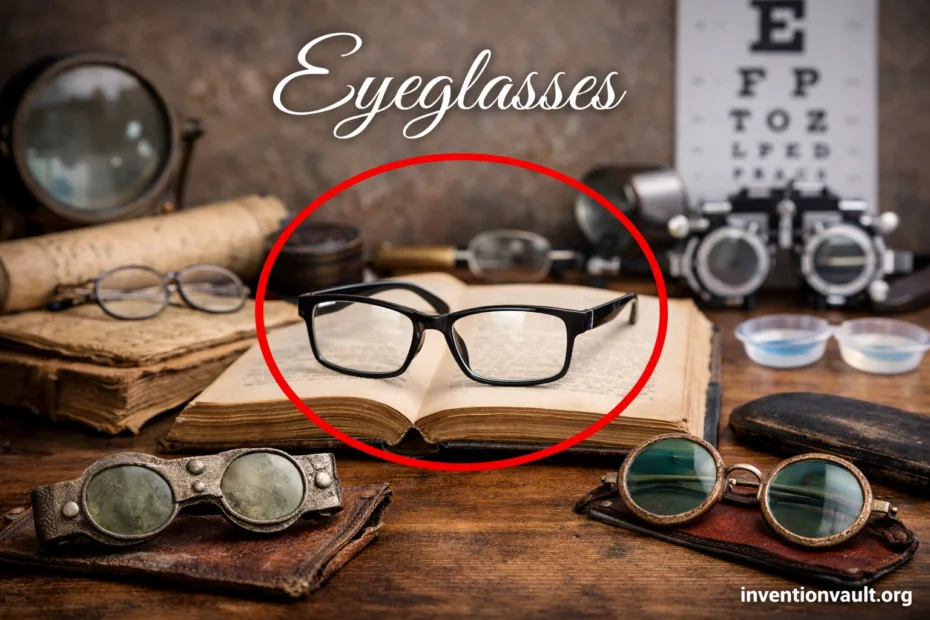
Eyeglasses did not appear as a single clean flash of genius. They emerged when optics, glassworking, and the everyday need to keep reading finally met in the same place. Most evidence places that turning point in late medieval Italy. The first wearable spectacles were simple, uncomfortable, and limited in what they could correct. Even so, they changed the lives of aging readers almost at once. That is the real force of the invention: not style, not luxury, but the moment when blurred text became readable again.
- Precursors
- True Eyeglasses
- Documented Evidence and Early Use
- Why the Inventor Remains Unnamed
- How Lens Design Solved Different Vision Problems
- How Early Spectacles Were Made
- Frame Forms and Subtypes
- Rivet Spectacles
- Nose Spectacles
- Temple Spectacles
- Hand-Held and Fashion Forms
- Bifocals and Precision Correction
- Why Eyeglasses Changed Work, Reading, and Daily Life
- Reading and Literacy
- Work and Skill
- Eyeglasses in the Present Day
- References Used for This Article
Precursors
Before true eyeglasses, people used reading stones, polished crystals, and other magnifying aids. These tools enlarged letters, yet they were handheld or placed on the page. They helped vision, but they were not wearable binocular devices.
True Eyeglasses
Eyeglasses begin when two lenses are mounted together and used in front of both eyes as one instrument. That shift matters. It turns a general magnifier into a personal visual aid built for repeated daily use.
Documented Evidence and Early Use
The strongest evidence does not name a universally accepted inventor. It gives a place, a date range, and a trail of early proof. The late 13th century is the safest ground. A sermon delivered in 1306 by the Dominican friar Giordano da Pisa says the art of making eyeglasses had been found less than twenty years earlier, which pushes the invention back into the 1280s or 1290s. That statement matters because it is close to the event itself, not a much later legend.
“It is not yet twenty years since there was found the art of making eyeglasses…”
A second layer of evidence appears in trade language. By 1317, commercial records already used the term for spectacles. That tells us the object had moved beyond workshop experiment and entered buying and selling. A third layer comes from art. In 1352, Tommaso da Modena painted a friar wearing rivet spectacles in the chapter house of San Nicolò in Treviso. This is the earliest famous image most readers now associate with the birth of eyeglasses.
That sequence is far more useful than the usual one-line answer. It shows invention, circulation, and visual proof as separate stages. Many short articles flatten these stages into a single claim. The history is cleaner when those stages stay distinct.
Why the Inventor Remains Unnamed
Popular pages often try to solve the story with one person. That makes the topic easy to package, though the evidence does not cooperate. Names such as Salvino d’Armati and Alessandro della Spina appear in later traditions, but the surviving record does not securely prove that either man alone created the first eyeglasses. The safest historical position is plain: the inventor is unknown.
- The early record is fragmentary and tied to sermons, guild activity, trade, and workshop practice rather than patent-style authorship.
- Medieval glassmaking often protected methods as craft knowledge, so secrecy worked against clear attribution.
- Later stories gave readers memorable names, but memorable is not the same thing as well documented.
- The evidence fits a gradual making process better than a single public unveiling.
This matters because the true achievement was not only optical theory. It was the joining of lens knowledge, fine grinding, frame making, and the practical habit of reading. Eyeglasses were born where skilled hands and everyday need overlapped.
How Lens Design Solved Different Vision Problems
The first spectacles did not solve every visual problem. They solved one problem first, and that tells us a great deal about early demand. Medieval readers most often needed help with close text as age reduced near focus. So the first successful lenses were convex. Only later did makers and users widen the range of correction.
| Vision Need | Optical Change | Historical Result |
|---|---|---|
| Presbyopia | Convex lenses | Made close reading easier for older adults, especially clergy, scholars, and scribes |
| Myopia | Concave lenses | Expanded spectacle use beyond reading into distance vision and broader daily activity |
| Near and Far in One Pair | Bifocal design | Reduced the need to switch between separate pairs of glasses |
| Astigmatism | Cylindrical lenses | Brought more precise correction and pushed spectacles further into scientific eye care |
The sequence is easy to miss when articles jump straight from “first glasses” to “modern eyewear.” A better reading of the invention follows the problem each lens solved. First came aging eyes reading at close range. Then came distance correction for myopia. Then combination lenses. Then more refined correction. That path gives the history a functional spine.
How Early Spectacles Were Made
Early spectacles were usually built from two small lenses set into separate rims and joined at the center. The earliest well-known type is the rivet spectacle. It had no side arms. The wearer balanced it on the nose or held it in place with the hand. These frames could be made from leather, wood, horn, or metal. Lenses were first cut from materials such as rock crystal or beryl before glass became dominant.
They were awkward, yes, but they worked. That is why their spread matters more than their comfort. Once a reader could return to manuscripts, accounts, or devotional texts, the device had proved its value. An object does not need to look modern to be a true invention. It needs to solve a real problem well enough to survive.
Frame Forms and Subtypes
Rivet Spectacles
The earliest famous form. Two lenses, a central rivet, little stability. Best for close work done in a fairly fixed posture. They belong to the birth phase of eyeglasses and are the form most closely tied to the 13th- and 14th-century evidence.
Nose Spectacles
Later designs improved the bridge and grip on the nose. They still lacked the secure side support that modern wearers expect, but they were a practical step forward. By this stage, spectacle use had already widened beyond the narrow circle of the earliest learned users.
Temple Spectacles
The real leap in comfort came when makers developed side pieces, or temples, that rested over the ears. Designs associated with 18th-century London, especially with Edward Scarlett, mark the move toward the familiar structure of modern glasses. After that point, spectacles became easier to wear for longer periods and in motion.
Hand-Held and Fashion Forms
Lorgnettes, monocles, and later nose-clip forms belong to the wider family of vision aids that grew from spectacle culture. They matter historically because they show that eyeglasses were never only medical tools. They also became social objects, markers of learning, refinement, or style.
Bifocals and Precision Correction
By the late 18th century, Benjamin Franklin’s bifocal idea joined near and distance needs in one pair. In the 19th century, cylindrical lenses brought better correction for astigmatism. At that point the history of eyeglasses is no longer just a story of readable text. It becomes a story of precision vision.
Why Eyeglasses Changed Work, Reading, and Daily Life
Reading and Literacy
Eyeglasses lengthened the reading life of older adults. That may sound small. It was not. In manuscript culture, and later in print culture, the ability to keep reading meant the ability to keep teaching, copying, editing, calculating, and studying.
Work and Skill
Close visual work mattered to scribes, merchants, engravers, artisans, and scholars. Spectacles did not merely improve comfort. They extended useful working years and protected specialized knowledge from being lost too early.
The printing press later amplified that effect. As books became more available in the 15th century, the demand for readable text spread outward, and so did the demand for spectacles. This part of the story is often left too vague. Eyeglasses did not rise in isolation. They grew alongside book culture, urban trade, and increasingly literate societies.
There was also a symbolic side. In paintings and public life, spectacles could signal age, study, wisdom, clerical life, or authority. That symbolism came after utility, not before it. People first needed glasses because they could not see well enough. Their cultural meaning followed the practical victory.
Eyeglasses in the Present Day
The invention remains unfinished in one important sense: access is still uneven. The World Health Organization reported in 2026 that at least 2.2 billion people live with near or distance vision impairment, that refractive error remains one of the leading causes, and that in low-income countries two out of three people who need eyeglasses still do not have them. So the history of eyeglasses is not only medieval or early modern. It continues wherever a simple pair of lenses changes reading, learning, work, or independence today.
That is why eyeglasses deserve to be treated as more than a familiar object. They are a long-running technical answer to a basic human limit. The first pair was modest. The effect was not.
References Used for This Article
- University of Oxford — Spectacles: technology unknown to the ancients: Early documentary evidence for the dating of eyeglasses and the 1306 sermon.
- College of Optometrists — The history of spectacles: Museum summary of early spectacle forms, lens uses, and the shift toward temple arms.
- ANFAO — The origin of eyewear: Useful background on Italian origins, materials, and the early commercial spread of spectacles.
- Museum of Glasses Salerno — The glasses of Ugo: Concise museum note on the 1352 Treviso fresco and its place in spectacle history.
- Springer Nature — Three reading aids painted by Tomaso da Modena in the chapter house of San Nicolò Monastery in Treviso, Italy: Academic article on the earliest famous pictorial evidence of spectacles.
- World Health Organization — Blindness and vision impairment: Current global data on vision impairment, refractive error, and access to eyeglasses.
- World Health Organization — SPECS 2030: Official overview of the present-day global effort to expand refractive error coverage.
- The Franklin Institute — Benjamin Franklin’s Inventions: Institutional source for Franklin’s bifocal contribution within the longer history of eyeglasses.
- NCBI Bookshelf — Astigmatism: Medical reference noting the early history of cylindrical lenses used for astigmatism correction.