| Aspect | Details |
|---|---|
| What Was Invented | A thin optical device designed to sit directly on the eye so it can correct vision without spectacle frames. |
| Earliest Recorded Idea | Leonardo da Vinci described an eye-contact optical concept in 1508, though it was not a practical wearable lens. |
| First Successful Wearable Lens | Late-1880s glass scleral lenses, especially the work associated with Adolf Eugen Fick, brought the first usable fitted lens to the eye. |
| Why Credit Is Shared | The invention came in stages: concept, fit, material, comfort, oxygen flow, and mass manufacture were solved by different people across centuries. |
| Early Material | Heavy blown glass, later mixed glass-and-plastic shells, then full plastic lenses made from PMMA. |
| Turning Point in Shape | The shift from large scleral shells to smaller corneal lenses made wear more practical. |
| Turning Point in Comfort | Hydrogel soft lenses from the work of Otto Wichterle and Drahoslav Lím changed everyday wear because the lens became soft and water-loving. |
| Main Early Problems | Weight, crude fit, short wear time, blinking difficulty, and poor oxygen access to the cornea. |
| Main Modern Families | Soft lenses and rigid gas permeable lenses remain the two broad modern categories, with specialty forms such as scleral and orthokeratology designs. |
| Present-Day Scale | Contact lenses are now part of daily eye care for about 45 million people in the United States alone. |
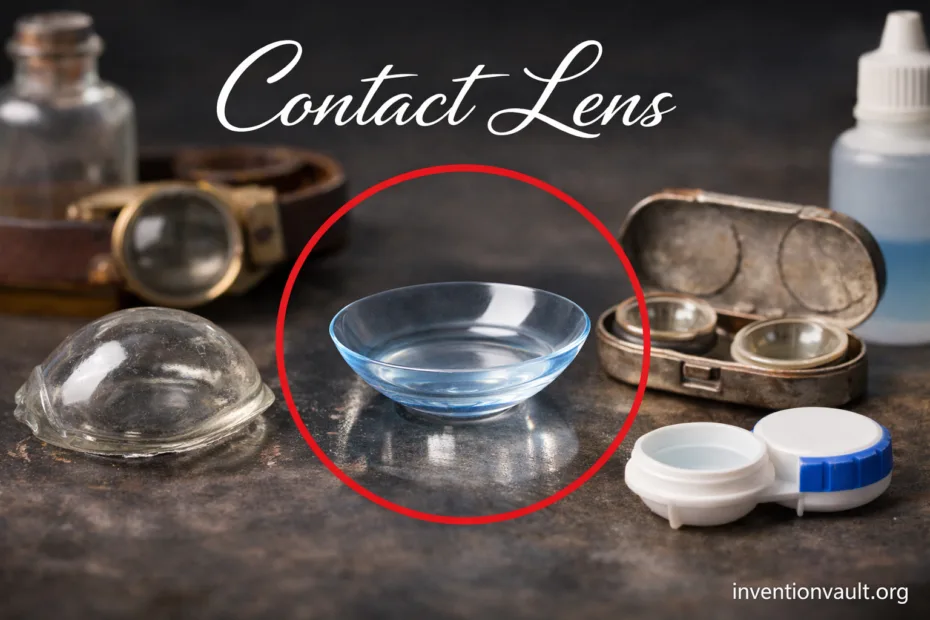
The contact lens did not appear in one clean stroke. It took centuries of optics, glasswork, chemistry, and eye care to turn a thought experiment into a device people could wear with comfort. That is why the question of invention needs a layered answer. Leonardo da Vinci stands at the start of the idea, Adolf Eugen Fick stands near the first successful wearable form, and Otto Wichterle and Drahoslav Lím stand behind the soft lens that brought contact wear into ordinary life.
- Who Invented the Contact Lens?
- From Glass Shell to Wearable Lens
- Why Early Designs Failed
- What Later Breakthroughs Fixed
- How the Lens Changed Shape and Material
- Why Soft Lenses Changed Daily Life
- The Main Lens Families That Grew From the Original Invention
- What Modern Lenses Still Owe to Early Designs
- References Used for This Article
A contact lens became truly usable only when designers solved fit, material, and oxygen flow together.
Who Invented the Contact Lens?
No single person owns the whole invention. If the phrase means the first recorded idea, da Vinci belongs at the beginning. If it means the first lens actually fitted to the eye, late-1880s work linked to Fick and glass maker F. A. Müller sits much closer to the answer. If it means the form that opened contact lenses to broad public use, the clearest credit goes to Wichterle and Lím, whose hydrogel chemistry made the soft lens possible.
- Leonardo da Vinci recorded the optical idea in 1508.
- John Herschel later proposed the corneal mould concept that pointed toward custom fitting.
- Adolf Eugen Fick fitted the first successful glass scleral lens in 1888.
- Joseph Dallos improved fit in the late 1920s by making moulds from living eyes.
- Otto Wichterle and Drahoslav Lím created the hydrogel path that made soft lenses practical for large numbers of wearers.
This shared credit matters because it answers a user question that many short history pages blur: the contact lens was not born as one finished object. It moved from concept to wearable device to comfortable daily product in stages.
From Glass Shell to Wearable Lens
The first workable contact lenses were large glass scleral shells. They covered the exposed front of the eye and sat over a liquid layer. Some were roughly 18 to 21 mm in diameter. They could correct vision, yet they came with obvious limits. They were heavy, they were difficult to fit, and they let wearers keep them in only for short periods. The eye also gets oxygen directly from the air, so full coverage created a basic physiological problem that early designers could not ignore.
That point is easy to miss in simple timelines. The slow progress was not just about inventors waiting for better ideas. It was about waiting for better materials, more precise shaping, better edge design, and a clearer understanding of how the cornea behaves during wear. Once those pieces started to come together, the lens stopped being a fragile optical curiosity and started to behave like a real medical device.
Why Early Designs Failed
- Glass made the lens heavy and awkward.
- Large scleral coverage reduced oxygen access.
- Early fit was crude because the living eye was hard to measure well.
- Edges and surface shape often made blinking uncomfortable.
- Wear time stayed short even when vision improved.
What Later Breakthroughs Fixed
- Eye moulds improved the match between lens and ocular surface.
- Plastic reduced weight and breakage risk.
- Smaller corneal lenses improved everyday wear.
- Hydrogel materials made the lens soft and flexible when wet.
- Gas-permeable and silicone-hydrogel materials addressed the old oxygen problem.
How the Lens Changed Shape and Material
| Period | Lens Type | What Improved | Main Limitation |
|---|---|---|---|
| Late 1880s | Glass Scleral Lens | First successful fitted lens for vision correction; large shell sat over the front of the eye. | Heavy build, short wear, poor oxygen access. |
| 1930s | Glass-Plastic Scleral Lens | Lighter design through the use of plastic in part of the lens. | Still large and still limited for long daily wear. |
| Late 1940s to 1960s | PMMA Corneal Lens | Smaller lens, often around 11.5 mm, sat on the cornea and improved practicality. | PMMA did not pass oxygen well. |
| 1960s to 1970s | Hydrogel Soft Lens | Flexible, water-absorbing lens based on hydrophilic polymer chemistry; comfort rose sharply. | Early soft materials still had oxygen and durability limits. |
| Late 1970s Onward | Rigid Gas Permeable Lens | Sharper rigid optics with better oxygen flow than old hard PMMA lenses. | Adaptation could take longer than with soft lenses. |
| Late 1990s Onward | Silicone Hydrogel Lens | Soft-lens comfort paired with much stronger oxygen transmission. | Fit, hygiene, and replacement schedule still matter. |
Two turning points stand above the rest. The first was the move from a full scleral shell to a smaller corneal lens. The second was the move from hard material to a hydrophilic soft lens. Without the first change, wear stayed awkward. Without the second, contact lenses would probably have remained far more limited in everyday use.
Why Soft Lenses Changed Daily Life
Wichterle and Lím did more than create a new material. They changed the definition of a contact lens. A lens no longer had to be a hard shell that the eye merely tolerated. It could be a soft, water-loving polymer designed to sit gently on the ocular surface. Their work on hydrophilic gels, published in Nature in 1960, opened the path to the soft-lens era and to U.S. market approval in 1971.
The chemistry behind that shift matters. Early hydrogel lens material, often linked to HEMA, could absorb large amounts of water and become flexible in use. That helped comfort, lens handling, and manufacturing. Later designers still had to answer the old oxygen question, which is why rigid gas permeable materials and then silicone hydrogels became so important. The lens kept getting softer and more breathable at the same time.
That long material story explains modern habits. Contact lenses now sit inside ordinary daily life, yet they remain medical devices, not casual accessories. The FDA still classifies their types and approvals with that reality in mind, and the CDC says about 45 million people in the United States wear them. Comfort made contacts popular, but careful design made that popularity possible.
The Main Lens Families That Grew From the Original Invention
- Scleral lenses came first as large shells. They never disappeared completely and still have specialist value today.
- Corneal hard lenses made the lens smaller and more wearable, even though early PMMA versions still restricted oxygen flow.
- Rigid gas permeable lenses kept the optical precision of a rigid design while letting more oxygen reach the cornea.
- Soft hydrogel lenses made everyday adaptation much easier for many wearers.
- Silicone hydrogel lenses pushed soft-lens design further by raising oxygen transmission.
- Specialty branches such as orthokeratology and modern scleral fits show that the contact lens did not settle into one final shape.
That branching history matters because the “contact lens” is not one static object. It is a family of solutions built from the same original aim: place optical correction on the eye itself rather than in front of it. Once material science caught up with that aim, designers could tune lenses for comfort, corneal health, overnight wear patterns, or specialty fitting needs.
What Modern Lenses Still Owe to Early Designs
Present-day contact lenses still depend on the same design rules that shaped the first century of development. A usable lens must match the eye, stay wet, let the cornea breathe, and hold precise optical power without irritating the surface. That is why the old milestones still matter even now.
- Fit: Herschel’s idea and Dallos’s moulds still echo in modern fitting logic.
- Material: The move from glass to polymer changed safety, comfort, and wear time.
- Oxygen: The cornea’s need for air shaped the move away from glass and PMMA alone.
- Purpose: The first goal was vision correction, yet later designs expanded into specialist and medical roles.
The honest history of the contact lens is not a single date with a single name. It is a chain of solutions, each solving one hard problem left behind by the last design. That is what turned a sketch in 1508 into a device worn by millions.
References Used for This Article
- National Library of Medicine — Development of Contact Lenses and Their Worldwide Use: Historical overview of lens materials, adoption, and clinical use.
- The College of Optometrists — The History of Contact Lenses: Museum account of early lens milestones and later material changes.
- Nature — Hydrophilic Gels for Biological Use: Original paper behind the hydrogel soft-lens era.
- U.S. Food and Drug Administration — Types of Contact Lenses: Current regulatory description of the main lens categories.
- Centers for Disease Control and Prevention — About Contact Lenses: Current public-health data on lens wear in the United States.
- Contamac — In Contact, Chapter 1: The History of Contact Lenses: Detailed notes on scleral, corneal, and hydrogel development.