| Field | Details |
|---|---|
| Invention | Automobile (self-propelled road vehicle), evolving from steam and electric experiments to gasoline internal-combustion designs. |
| Often Cited “Birth Certificate” | Patent DRP 37435 (“Vehicle with gas engine operation”), filed January 29, 1886 by Carl (Karl) Benz. |
| Core Idea | Combine a compact engine, steering, braking, and a road-worthy chassis into one controllable vehicle designed for repeatable use. |
| Key People And Teams | Carl Benz (three-wheeled Patent-Motorwagen), Gottlieb Daimler and Wilhelm Maybach (early four-wheeled gasoline car), plus many innovators who advanced batteries, electric motors, and steam propulsion. |
| Foundational Engines | Four-stroke internal-combustion engine (Otto cycle era) enabling higher efficiency and practical vehicle power. |
| Early Propulsion Types |
Steam: self-propelled road vehicles by the late 1700s. Electric: experimental and early practical cars across the 1800s. Gasoline: compact engines and fuel systems enabling lighter vehicles by the mid-to-late 1800s. |
| Enabling Breakthroughs | Pneumatic tyre development and adoption for smoother travel; improved ignition and fuel metering; stronger frames and suspension; practical starting systems. |
| Notable Milestones |
1769: early steam road vehicle demonstrated as animal-free traction. 1876: practical four-stroke engine built (Otto). 1885–1886: Benz Patent-Motorwagen development and patent filing; first public outings reported in 1886. 1886: early four-wheeled gasoline vehicle path (Daimler/Maybach). 1900: electric cars reach strong popularity in cities in some markets. 1913: moving assembly line production becomes a defining manufacturing method for automobiles. |
| Why It Mattered | It reshaped personal mobility, goods movement, and industrial design—while continuously evolving in safety, comfort, and efficiency. |
| Surviving Early Examples | Historic steam and early gasoline vehicles preserved in major museum collections and archives. |
Because “automobile” can mean different things—steam, electric, or gasoline—this topic is best understood as a chain of breakthroughs rather than a single moment.
- What Counts as an Automobile
- Why 1886 Is Often Highlighted
- Foundations Before 1886
- Steam Road Vehicles
- Early Electric Carriages
- From Engine to Automobile
- The Four-Stroke Breakthrough
- Benz and the Patent-Motorwagen
- Daimler and Maybach’s Four-Wheel Path
- Milestones In Early Automotive History
- Key Building Blocks That Made Cars Practical
- Power And Fuel Control
- Comfort And Road Readiness
- A Small Change That Shifted the Market
- Early Automobile Types And Layouts
- From Craft to Industry
- Automobile Legacy in Everyday Life
- References Used for This Article
The automobile was not created by swapping horses for an engine. It emerged when inventors learned how to make a self-propelled, steerable, stoppable machine that could run reliably on real roads, day after day. In that sense, the story is both human and mechanical: bold prototypes, careful engineering, and a steady march of parts that finally worked together.
What Counts as an Automobile
Many pages simplify the question to “who invented the car?” yet the deeper issue is definition. A practical automobile is usually understood as a road vehicle that is self-propelled, can be controlled (steering and braking), and can be operated repeatedly without constant rebuilding. Under that lens, earlier steam and electric vehicles remain part of the automobile’s invention story, even if later gasoline designs became the most widely adopted.
- Self-propelled: the vehicle moves under its own power.
- Road-capable: it can travel on ordinary routes, not just a track.
- Controllable: steering and braking are integral, not improvised.
- Repeatable: it can be operated again and again with routine servicing.
Why 1886 Is Often Highlighted
Many historians point to Patent DRP 37435 as a key marker because it documents a vehicle designed around a gas engine rather than simply attaching a motor to a carriage. This is why 1886 is frequently treated as a formal “starting line” for the modern automobile, even though the broader invention story begins earlier.
Think of the automobile as a system: power, control, structure, and usability had to arrive together.
Foundations Before 1886
Steam Road Vehicles
One of the clearest early steps toward the automobile was the steam road vehicle demonstrated in 1769 by Nicolas-Joseph Cugnot. It proved a crucial idea: a wheeled vehicle could move without animal traction. Even with practical limits, it established a technical direction that later inventors refined.
Early Electric Carriages
Electric vehicles were not a modern surprise. Through the 1800s, improvements in batteries and electric motors enabled increasingly capable electric carriages. By around 1890 in the United States, a successful electric car appeared, and by 1900 electric cars were popular in urban settings in some markets—valued for their quiet operation and ease of use.
| Power Source | Where It Shined | Typical Limits | Lasting Legacy |
|---|---|---|---|
| Steam | Strong torque and proven industrial know-how | Warm-up time, water needs, heavy systems | Early proof of self-propelled road travel |
| Electric | Quiet, smooth city travel; simpler operation | Battery capacity and charging constraints | Returns as a major modern propulsion path |
| Gasoline | Longer range potential with compact fuel | Early starting and control could be demanding | Dominant automotive form through the 20th century |
From Engine to Automobile
The Four-Stroke Breakthrough
A truly workable car needed a more efficient engine than earlier designs could deliver. In 1876, Nikolaus August Otto built a practical four-stroke engine—an advance that helped make internal combustion a realistic alternative for compact, repeatable power. This change mattered because it supported lighter vehicles and steadier operation, essential for road use.
Benz and the Patent-Motorwagen
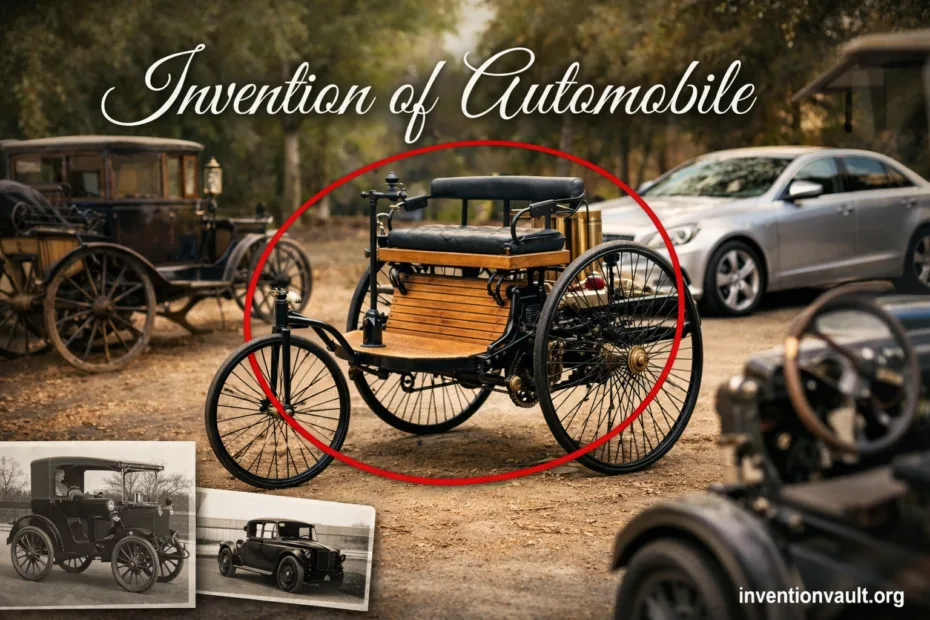
Carl Benz’s breakthrough is often framed as a single invention, yet its strength lay in integration. His vehicle brought together a gasoline engine with a purpose-built chassis and control systems. On January 29, 1886, he applied for the patent widely associated with the automobile’s “birth certificate,” and in 1886 reports followed about public outings of the three-wheeled Patent-Motorwagen.
In August 1888, Bertha Benz and her two sons completed the first long-distance automotive journey in recorded history, demonstrating real-world usability and accelerating public confidence in motor travel.
Daimler and Maybach’s Four-Wheel Path
In the same era, Gottlieb Daimler and Wilhelm Maybach pursued a four-wheeled gasoline vehicle approach. Contemporary summaries often treat this as a footnote, yet it helped broaden what early automobiles could look like—moving beyond three wheels and pushing toward more familiar vehicle proportions.
Milestones In Early Automotive History
- 1769: A steam-powered road vehicle demonstrates self-propelled motion without animal traction.
- 1830s (approx.): early electric carriage concepts appear in Europe, showing another viable propulsion path.
- 1876: the practical four-stroke internal-combustion engine is built, enabling efficient compact power.
- 1885–1886: Benz develops the Patent-Motorwagen and files Patent DRP 37435; public outings are reported in 1886.
- 1886: early four-wheeled gasoline vehicle development gains visibility through Daimler/Maybach work.
- 1888: a landmark long-distance trip proves that the automobile can function beyond short demonstrations.
- Around 1890: successful electric cars appear in the U.S., expanding the “automobile” category beyond gasoline.
- By 1900: electric cars reach significant popularity for city driving in some markets.
- 1908: a mass-market approach to the automobile becomes viable, reshaping accessibility.
- 1913: moving assembly line production becomes a defining method for scaling automobile manufacturing.
Key Building Blocks That Made Cars Practical
Many histories focus on the first car and skip the parts that made cars usable. The automobile matured when a set of technical building blocks became dependable and manufacturable at scale.
Power And Fuel Control
- Efficient cycles: four-stroke operation made smaller engines more capable.
- Fuel metering: early systems evolved toward steadier mixing of fuel and air.
- Ignition reliability: consistent spark timing improved repeatable starts and running.
Comfort And Road Readiness
- Pneumatic tyres: patented and popularized in the late 1880s, they improved ride quality and control on imperfect roads.
- Chassis strength: frames and joints had to handle vibration and uneven surfaces.
- Suspension: basic springing improved stability and reduced mechanical stress.
A Small Change That Shifted the Market
Early gasoline cars could require physical effort to start. When the electric starter arrived in the early 1910s, it removed a major daily friction point and made gasoline cars easier to operate—especially for short, frequent trips. This kind of “invisible” convenience often changes adoption faster than raw horsepower.
Early Automobile Types And Layouts
“Automobile” in the 1800s covered a surprisingly wide range of designs. Understanding these early types clarifies why different inventors can all be part of the invention story without contradiction.
- Three-wheeled automobiles: compact layouts that reduced complexity and weight in early gasoline designs.
- Four-wheeled automobiles: more carriage-like stability and a path toward familiar proportions.
- Steam automobiles: early demonstrations of self-propelled travel, later refined for niche uses.
- Electric automobiles: valued for smooth city operation and simple driving characteristics.
- Gasoline automobiles: increasingly favored as fuel availability and engine systems improved.
From Craft to Industry
The automobile became a world-changing invention when production methods caught up with the machine. By the early 1900s, manufacturers pursued designs that could be built in larger numbers with consistent quality. Mass-market cars helped shift the automobile from a specialized object into a practical household tool, and the moving assembly line (introduced in 1913 for automotive manufacturing in a defining form) became a symbol of that scale-up.
| Phase | What Changed | Why It Mattered |
|---|---|---|
| Prototype Era | Inventors proved self-propelled motion and basic control | Established feasibility and sparked engineering competition |
| Integration Era | Engines, frames, and controls became unified designs | Improved reliability and repeatable operation |
| Manufacturing Era | Interchangeable parts and faster assembly methods spread | Lower cost and wider access to personal mobility |
Automobile Legacy in Everyday Life
The automobile’s influence comes from what it enabled: personal schedules no longer had to match animal endurance, distances felt shorter, and industries reorganized around faster movement of people and goods. The invention also kept evolving—electric propulsion, hybrids, and improved energy storage echo the same early question: how to build a road vehicle that is practical, efficient, and comfortable in daily use.
References Used for This Article
- Library of Congress — Who Invented the Automobile?: A curated institutional overview with key early milestones and definitions.
- UNESCO Memory of the World — Patent DRP 37435 “Vehicle with Gas Engine Operation” (Carl Benz, 1886): Explains the patent’s global significance and its documented date.
- Mercedes-Benz Group — Benz Patent Motor Car: The First Automobile (1885–1886): Details the 1886 patent filing and early public demonstrations, including the 1888 long-distance journey.
- National Motor Museum (UK) — 29th January 1886: The Birth of the Motorcar?: Provides dated notes on the Benz patent timeline and parallel early developments.
- U.S. Department of Energy — The History of the Electric Car: Summarizes 19th-century electric vehicle progress and market dynamics around 1900.
- Musée des Arts et Métiers — Fardier à vapeur: Museum documentation of the 1769 steam road vehicle and its operating concept.
- Science Museum Group — Replica Otto Four-Stroke Engine: Confirms the 1876 four-stroke milestone and its role as a practical alternative to steam.
- German Patent and Trade Mark Office (DPMA) — Dunlop’s Pneumatic Tyre: Explains the late-1880s pneumatic tyre breakthrough and its patenting.
- The Henry Ford — Henry Ford: Assembly Line: Describes the 1913 moving assembly line as a decisive step in scaling automobile production.