| Item | Details |
|---|---|
| Invention Name | Artificial heart valve, also called a prosthetic heart valve |
| Medical Need | To restore one-way blood flow when a native valve becomes narrowed, leaky, or badly damaged |
| Earliest Widely Credited Workable Implant | 1952, Charles A. Hufnagel’s caged-ball prosthesis for severe aortic regurgitation, placed in the descending thoracic aorta rather than in the native valve position |
| First Published Clinical Report | 1954, reporting surgical correction of aortic insufficiency with Hufnagel’s prosthesis |
| First Successful Orthotopic Aortic Valve Replacement | 1960, Dwight Harken and colleagues |
| First Successful Orthotopic Mitral Valve Replacement | 1960, Albert Starr with engineer Lowell Edwards and the Starr-Edwards valve |
| Original Working Principle | A ball-and-cage one-way valve that opened under forward pressure and sealed when flow tried to reverse |
| Early Materials | Plastic chambers, metal cages, silicone or similar poppets, and fabric sewing rings |
| Major Material Turning Points | Pyrolytic carbon for mechanical valve parts; glutaraldehyde-fixed tissue for durable bioprosthetic leaflets |
| Main Branches That Followed | Caged-ball, tilting-disc, bileaflet mechanical valves; porcine and bovine tissue valves; transcatheter valves; polymeric and tissue-engineered designs under study |
| Lasting Engineering Problem | How to combine long life, low clot risk, quiet motion, natural flow, and easy implantation in one device |
Artificial heart valve history does not fit one clean date. It came together in steps. Surgeons first needed a device that could stop backflow at all. Then they needed a valve that could sit in the native valve position. After that, they needed materials that could survive a brutal workload inside the heart. That sequence matters. It shows why the invention of the artificial heart valve was not just a surgical event, but a long engineering answer to a hard biological problem.
- Why Surgeons Needed an Artificial Valve
- The Invention Happened in Stages
- 1952: Hufnagel Opened the Door
- 1960: Native Valve Replacement Became Real
- Late 1960s and 1970s: Materials Changed the Outcome
- How Early Artificial Valves Worked
- Mechanical Designs and Their Subtypes
- Why Materials Changed the Story
- The Mechanical Path
- The Tissue Path
- Main Valve Families That Followed
- Why the Search Did Not End
- Later Directions Built on the Original Idea
- References Used for This Article
Why Surgeons Needed an Artificial Valve
A native valve looks simple on paper. It is not. It must open fully, close at once, and do both over and over without losing shape. In daily life, that means more than 100,000 cycles a day and roughly 30 to 40 million cycles a year. A failed valve can leave the heart pushing against a tight opening, or it can let blood fall backward when it should move forward.
- Maintain forward flow with little resistance
- Seal fast enough to prevent regurgitation
- Survive years of repetitive impact and flexing
- Touch blood without inviting clot formation
- Fit into a small valve ring and be sewn in securely
The artificial heart valve was born in stages: first a workable implanted prosthesis, then true valve replacement in the native position, then materials and designs that made long-term use realistic.
The Invention Happened in Stages
1952: Hufnagel Opened the Door
Charles A. Hufnagel implanted a caged-ball prosthesis in a patient with severe aortic regurgitation. This was a real milestone, but it was not yet the modern form of valve replacement. The device sat in the descending thoracic aorta, downstream from the diseased native valve. It reduced backward flow. It did not remove and replace the valve in its own ring.
1960: Native Valve Replacement Became Real
Once cardiopulmonary bypass made open intracardiac surgery workable, surgeons could move from a helpful bypass trick to orthotopic replacement — replacing the valve in its natural position. Dwight Harken achieved the first successful aortic valve replacement in 1960. That same year, Albert Starr and Lowell Edwards achieved the first successful mitral valve replacement with the Starr-Edwards prosthesis.
Late 1960s and 1970s: Materials Changed the Outcome
Early success proved that prosthetic valves could work. The next step was harder. Designers had to reduce clotting, noise, bulk, and wear. This is where pyrolytic carbon and glutaraldehyde-fixed tissue changed the field. They helped produce lighter, longer-lasting mechanical valves and more practical tissue valves for routine use.
How Early Artificial Valves Worked
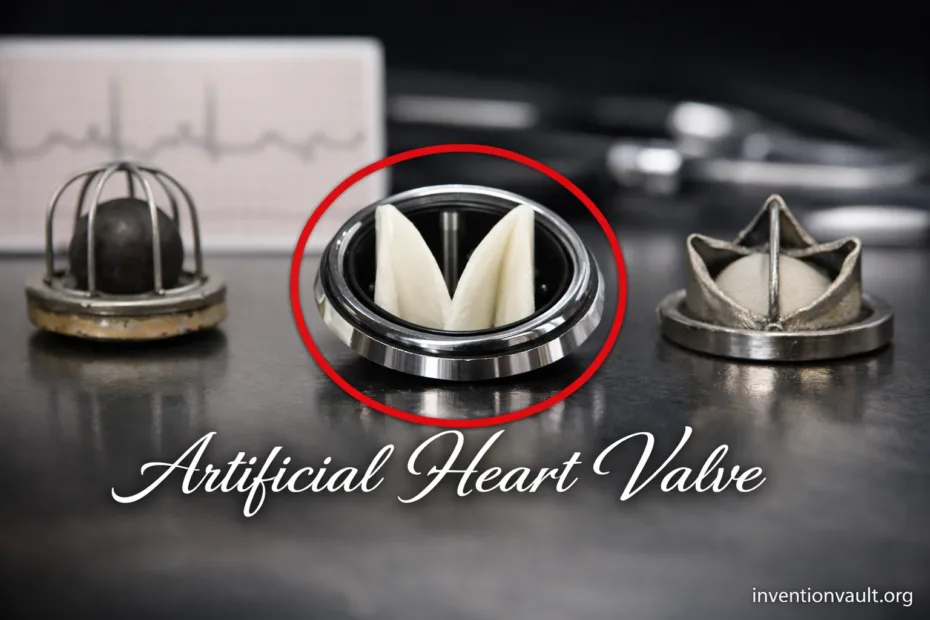
The earliest artificial heart valves borrowed a familiar mechanical idea: a one-way check valve. In a caged-ball design, forward blood pressure lifted a small ball away from the opening. Reverse pressure pushed the ball back into the seat and blocked backflow. It was blunt, but it solved the central problem. Blood could move one way.
That first solution also showed its limits. A ball inside a cage takes up space. It disturbs flow. It can create a high profile inside the heart. It can also raise the device’s tendency to form clots. Those limits drove the next designs. Inventors did not abandon the original idea because it failed. They refined it because it worked enough to reveal what still needed fixing.
Mechanical Designs and Their Subtypes
- Caged-ball valves came first. They proved the concept, but their flow pattern was not very natural and their profile was bulky.
- Tilting-disc valves lowered the profile and improved forward flow by replacing the ball with a disc that opened at an angle.
- Bileaflet valves used two semicircular leaflets. This design improved central flow, reduced bulk, and became the dominant mechanical form.
Modern mechanical valves still carry the same basic promise that made the earliest versions attractive: durability. Many last for decades. The price is familiar too. Because blood meets artificial moving surfaces, patients usually need lifelong anticoagulation. That trade-off has been present since the beginning, even though modern designs handle flow much better than the earliest ball-and-cage prostheses.
Why Materials Changed the Story
The Mechanical Path
Early devices used plastics, metals, silicone components, and fabric sewing rings. Those materials proved the idea, but long-term motion inside the heart punishes every weak spot. Pyrolytic carbon became the major turning point because it offered high wear resistance, good blood compatibility, and the strength needed for leaflet motion and repeated impact.
The Tissue Path
Tissue valves followed a different logic. If a fully artificial surface encourages clotting, why not use shaped biological leaflets instead? The major step here was glutaraldehyde fixation, which helped preserve animal tissue, lowered antigenicity, and made mounted porcine and bovine valves practical. This helped tissue valves enter regular surgical use in the 1970s.
This is one of the most missed parts of the invention story. Valve history is not only a parade of names and years. It is also a history of biomaterials. Without better materials, the procedure would have stayed a heroic experiment instead of becoming standard cardiac surgery.
Main Valve Families That Followed
| Valve Family | Typical Material or Structure | Main Benefit | Main Limitation | Historical Role |
|---|---|---|---|---|
| Caged-Ball Mechanical | Metal or plastic cage with a moving ball | Proved that surgical prosthetic valves could work | Bulky profile, less natural flow, higher clot burden | The first durable proof of concept |
| Tilting-Disc Mechanical | Single disc occluder, later improved with better materials | Lower profile and better forward flow than caged-ball valves | Still created abnormal flow zones and design-specific failure risks | The bridge between first-generation and modern mechanical valves |
| Bileaflet Mechanical | Pyrolytic carbon leaflets with metal or carbon housing | Very long service life and improved flow geometry | Usually requires lifelong anticoagulation | The leading modern mechanical form |
| Bioprosthetic Tissue Valve | Porcine valve or bovine pericardium, usually fixed and mounted on a frame | More natural flow and lower need for lifelong anticoagulation | Leaflet degeneration and calcification over time | The main alternative to mechanical valves since the 1970s |
| Homograft or Autograft | Human donor valve or the patient’s own pulmonary valve in the aortic position | Living or near-living tissue behavior in selected settings | Limited supply or technically demanding surgery | Shows that surgeons kept searching for a more natural replacement |
| Transcatheter Valve | Biological leaflets mounted on a collapsible stent frame | Catheter delivery without standard open valve replacement surgery | Long-term durability is still followed closely, especially in younger patients | Extended the invention into minimally invasive care |
| Emerging Polymeric or Tissue-Engineered Valve | Advanced polymers, scaffolds, or cell-guiding structures | Attempts to combine low clot risk with better durability | Still under study and not the routine standard | The newest chapter in the same design search |
Why the Search Did Not End
The history of the artificial heart valve is also the history of an unsolved trade-off. Mechanical valves last longer, but they ask the patient to live with long-term anticoagulation and the bleeding risk that can follow. Bioprosthetic valves usually offer more natural flow and less need for lifelong blood thinners, but their leaflets can stiffen, calcify, tear, or fail over time.
That is why there has never been a single “final” artificial valve. Surgeons and engineers never chased one device for every patient. They kept adjusting the balance between durability, clot risk, and flow quality. Age, valve position, anatomy, and tolerance for anticoagulation all changed the answer.
One of the strongest lessons from this invention: the best artificial heart valve is not the valve with the longest engineering life alone. It is the valve whose design fits the patient’s physiology and the risks that come with that design.
Later Directions Built on the Original Idea
By the early 21st century, the field moved into another phase. In 2002, the first human transcatheter aortic valve implantation showed that a replacement valve could be folded, delivered by catheter, expanded inside the diseased native valve, and put to work without the classic open replacement route. This did not replace the older invention. It extended it.
Researchers now push further in two directions. One path aims for better polymeric valves that might behave more like tissue valves while lasting longer. The other path explores tissue engineering, decellularized scaffolds, and living constructs that may remodel over time. Those newer efforts make sense only because the original inventors proved three things first: the valve can be replaced, the device can survive inside the heart, and design choices always shape blood flow, clotting, and wear.
That is the lasting value of the invention. It changed fatal valve disease from a problem with almost no direct answer into a field of repeatable surgery, refined device design, and ongoing biological engineering. The first artificial heart valve did more than save early patients. It created a template for how medicine solves mechanical failure inside living tissue — one careful improvement at a time.
References Used for This Article
- OHSU — Dr. Albert Starr, Heart Valve Pioneer: Confirms the 1960 Starr-Edwards milestone and its long clinical reach.
- PubMed — Surgical Correction of Aortic Insufficiency: The original clinical publication tied to Hufnagel’s early prosthetic valve work.
- PubMed — The Caged-Ball Prosthesis 60 Years Later: A Historical Review of a Cardiac Surgery Milestone: Clarifies the 1960 aortic and mitral replacement milestones.
- European Society of Cardiology — Prosthetic Heart Valves: Part 1 – Selection: Supports the history, material classes, and modern valve categories.
- NCBI Bookshelf — Aortic Valve Replacement: Summarizes the path from Hufnagel to Harken and Starr-Edwards in plain clinical terms.
- Frontiers — A Chronological History of Heart Valve Prostheses to Offer Perspectives of Their Limitations: Provides a broad timeline for mechanical, tissue, and transcatheter valve development.
- PubMed Central — Polymeric Prosthetic Heart Valves: A Review of Current Technologies and Future Directions: Supports the discussion of polymeric valves and newer design goals.
- PubMed Central — Degeneration of Bioprosthetic Heart Valves: Update 2020: Supports the tissue-valve section, especially degeneration and calcification limits.