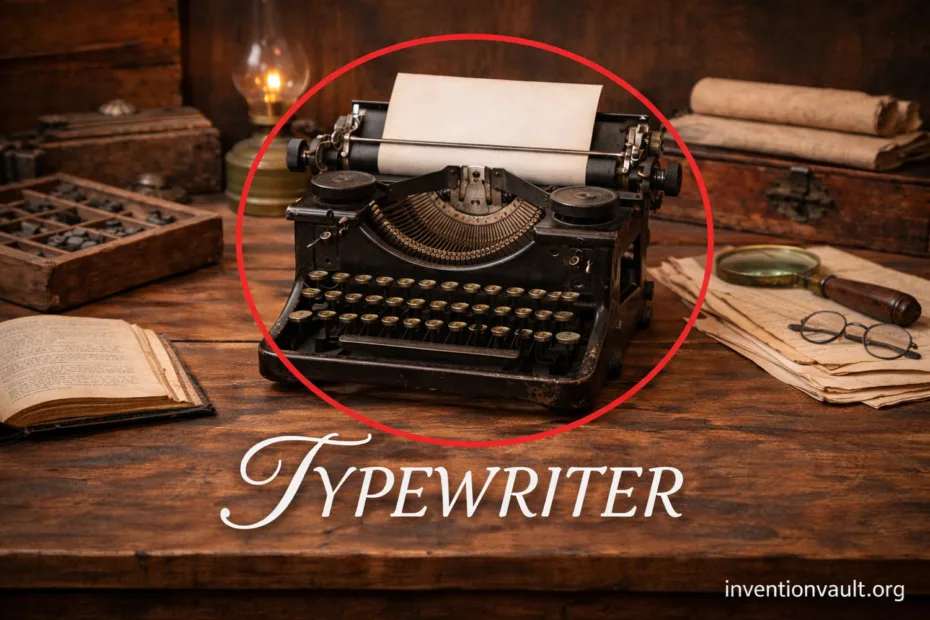
| Detail | Information |
|---|---|
| Invention Name | Typewriter (mechanical and later electric writing machines) |
| Core Purpose | Create uniform, legible text quickly for letters, records, and forms |
| Earliest Known Patent Idea | 1714: Henry Mill patented a concept for impressing letters on paper (details of the machine are unclear) |
| First Proven Working Machine | 1808: Pellegrino Turri built a typing machine for Countess Carolina Fantoni da Fivizzano; surviving typed letters confirm use |
| First Commercially Successful Model | 1874: Sholes & Glidden / Remington No. 1 entered the market (widely credited as the first commercial success) |
| Principal Designer (Commercial Era) | Christopher Latham Sholes (with key collaborators including Samuel W. Soule and Carlos S. Glidden; later development support from James Densmore) |
| What “Standardized” Most | Fixed spacing (monospaced output), repeatable layout, and shared keyboard habits |
| Typical Output Traits | Monospaced characters, consistent line spacing, crisp alignment for tables and forms |
| Common Pitches | Pica (10 characters per inch) and Elite (12 characters per inch), plus less common condensed pitches |
| Major Technology Steps | Manual → Electric → Typeball (Selectric-style) → Electronic → Daisy wheel → computer-era keyboards |
| Long-Lasting Legacy | Everyday keyboard layouts, fixed-width typography in code, and modern document formatting expectations |
The typewriter did more than speed up writing. It made written output look consistent, page after page, no matter who sat at the keys. That steady look helped offices, schools, and publishers agree—often quietly—on what “standard” communication should feel like.
- Why Uniform Text Mattered
- What Became Standard
- What Changed In Daily Work
- How A Typewriter Makes Text
- Fixed Spacing And The “Same-Page” Look
- The Keyboard Habit That Spread Everywhere
- Key Milestones In Typewriter Development
- Typewriter Families And Their Strengths
- Manual Standard And Manual Portable
- Electric Typewriter
- Typeball Systems
- Electronic And Daisy Wheel
- Thermal And Compact Specialty Units
- Standard Pages: Margins, Tabs, And Line Spacing
- Carbon Copies And Repeatable Records
- Typing Skill As A Shared Workplace Language
- Small Standards With Big Impact
- Editing Before Screens
- How Typewriters Shaped Modern Digital Writing
- References Used for This Article
Why Uniform Text Mattered
Handwriting can be beautiful, but it varies. The typewriter delivered repeatable letterforms and spacing, which made reading faster and filing simpler. Once people expected that clean texture of typed text, “professional” started to mean “looks the same on every desk.”
What Became Standard
- Margins and indentation people could recognize at a glance everywhere
- Line spacing that kept pages tidy and easy to scan quickly
- Tab stops for forms and neat columns of numbers without guesswork
What Changed In Daily Work
- Copyable documents became routine with carbon paper stacks
- Legibility improved across teams, even with different writers each day
- Templates for letters and forms spread faster because the output matched
How A Typewriter Makes Text
Most classic machines use a key to drive a mechanism that strikes an inked ribbon against paper, producing a clean character. After each strike, the carriage advances by a fixed step, building even spacing. That simple rhythm—strike, advance, line feed—made pages look predictable in a way handwriting rarely can.
Common Parts You See On Many Machines
Keyboard and linkages translate finger motion into precise strikes every time. The platen (rubber roller) holds paper firm, while the carriage manages horizontal movement line by line.
A ribbon supplies ink, a selector or typebar set chooses characters, and controls like margin stops and tab shape the page layout without drifting.
Fixed Spacing And The “Same-Page” Look
Typewriters popularized fixed pitch, where each character takes the same horizontal space. Two famous pitches became everyday expectations: Pica (10 characters per inch) and Elite (12 characters per inch). With fixed pitch, tables line up cleanly and page estimates feel reliable.
| Measurement | What It Means For Output | Why It Helped Standardization |
|---|---|---|
| Pica (10 cpi) | Wider characters and more air per line visually | Copyfitting and form design became simpler across teams |
| Elite (12 cpi) | More characters per line with a tight texture on paper | More text per page while keeping alignment consistent |
| Tab Stops | Jump the carriage to preset columns instantly | Forms and columns look “official” everywhere without rework |
The Keyboard Habit That Spread Everywhere
The QWERTY layout became common because it worked well with early mechanisms and then became a shared training target. Once schools and offices taught the same key map, switching layouts felt costly, even when alternatives appeared. That path—from machine constraint to human habit—is a big part of why modern devices still echo typewriter logic.
A shared keyboard did something subtle: it let teams assume the same muscle memory and the same page rhythm without negotiating it every time.
Key Milestones In Typewriter Development
- 1714 — Henry Mill patented an early idea for impressing letters onto paper with print-like neatness
- 1808 — Pellegrino Turri built a working typing machine; typed letters survive as evidence
- 1829 — William Austin Burt patented the “Typographer” in the U.S. early office-minded
- 1874 — The Remington No. 1 entered the market and proved commercial success was possible
- 1890s–1900s — “Visible writing” designs spread, shaping the familiar front-strike layout in offices
- 1961 — The IBM Selectric introduced the rotating typeball concept at scale
- 1970s — Daisy wheel printing advanced crisp, letter-quality output with swappable wheels
Typewriter Families And Their Strengths
Not all typewriters feel the same. The main families differ in how they form letters, how fast they repeat strokes, and how easily they change fonts. Seeing these families clearly helps explain why standard layouts and shared formatting rules became so durable.
Manual Standard And Manual Portable
A manual standard (desk-sized) machine is built for steady volume, while a portable aims for mobility. Both rely on purely mechanical force from the typist, which gives that iconic tactile feel and audible cadence. Their output is highly uniform because the spacing mechanism is fixed and dependable.
Electric Typewriter
Electric machines use a motor to drive the strike, so each character lands with similar force. That consistency improved clarity and reduced fatigue, especially when producing forms and repeated lines. Many electric models kept the same page controls—tabs, margins, and line spacing—so office standards stayed stable.
Typeball Systems
The typeball approach (famously used by Selectric-style machines) replaces typebars with a single element that rotates to the chosen character. It reduced mechanical jams and made font changes more practical by swapping the element. That mattered for standardized letterheads and consistent document style inside one office.
Electronic And Daisy Wheel
Electronic typewriters introduced more precise control over spacing and often supported simple memory features. Daisy wheel systems strike a petal-like wheel against the ribbon, producing crisp, print-like letters with easy wheel swaps for different fonts. This era reinforced the idea that typed output should look consistent no matter the operator.
Thermal And Compact Specialty Units
Some later compact units used thermal printing methods instead of impact strikes. These machines aimed for quiet operation and predictable output on special media. Even here, the familiar controls—margins, spacing, and the keyboard grid—kept the user experience aligned with decades of typewriter standards.
| Family | How It Forms Letters | What It Standardized Best |
|---|---|---|
| Manual | Typebars strike ribbon and paper mechanically | Fixed spacing, predictable margins for forms |
| Electric | Motor assists uniform strikes with steady force | Consistency across long sessions at scale |
| Typeball | Rotating element selects characters before striking | Font flexibility with consistent alignment per page |
| Daisy Wheel | Wheel petals strike like a stamp cleanly | Print-like uniformity and easy type changes on demand |
Standard Pages: Margins, Tabs, And Line Spacing
Typewriters turned page design into a set of controls rather than a personal style. Margin stops set consistent left and right edges, while the tab key jumped to preset columns for neat lists. With regular line spacing, even a busy page kept a calm structure that readers learned to trust.
That structure shaped templates long before “templates” became a menu option. A business letter, an invoice-like form, or a classroom assignment could share the same visual grammar: aligned headings, consistent indents, and tidy blocks of text. Over time, the typed page became a reference point for what a “proper document” should look like.
Carbon Copies And Repeatable Records
When carbon paper entered the story, the typewriter gained a powerful role in recordkeeping. One keystroke could create a readable original and one or more matching copies, each with the same line breaks and spacing. That made filing and sharing information more reliable, because different copies did not drift in meaning or layout.
Copies also reinforced the value of standard wording. If a department used the same phrasing and the same placement for names, dates, and amounts, people could scan pages faster and avoid confusion. The machine was not just making text; it was shaping a culture of consistent documentation that felt safe and predictable.
Typing Skill As A Shared Workplace Language
As typing spread, speed and accuracy became a measurable skill with clear benchmarks. The same keyboard layout, the same spacing rules, and the same page controls meant someone trained on one machine could adapt to another with minimal friction. This helped standardize not only output, but also the workflow of how people produced teh written word.
Small Standards With Big Impact
- Carriage return created a universal “end of line” action you could hear
- Backspace and overstrikes shaped practical correction habits on paper
- Monospaced output made columns and counts easier to verify
Editing Before Screens
A typewriter forced clarity. You planned lines, watched spacing, and committed characters to paper with a physical strike. Corrections existed—erasers, correction tapes, and careful retyping—but they encouraged a style of writing that valued precision, structure, and clean layout.
This pressure toward precision helped standard forms and official-looking documents thrive. When a page is difficult to revise casually, writers tend to settle on stable wording and consistent placement for key details. The typed document became a fixed object—easy to copy, easy to file, and easy to compare.
How Typewriters Shaped Modern Digital Writing
Modern computing did not appear from nowhere; it inherited everyday expectations from typewriters. The familiar keyboard rows, the comfort with consistent spacing, and the idea that documents should keep clean margins all carry forward. Even today, fixed-width fonts used in code and terminals echo the monospaced logic of the classic machine.
Digital tools added flexibility, but the “standard page” idea remained. Headings, alignment, and predictable line breaks still matter because readers learned to trust them across decades of typed communication. In a quiet way, the typewriter trained the world to expect writing that looks orderly and stays consistent from one writer to the next.
References Used for This Article
- Library of Congress — “First typewriter” (catalog record) : Institutional catalog entry supporting early typewriter history and verified object documentation.
- Smithsonian Institution — Sholes & Glidden Typewriter (object record) : Museum-grade record authority source for the Sholes & Glidden era and commercial typewriter context.
- Science Museum Group Collection — Typewriter objects (collection search) : Curated museum collection entries covering different typewriter families and design variations.
- National Museums Scotland — History of the typewriter : Structured historical overview of typewriter development and office-era adoption.
- Encyclopaedia Britannica — Typewriter (technology overview) : Editorial reference explaining how typewriters work, their evolution, and major technology shifts.
- ASME Engineering Landmark — Sholes & Glidden “Type Writer” (PDF) : Engineering-history documentation recognizing the Sholes & Glidden machine as a major milestone.
- Xavier University — Typewriter history reference page : University-hosted reference summarizing key early developments and typewriter history.