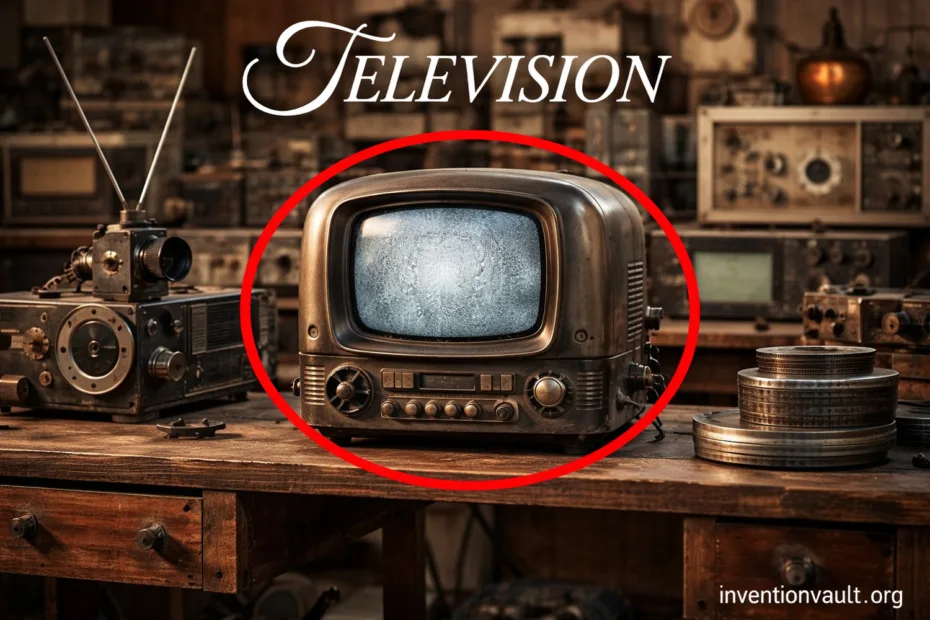
| Detail | Information |
|---|---|
| Invention | Television as a system for sending moving images with sound to a distant screen |
| Core Idea | Convert a scene into an electrical signal, transmit it, then rebuild it as a synchronized image and audio at home |
| Key Principle | Scanning a picture line-by-line, sending brightness (and later color) information with precise timing |
| Early Scanning Breakthrough | Paul Gottlieb Nipkow’s Nipkow disk concept (patent filed in 1884, granted in 1885) enabling mechanical television |
| First Public Live TV Demonstration | John Logie Baird’s live television demonstration on January 26, 1926 in London using an electro-mechanical system |
| First All-Electronic TV Transmission (Often Credited) | Philo T. Farnsworth’s all-electronic transmission on September 7, 1927 using the image dissector |
| First Regular “High-Definition” TV Service (At the Time) | BBC launches a regular high-definition television service on November 2, 1936 from Alexandra Palace (then “high-definition” meant 200+ lines) |
| Early Regular Electronic Broadcasting (U.S.) | RCA/NBC begins regularly scheduled electronic TV broadcasting in April 1939 (public showcase at the New York World’s Fair) |
| Analog Color Milestone | A compatible color television standard is approved in December 1953 (the NTSC color system) |
| Flat-Panel Milestones | Plasma display panel invented in 1964; Sharp demonstrates a 14-inch color TFT LCD in 1988; Sony announces the first OLED TV in October 2007 |
| What Made TV “Home-Friendly” | Stable synchronization, practical cathode-ray tube displays, and broadcast networks built around standards |
A television is not just a screen. It is an end-to-end system that captures a real scene, turns it into a timed signal, sends it across distance, then recreates that scene as light and sound in the living room.
- What Television Actually Does
- The Capture Side
- The Living-Room Side
- From Mechanical Disks To Electronic Scanning
- Why Scanning Matters So Much
- The All-Electronic Breakthrough
- A Short Timeline That Explains The Evolution
- Broadcast Signals and The Need For Standards
- Why Interlacing Was Used
- How Color Television Fit Into Black-and-White
- Inside A Classic Television Set
- Display Technologies: The Main Branches of Modern TV
- From Broadcast Waves To Digital Video
- Television Forms You See Today
- Terms That Make TV Technology Easier
- References Used for This Article
What Television Actually Does
At its core, television performs three jobs: capture, transport, and rebuild. A camera converts changing light into an electrical waveform, the transmitter carries that waveform as a broadcast signal, and the receiver times every step so the screen draws the same pattern in the same order—frame after frame, with synchronization keeping motion believable.
The Capture Side
A TV camera needs scanning: it samples the scene in a strict order so each moment becomes a timed video signal. Early systems did this with spinning disks; later systems used electron beams and camera tubes, making detail and stability far better.
The Living-Room Side
The receiver turns RF into picture and sound, then drives a display so each scan line lands in the right place. When timing is precise, the image looks steady; when timing drifts, you see tearing, jitter, or rolling.
From Mechanical Disks To Electronic Scanning
Television began as a scanning problem. Nipkow’s disk idea—holes arranged in a spiral on a spinning wheel—showed a path to break an image into pieces in time. This mechanical television approach proved the concept, yet it struggled with low resolution, dim pictures, and demanding sync. It was clever, and it was also fragile.
John Logie Baird pushed the mechanical era into public view. His 1926 demonstration proved that live television could be shown to an audience, not only imagined on paper. The important leap was not comfort or image quality; it was showing a working chain: capture, transmission, and display with moving content.
Why Scanning Matters So Much
A TV picture is built from a timed path, not from a single snapshot. Once you accept scanning, you can transmit “brightness over time,” then reconstruct it with a synchronized raster. That single idea underpins analog TV, digital TV, and even streaming video frames today.
The All-Electronic Breakthrough
The turning point came when inventors replaced rotating hardware with electrons. In 1927, Philo T. Farnsworth transmitted an image using an all-electronic pickup tube (the image dissector), demonstrating that scanning and display could be fully electronic. That mattered because electronics scale: more lines, more stability, brighter displays, and far cleaner timing.
Electronic television also leaned on the cathode-ray tube (CRT). A CRT uses an electron gun to draw lines on a phosphor-coated screen. By steering the beam left-to-right and top-to-bottom in a strict rhythm, the set “paints” the picture. With persistence of vision, those lines blend into a stable image that feels continuous.
A simple way to picture a classic scan:

Line 1  →→→→→
Line 2  →→→→→
Line 3  →→→→→
...
(Do this fast enough, and the eye sees a full frame.)
Once electronic scanning matured, broadcasters could run reliable services. In 1936, the BBC launched a regular “high-definition” service from Alexandra Palace—high-definition by the standards of that time, meaning 200+ lines. The bigger story is that regular scheduling requires repeatable engineering: consistent signal levels, dependable synchronization, and equipment that works day after day.
A Short Timeline That Explains The Evolution
| Year | Milestone | Why It Mattered |
|---|---|---|
| 1884–1885 | Nipkow disk patent filed/granted | Introduced practical image scanning as a timed process |
| 1926 | Public live TV demonstration (Baird) | Proved a working chain from scene to screen |
| 1927 | All-electronic transmission (Farnsworth) | Enabled higher detail and stable synchronization |
| 1936 | Regular “high-definition” service begins (BBC) | Made TV a scheduled service, not a lab experiment |
| 1939 | Regular electronic broadcasts expand in the U.S. (RCA/NBC) | Accelerated receiver development and public adoption |
| 1953 | Compatible color TV standard approved (NTSC) | Added color while preserving monochrome compatibility |
| 1964 | Plasma display panel invented | Opened a new path beyond CRT displays |
| 1988 | 14-inch color TFT LCD demonstrated (Sharp) | Showed flat panels could reach meaningful sizes |
| 2007 | OLED TV announced (Sony) | Enabled ultra-thin panels with per-pixel light control |
Broadcast Signals and The Need For Standards
For television to “bring the world home,” every TV set must agree on timing and format. A broadcast carries video, audio, and hidden sync pulses that tell the receiver where each line and frame begins. Without that shared blueprint, the screen cannot lock onto the signal, and motion becomes unstable.
Analog broadcasting historically organized itself into regional systems like NTSC, PAL, and SECAM. Each system defined line counts, frame timing, and how color rides alongside brightness. The goal was the same: predictable compatibility so cameras, transmitters, and receivers behaved as one ecosystem.
Why Interlacing Was Used
Early TV systems often used interlacing: drawing half the lines, then the other half, alternating rapidly. This reduced flicker without demanding an extreme increase in bandwidth. On a CRT, interlacing was a practical compromise between smooth motion and signal limits.
How Color Television Fit Into Black-and-White
Color television succeeded when it respected the installed base of monochrome sets. The compatible approach keeps luminance (brightness detail) as the primary signal and adds color as a separate, carefully placed component. That way, a black-and-white receiver still shows a solid picture, while a color receiver extracts chrominance and produces full color.
In 1953, the NTSC compatible color system was approved, and it became a major blueprint for analog color broadcasting. The long-term impact was cultural and technical: color made television feel more like a window and less like a diagram, while engineers gained a durable method for packing more meaning into the same broadcast channel without breaking compatibility.
Inside A Classic Television Set
A traditional TV receiver is a layered machine: it pulls a weak signal out of the air, cleans it up, separates audio from video, then drives the screen. In a CRT set, the final stage converts the video waveform into beam intensity and steering. In a flat-panel set, the same concept maps the signal into a grid of pixels and backlight or emissive control.
- Tuner: selects a station and converts it to an internal frequency for stable processing (RF to IF)
- Demodulation: recovers the baseband video and audio from the carrier
- Synchronization: extracts timing markers so the display scans in lockstep (line and frame sync)
- Display drive: controls CRT beam position/intensity or pixel voltages for an LCD/OLED panel
- Audio amplifier: powers speakers so dialogue and music match the picture’s timing (sound with lip sync)
Display Technologies: The Main Branches of Modern TV
Display technology changed what “bringing the world to the living room” feels like. CRTs excelled at motion and deep blacks in a dark room. Flat panels made large screens practical and living-room friendly. Today, the common options are variations of LCD (with LED backlights) and OLED, with emerging approaches like microLED aiming to combine brightness and per-pixel control.
| Type | How It Makes Light | Strength | Trade-Off |
|---|---|---|---|
| CRT | Electron beam excites phosphor on glass | Natural motion and flexible scanning | Bulky, heavy, higher power draw |
| Plasma | Cells glow from energized gas; light passes color filters | Good contrast and wide viewing angles | Heat and efficiency limits at large sizes |
| LCD (LED-Backlit) | Backlight shines through liquid-crystal shutters | Bright, thin, widely available | Black levels depend on backlight control |
| OLED | Each pixel emits its own light (self-emissive) | Per-pixel blacks and strong contrast | Needs careful management for long-term uniformity |
| MicroLED | Tiny inorganic LEDs form the picture (self-emissive) | High brightness with per-pixel control | Manufacturing complexity for dense pixel grids |
From Broadcast Waves To Digital Video
Digital television keeps the same promise—moving pictures and sound delivered to homes—yet the method changes. Instead of sending an analog waveform that mirrors brightness directly, digital systems encode video into data, add error protection, and reconstruct the image using decoding. The practical win is that picture quality becomes more stable in the presence of noise, and high-resolution formats become easier to carry.
Modern TVs also act like small computers. They decode compressed formats, manage HDMI inputs, process color and motion, and run apps. Even so, the core idea is unchanged: a timed sequence that the display must rebuild with accuracy. If the timing drifts, the viewer still notices—audio delay, motion judder, or a slightly “off” picture that feels wrong in a way the eye catches fast.
Television Forms You See Today
“Television” can mean the set, the service, or the whole medium. In homes, it usually arrives through several delivery paths, each built around the same fundamentals: encoded video, synchronized decoding, and a display that turns math back into light. The variety is mostly in how the signal travels and how content is packaged.
- Over-the-air broadcast: received by an antenna; designed for wide coverage and predictable decoding
- Cable delivery: carried through coaxial networks with managed bandwidth and channel maps
- Satellite delivery: long-range links feeding a home receiver that outputs decoded video
- Internet streaming: adaptive delivery where the TV or box requests segments and buffers playback
Terms That Make TV Technology Easier
Television vocabulary sounds dense until you connect each term to a simple job. Think of resolution as “how many picture elements,” frame rate as “how often the image updates,” and dynamic range as “how much contrast the set can show at once.” Once those anchors are clear, the rest becomes far less mysterious.
Resolution = how much detail fits on screen (pixels or lines)
Frame Rate = how often a full picture is shown (motion smoothness)
Interlaced/Progressive = how the picture is drawn (timing pattern)
Bitrate (digital) = how much data per second is used (compression detail)
One last perspective helps: TV is a synchronized illusion built from timing. Whether it’s a spinning disk in a workshop, a CRT beam tracing a raster, or a modern OLED panel refreshing pixels, the job is to rebuild the same sequence, in the same order, fast enough that the living room sees the world—steady, coherent, and surprisingly real. That defintion has held up for more than a century.
References Used for This Article
- U.S. National Archives — “The Following Program . . .” (Color Television and the FCC): Explains how the FCC accepted a new compatible color TV standard in December 1953.
- German Patent and Trade Mark Office (DPMA) — Nipkow Disc (“Elektrisches Teleskop”, Patent DE30105): Summarizes Nipkow’s 1884/1885 patent milestone that enabled mechanical image scanning.
- Science Museum Group Collection — Experimental Television Receiver Used by J. L. Baird (1925–1926): Documents Baird’s 26 January 1926 demonstration and the apparatus associated with it.
- Alexandra Palace — BBC at the Palace (Opening Night of Television, 1936): Notes the BBC’s launch of the world’s first high-definition television service on 2 November 1936.
- Lemelson–MIT Program — Philo Farnsworth: Provides an authoritative overview of Farnsworth’s role in developing all-electronic television.
- University of Illinois ECE — Plasma Display: Describes the 1964 invention of the plasma display panel at the University of Illinois.
- Sharp Corporation — 1988–1989: World’s First 14-Inch Color TFT LCD: Details Sharp’s 1988 demonstration of a 14-inch full-color TFT-LCD suitable for TV use.
- Sony Press Release — Sony Launches World’s First OLED TV (XEL-1): Announces Sony’s October 2007 introduction of its first OLED TV product.