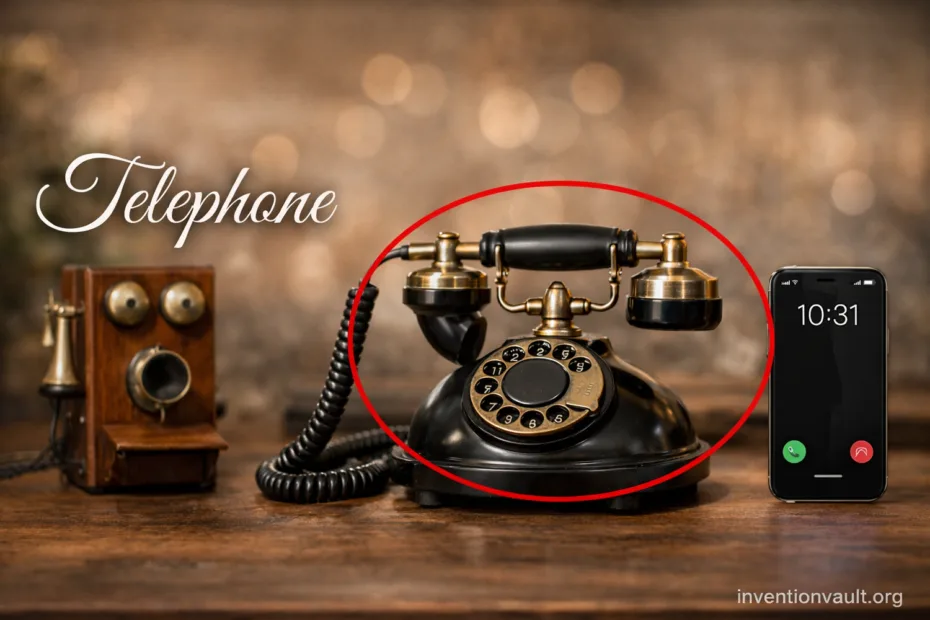
Telephone Details
| Invention | Telephone (electric voice communication at distance) |
| Core Idea | Turn sound into electrical variations, move them through a network, then rebuild the voice at the other end. |
| Widely Credited Inventor | Alexander Graham Bell (credited through the first broad U.S. patent for a telephone system) |
| Key Early Collaborator | Thomas A. Watson (workshop partner in early experiments) |
| Landmark Patent | U.S. Patent 174,465 (granted March 7, 1876) |
| First Clear Spoken Message | March 10, 1876 — a short spoken summons transmitted between rooms (a practical “it works” moment) |
| Early Public Demonstrations | 1876 — demonstrations helped move the telephone from lab curiosity to public attention. |
| First Commercial Telephone Exchange | January 28, 1878 — New Haven storefront exchange; early switchboard connected subscribers. |
| What Made It “New” | Continuous electrical undulations that could follow speech vibrations, not just on/off pulses. |
| Main Building Blocks | Transducers (microphone/receiver), wires or radio links, switching, and signaling. |
| Modern Forms | Landline, cordless, mobile, and VoIP calls carried over data networks. |
The telephone is a simple promise with huge impact: your voice can travel far, stay recognizable, and arrive fast enough to feel like real conversation. Under the surface, it’s a tidy chain of physics, electrical engineering, and network design working together.
- Telephone Details
- What A Telephone Really Does
- Core Parts Of A Classic Telephone
- Voice In
- Voice Out
- How Voice Becomes Electricity
- Two Common Signal Styles
- Milestones That Shaped Telephony
- Switchboards and Networks
- The Local Loop
- Switching
- How A Call Usually Travels Today
- Telephone Types and Subtypes
- Wired Telephones
- Wireless Telephones
- Internet Voice Calls
- Dialing and Control Signals
- Pulse Dialing
- Tone Dialing
- A Small Glossary For Clear Reading
- Design Choices That Improved Calls
- A Practical Way To “Spot” Good Telephony
- Telephone Impact On Everyday Life
- References Used for This Article
What A Telephone Really Does
Any telephone call has three jobs, repeated with care and speed. Each job protects clarity and reduces delay.
- Capture the voice with a microphone.
- Carry the signal through a route (local wires, radio, fiber, or internet paths).
- Rebuild the sound with a receiver (speaker or earpiece).
VOICE (air pressure)
   ↓  (microphone diaphragm)
ELECTRICAL SIGNAL (analog or digital)
   ↓  (switching + routing)
NETWORK PATH (local → long-distance → local)
   ↓  (receiver / speaker)
VOICE AGAIN (air pressure)
This loop is the heart of telephony. Even when the path is modern and digital, the goal stays human: preserve meaning and tone of a voice.
Core Parts Of A Classic Telephone
A traditional landline telephone looks plain, yet its internals are carefully matched. The parts below explain why early designs worked at all, and why later designs sounded cleaner and felt more reliable.
Voice In
- Microphone: turns speech into an electrical signal.
- Housing: shapes sound reaching the mic, helping consistency.
- Local power: supports the circuit for stable transmisson.
Voice Out
- Receiver (earpiece): converts the signal back to sound.
- Ringer: announces incoming calls with a distinct pattern.
- Hybrid circuit: helps separate your speaking from your listening.
How Voice Becomes Electricity
When you speak, air pressure makes a diaphragm move. That motion changes an electrical property—often resistance or magnetic field—creating a signal that follows the shape of your speech. Early telephones proved this could be done well enough that a listener recognized words, not just noise.
Two Common Signal Styles
- Analog voice: the electrical wave resembles the voice waveform, continuously.
- Digital voice: the voice is sampled and encoded as numbers, then decoded at the far end.
Many modern calls still start as analog vibrations at the microphone, then become digital packets for travel, then return to sound at the speaker.
Milestones That Shaped Telephony
The telephone’s story is easy to misunderstand if you only remember one date. It’s more useful to track capability gains: clearer speech, longer distance, and bigger networks that connected more people at once.
| Year / Date | What Changed | Why It Matters |
| March 7, 1876 | Patent 174,465 granted | Helped define a telephone system, not only a single device. |
| March 10, 1876 | First clear spoken message | Showed that speech could travel by wire in a recognizable form. |
| January 28, 1878 | First commercial exchange opens | Switching made many-to-many calling practical, not just one pair of phones. |
| Early 1900s | Growing long-distance networks | Routes became managed services, not improvised connections. |
| January 7, 1927 | Commercial transatlantic telephone service | Voice crossed the ocean through carefully engineered links, expanding global reach. |
| September 25, 1956 | First transatlantic telephone cable era | More stable international calls with higher capacity and predictable quality. |
| 1960s | Touch-tone dialing spreads | Keypads enabled faster dialing and cleaner control signals. |
Switchboards and Networks
A telephone is only half the invention. The other half is the network: rules and equipment that decide where your call goes, and how it gets there with steady audio. Early networks relied on manual switching, then moved toward automated switching, then digital routing.
The Local Loop
The local loop is the physical link from a subscriber’s phone to the nearby exchange. It can be copper pair, fiber in modern builds, or a radio link in wireless systems.
- Short distance to the exchange keeps loss manageable.
- Consistent design supports predictable call quality.
Switching
Switching is the behind-the-scenes decision that connects caller and callee. In classic systems, it built a dedicated path for the duration of the call. In many modern systems, it can carry voice data alongside other traffic.
- Manual switchboards: an operator patched cords to make a connection.
- Automatic exchanges: mechanisms and electronics selected routes faster.
- Digital switching: software-driven control manages calls at scale.
How A Call Usually Travels Today
- Your phone captures voice and creates a signal.
- The system checks the dialed number and applies routing rules.
- Voice may be carried as circuit audio or as packets, depending on the network.
- The far end converts the signal back to sound with minimal delay.
That blend of speed, routing, and audio clarity is why telephone systems feel immediate even across long distance paths.
Telephone Types and Subtypes
The word telephone covers a family of designs. Each subtype keeps the same goal—carry voice—while changing the medium and the control method for dialing and setup.
Wired Telephones
- Early magneto phones: local signaling and simple circuits.
- Rotary-dial landlines: pulse-based dialing; sturdy and familiar.
- Push-button landlines: tone dialing for faster number entry.
Wireless Telephones
- Cordless phones: short-range radio replaces the home handset cord.
- Mobile phones: handsets roam across cells, handing off calls smoothly.
- Satellite phones: specialized devices for remote areas, using space links.
Internet Voice Calls
VoIP (voice over internet protocol) carries voice as data. It can live inside business phone systems, home routers, and everyday calling apps. The key is a codec that compresses speech and keeps latency low.
- Pros: efficient use of bandwidth, easy integration with software tools.
- Focus point: steady network quality protects call clarity.
Dialing and Control Signals
Telephones don’t only carry voice. They also send control information that tells the network what you want: who you’re calling, when you hang up, and which menu option you chose in an automated system.
Pulse Dialing
Rotary dials create a series of electrical interruptions—little pulses—for each digit. It’s mechanically simple, and it shaped the look and feel of classic landline phones.
Tone Dialing
Touch-tone dialing uses paired audio tones to represent digits. It’s quick, readable by machines, and ideal for modern interactive systems. Those tones can share the same path as voice audio, which makes the user experience feel immediate.
A Small Glossary For Clear Reading
These terms appear often in telephone history and modern telecom. Each definition is short on purpose, so the idea stays usable.
PSTN (Public Switched Telephone Network)
The classic global network of exchanges and lines built for voice calls. Many modern services still connect into the PSTN for reach and compatibility.
Exchange (Central Office)
A switching point that connects local lines and routes calls onward. Early exchanges relied on operators; modern exchanges rely on software-controlled switching.
Codec (Voice Coding)
A method to turn speech into compact digital data and back again. Good codecs preserve clarity while keeping bandwidth and delay low.
Latency (Delay)
The time it takes for speech to travel and be heard. Low latency keeps conversation natural and reduces talk-over moments.
Design Choices That Improved Calls
Over decades, telephone engineering focused on a few stubborn problems: volume, noise, and reliability. Improvements often came from practical tweaks rather than flashy breakthroughs.
- Better microphones made soft speech more understandable without strain.
- Cleaner switching reduced clicks, hum, and random dropouts.
- Digital transmission protected calls over long routes, keeping quality steadier.
- Smarter signaling made dialing faster and enabled automated services.
A Practical Way To “Spot” Good Telephony
You can usually recognize a well-designed telephone system by three user-facing traits: stable audio, low delay, and clear behavior when the network is busy. When those traits hold, the tech disappears and the conversation takes over.
Telephone Impact On Everyday Life
The telephone changed daily routines by making voice contact possible without travel. Businesses coordinated faster, families stayed closer, and emergency services gained a direct voice channel when minutes mattered. Even now, with many messaging options, live speech remains the fastest way to share emotion, clarity, and context.
References Used for This Article
- United States Patent and Trademark Office — UNITED STATES PATENT OFFICE (Patent No. 174,465 PDF): This primary document verifies Bell’s landmark patent number and grant date (March 7, 1876) and documents the underlying technical claims.
- Library of Congress — Today in History: March 10 (Alexander Graham Bell): This page summarizes Bell’s March 10, 1876 notebook-recorded experiment and contextualizes the first clearly transmitted spoken message.
- Library of Congress — Alexander Graham Bell Papers: Collection Highlights: This collection highlight points to Bell’s original notebook entry describing the successful March 10, 1876 telephone experiment with Watson.
- Smithsonian National Museum of American History — Alexander Graham Bell Experimental Telephone: This museum record provides object-based documentation for early telephone hardware and Bell’s 1876 demonstrations of experimental telephones.
- U.S. National Park Service — Site of the First Telephone Exchange: This National Historic Landmarks entry confirms the first commercial telephone exchange began operations on January 28, 1878 in New Haven and explains why switching mattered.
- Library of Congress — First Official Transatlantic Telephone Call (January 7, 1927): This National Recording Registry document substantiates the opening of commercial transatlantic telephone service on January 7, 1927 and preserves the historic recording context.
- Science Museum Group Collection — Specimen of the First Transatlantic Telephone Cable, 1956: This museum collection entry documents TAT-1 as the first transatlantic telephone cable system and supports the 1956 cable-era milestone.
- International Telecommunication Union (ITU-T) — Q.23: Technical Features of Push-Button Telephone Sets: This standards reference supports the technical basis for push-button dialing and standardized tone signaling used in touch-tone style telephony.
- International Telecommunication Union (ITU-T) — G.711: Pulse Code Modulation (PCM) of Voice Frequencies: This recommendation documents a foundational speech coding standard widely used in digital telephony and VoIP interconnection.
- NIST Computer Security Resource Center — PSTN Glossary Term: This glossary entry provides an authoritative definition for “PSTN” and helps validate the terminology used for traditional switched telephone networks.