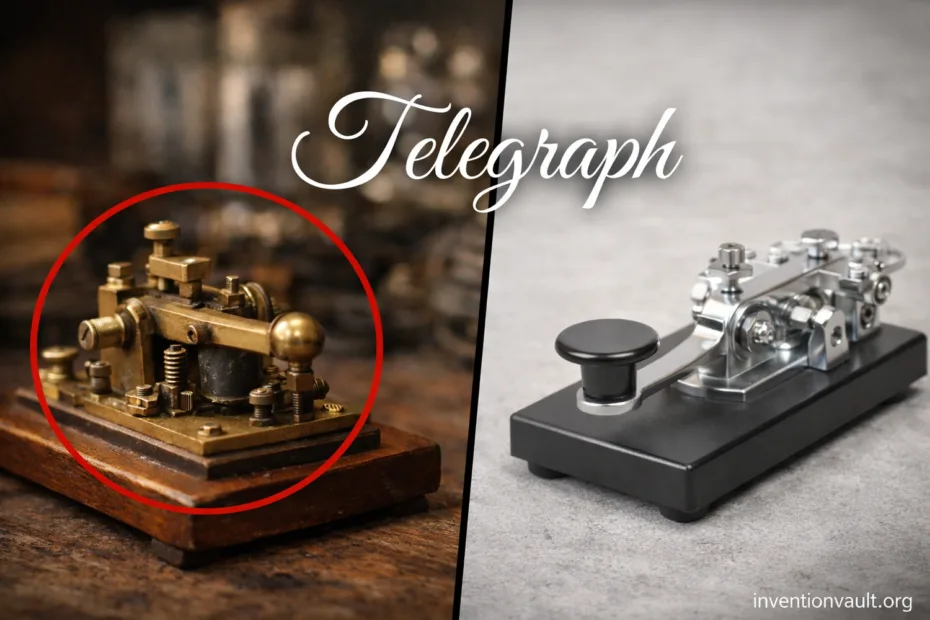
Telegraph Details
| Invention Type | Electrical long-distance messaging using coded signals over conductors |
| Core Idea | Convert a message into signal patterns, move them through a circuit, then convert them back into readable text |
| Early Electric Proof | 1816 — Francis Ronalds demonstrated near-instant signaling over long wires |
| First Practical Commercial Use | Late 1830s — William Fothergill Cooke and Charles Wheatstone telegraphs adopted along British rail lines (notably Great Western Railway) |
| Key U.S. Breakthrough | May 24, 1844 — Samuel F. B. Morse sent “What hath God wrought?” from Washington, D.C. to Baltimore, proving long-distance service |
| Common Encoding | Morse code — short and long pulses (dots and dashes) mapped to letters and numbers |
| Typical System Pieces | Key, battery, wire line, relay, receiver (sounder or register) |
| Scaling Breakthroughs | Relays and repeat stations to keep signals clear; improved insulation for underground and submarine routes |
| Ocean-Crossing Milestones | Aug 16, 1858 — first transatlantic messages (short-lived); July 27, 1866 — durable transatlantic connection established |
| Major Descendants | Printing telegraph, teleprinter, and later digital character codes such as Baudot (patented 1874) |
The telegraph made time feel smaller. A message no longer had to ride inside a bag, on a wagon, or with a person. It could move as a controlled electrical pulse across a wire, reach the far end, and become words again—fast enough to change how people planned, traded, and stayed connected.
- Telegraph Details
- Why the Telegraph Mattered
- How a Telegraph Message Traveled
- Sender Side
- Line Side
- Receiver Side
- Morse Code in Real Use
- Milestones That Shaped Telegraphy
- Hardware You Can Recognize
- Networks, Cables, and Distance
- From Signals to Telegrams
- Types of Telegraph Systems
- How the Telegraph Foreshadowed Instant Messaging
- Common Questions
- Was the Telegraph One Single Invention?
- Did the Telegraph “Send Electricity” or “Send Information”?
- Why Did Operators Matter So Much?
- References Used for This Article
Why the Telegraph Mattered
Before the electric telegraph, the speed of communication matched the speed of transport. With telegraphy, the message arrived while the sender was still at the desk. That shift created a new expectation: information should travel quickly, and decisions should follow just as fast.
- Near-instant transmission over distance, using standardized codes and repeatable signals
- Better coordination for schedules, deliveries, and services through time-sensitive updates in minutes
- A practical model for networked communication: addressing, routing, and handling messages through organized stations and trained operators
How a Telegraph Message Traveled
A classic telegraph system was simple in concept and surprisingly strict in execution. Every message relied on a complete circuit, a stable power source, and a receiver that could turn pulses into sound or marks on paper.
Sender Side
- Press a telegraph key to open and close the circuit in timed patterns
- Use an agreed code (often Morse) so the pattern has meaning
- Keep spacing consistent so letters do not blur into noise
Line Side
- Current travels along a wire, supported by insulators to reduce leakage
- At distance, a relay can “re-build” the signal using a local battery for cleaner pulses
- Operators manage traffic so lines stay ordered and readable
Receiver Side
- An electromagnet reacts to current, moving a lever to make a click or a mark on paper tape
- The operator reads the rhythm as characters, then writes the final message in plain language
- For telegram services, the station prepares a delivery copy for local handoff
Morse Code in Real Use
Morse code looks like dots and dashes on paper, yet the working reality is timing. Operators learn a steady beat. A short press becomes a dot. A longer press becomes a dash. The receiver hears patterns and recognizes letters as familiar sounds rather than counting.
| Timing Element | What the Operator Controls | Why It Matters |
|---|---|---|
| Dot | Short key press | Keeps fast letters efficient and distinct |
| Dash | Longer key press | Adds variety so codes remain unambiguous |
| Intra-letter Space | Brief pause | Stops symbols from merging into one blur |
| Inter-letter Space | Longer pause | Makes decoding reliable at speed and over long lines |
Milestones That Shaped Telegraphy
The telegraph did not appear in one clean moment. It grew from signaling experiments into real infrastructure. Dates matter here because each step solved a different bottleneck—visibility, distance, insulation, or network scale.
| Date | What Happened | Why It Matters |
|---|---|---|
| 1794 | Optical semaphore lines proved that standardized visual codes could move messages quickly between fixed stations | Introduced the idea of a network with repeat points and agreed symbol systems |
| 1816 | Francis Ronalds demonstrated an electric telegraph concept over long wire runs | Showed that electricity could carry signals extremely fast |
| May 1837 | Cooke and Wheatstone patented needle telegraph designs | Created practical instruments suited to real installations |
| July 25, 1837 | Cooke and Wheatstone system demonstrated between Euston and Camden Town in London | Proved a working line-and-instrument setup under field conditions |
| 1838–1839 | Early commercial railway telegraph service on the Great Western Railway route between Paddington and West Drayton | Telegraphy moved from lab curiosities to telegrah operations with trained staff |
| May 24, 1844 | Morse sent the famous Washington–Baltimore message | Accelerated adoption by proving long-distance reliability |
| Aug 16, 1858 | First transatlantic messages sent on an early ocean cable (service was short-lived) | Confirmed the feasibility of continent-to-continent signaling |
| July 27, 1866 | Durable transatlantic telegraph connection established | Made global routing more stable and predictable |
| 1874 | Baudot patented a five-unit telegraph code; Edison introduced quadruplex telegraphy | Improved efficiency and pushed toward machine-driven text handling |
Hardware You Can Recognize
A telegraph set looks modest, yet each part does a strict job. When one component drifts—weak battery, wet insulation, loose connections—the line loses clarity and the receiver hears confusion.
- Telegraph key: the operator’s switch, shaping every pulse
- Battery: steady power so the signal stays consistent over distance
- Line wire: the pathway, protected by insulators to limit leakage
- Relay: an electrically controlled switch that refreshes the message and supports long routes
- Sounder or register: converts pulses into clicks or marks so humans can decode text
Networks, Cables, and Distance
Once a telegraph line leaves a town, the real challenge begins: environment. Weather, moisture, and corrosion all work against signal quality. Over time, engineers refined materials and layouts, especially for underground routes and submarine cables.
| Route Type | What It Needed | Practical Tradeoff |
|---|---|---|
| Overhead Lines | Poles, durable wire, good insulators | Accessible for repair, exposed to weather |
| Underground | Strong insulation, drainage planning | Protected from many hazards, harder to locate faults and replace |
| Submarine | Excellent insulation (notably gutta-percha in later 1800s practice), armoring, careful laying | Enables vast connections, demands high engineering precision and testing |
As cable craft improved, telegraphy gained a new strength: dependable routing across regions that were once communication barriers. The result was a more integrated world of news, commerce, and routine updates in near real time.
From Signals to Telegrams
The public did not “use wires” directly most of the time. People used a service. A telegram system wrapped the raw telegraph into a clear process: write, transmit, verify, and deliver. That service layer is a quiet ancestor of modern messaging workflows and delivery states.
- Message intake: a clerk confirms names and destinations, then prepares the transmission text in standard form
- Encoding: the operator sends the text using code timing and line protocol for clarity
- Reception: the destination station decodes, writes a clean copy, and checks for errors or missing words in context
- Delivery: local distribution completes the final step so the message becomes useful, not just fast
Types of Telegraph Systems
“Telegraph” is a family name. Over the 1800s and into the early 1900s, engineers built multiple styles, each optimized for different constraints—visibility, operator speed, line quality, or automated printing. Seeing the range helps explain how telegraphy slid toward machine text and finally digital messaging.
| Type | How It Signaled | What It Was Good For |
|---|---|---|
| Optical Semaphore | Line-of-sight arms and position codes | Fast fixed-station messaging without wires; depends on visibility |
| Needle Telegraph | Needles deflect via electromagnetism | Readable displays for certain rail and station contexts; early practicality |
| Morse Telegraph | Timed pulses decoded as dots and dashes | Efficient over long lines with skilled operators and sounders |
| Printing Telegraph | Mechanisms print characters | Less dependence on ear training; supports paper records |
| Multiplex Telegraphy | Multiple messages share one line via methods like duplex and quadruplex | Higher capacity without adding wires; an early form of bandwidth efficiency |
| Teleprinter | Keyboard input and printed output using character codes (such as Baudot descendants) | Moves telegraphy toward machine text and later computer-friendly encodings |
How the Telegraph Foreshadowed Instant Messaging
Instant messaging feels modern because the screen is personal and the network is invisible. The telegraph already had the essential logic: encode, transmit, decode. It also introduced the social expectation that a message can be timely and still be short.
- Protocol thinking: agreed rules for signals, spacing, and handling make messages portable across equipment and operators in many places
- Compression habits: people learned to write with purpose; short phrasing became a skill for paid-per-word systems and shaped message culture
- Routing by nodes: stations behaved like relays in a network; each node kept traffic orderly and ensured the right destination got the final text
- Human-in-the-loop delivery: operators acted like today’s servers in one key way—they validated and forwarded; the modern difference is automation at scale
One lesson stands out: when a network makes speed normal, people start expecting responsiveness. That expectation is the real “dawn” behind modern instant messaging.
Common Questions
Was the Telegraph One Single Invention?
No. The telegraph is a chain of improvements—early electric demonstrations, practical instruments, better insulation, smarter codes, and reliable network operations. People often credit one name, yet the working system came from many contributors solving different engineering problems.
Did the Telegraph “Send Electricity” or “Send Information”?
It sent electrical changes that carried information. The meaning lived in the pattern, not the power. A dot, a dash, and a pause are small physical events, yet together they become language when both ends share the same code.
Why Did Operators Matter So Much?
Because telegraphy depended on precision. Operators kept timing clean, detected mistakes, and maintained line discipline. In many systems, a trained ear was the difference between a clean message and gibberish caused by weak signals or line noise.
Today’s messaging apps hide encoding and routing under a button. The telegraph made those layers visible—and that visibility is exactly why it remains such a powerful invention to study. Its core move was simple: turn words into a pattern the world can carry, then turn that pattern back into words, fast, repeatable, and useful.
References Used for This Article
- Library of Congress — “First telegraphic message—24 May 1844” : Primary record of the “What hath God wrought?” transmission, with artifact description and context.
- U.S. Senate — “What Hath God Wrought”: Morse’s Telegraph in the Capitol : Official institutional history page summarizing the May 24, 1844 demonstration and its significance.
- Smithsonian (National Museum of American History) — “What Hath God Wrought” telegraph message : Museum object record tying the famous message to collections and explaining the early paper-tape/marking approach.
- Physics Today (AIP) — “The bicentennial of Francis Ronalds’s electric telegraph” : Scholarly-style overview of Ronalds’s 1816 long-wire signaling demonstration and early technical framing.
- Science Museum Group Collection — Cooke & Wheatstone five-needle telegraph (object record) : Museum catalog entry supporting the Cooke/Wheatstone railway line context (Paddington–West Drayton) and practical deployment.
- London Museum — Four-needle telegraph (object record) : Curated museum description referencing early railway demonstrations and the operational reality of multi-needle instruments.
- The IET (Institution of Engineering and Technology) Archives — The first transatlantic telegraph cable (1858) : Engineering-archive narrative for the 1858 attempt, why it was short-lived, and how it informed later success.
- Encyclopaedia Britannica — Telegraph (technology overview) : High-level, editorially reviewed reference on how telegraph systems worked and how they scaled into networks/services.
- Encyclopaedia Britannica — Morse Code : Reference explanation of Morse timing (dots/dashes and spacing) and how operators decoded signals in real use.