| Detail | Information |
|---|---|
| Invention / Concept | Tabulating as a practical system: turning recorded facts into counted, grouped, and totaled tables using machines and standardized data media. |
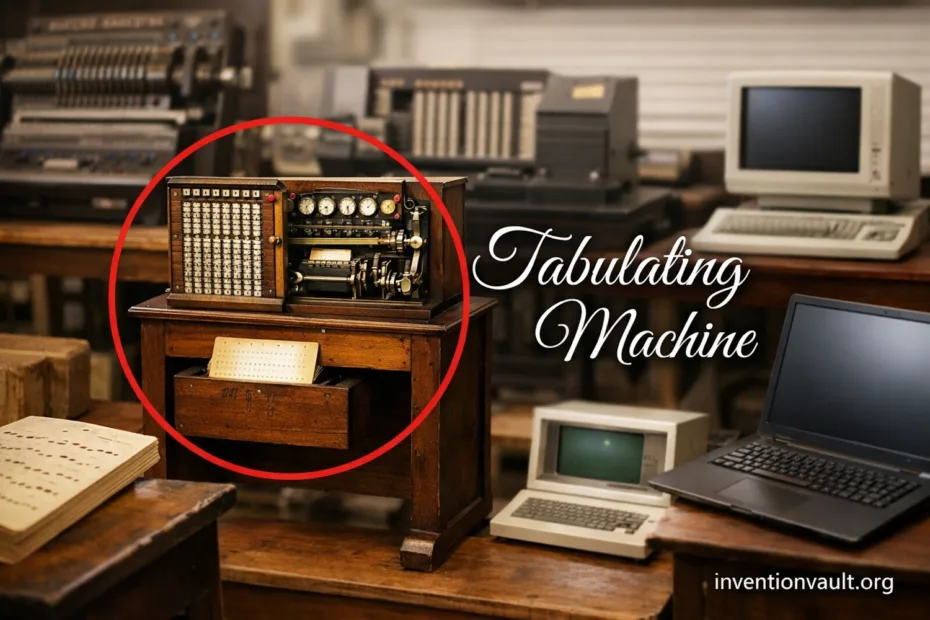
| Breakthrough Device | Electromechanical tabulating machine that reads patterns of holes in cards and drives counters, enabling fast, repeatable summaries. |
| Key Figure | Herman Hollerith, who developed an electric tabulating approach in the late 1880s and proved it at scale for large statistical work. |
| First Major Large-Scale Use | 1890 U.S. Census tabulation work, where Hollerith’s approach won a formal test and then handled nationwide counting and cross-tabulation. |
| Core Medium | Punched cards (early census-era formats varied), later converging toward the well-known 7⅜ × 3¼ inch card family used widely in 20th-century data processing. |
| How Data Was Read | Spring-loaded pins detect holes; where a hole exists, a circuit closes (historically via contacts into conductive cups) and counters advance. |
| System Pieces | Card punching tools, a tabulator (reader + counters), and a sorter so the same card deck can be regrouped and re-tallied many ways. |
| Notable Recognition | Hollerith’s system earned prominent international recognition in 1889, then quickly spread into government and business record work. |
| Business Lineage | Hollerith incorporated the Tabulating Machine Company in 1896; it later joined the Computing-Tabulating-Recording Company in 1911, renamed IBM in 1924. |
| Enduring Legacy | Modern analytics, spreadsheets, databases, and dashboards still mirror the same logic: encode → group → count → total → present. |
Tabulating is the quiet craft behind readable totals. It takes raw facts and turns them into tables you can trust, where each number has a clear place and meaning. When people started recording more data than any ledger could hold, tabulating machines made that jump to scale feel natural, almost inevitable.
- What Tabulating Is
- The Core Moves of Tabulating
- The Breakthrough Machine
- How the Hollerith System Worked
- Card Creation
- Reading and Counting
- Cards and Codes
- Tabulating Equipment Families
- Tabulators
- Support Machines
- Special Card Variants That Extended Tabulating
- Milestones That Shaped Tabulating
- From Tabulators to Modern Data Work
- Where You Still Meet Tabulating Today
- Why Tabulating Endures
- References Used for This Article
What Tabulating Is
Tabulating means arranging information into rows and columns so you can count, compare, and summarize it quickly. The value is not the table itself; it is the discipline behind it—consistent categories, consistent counting, consistent totals.
The Core Moves of Tabulating
- Encode observations into consistent fields (a choice, a number, a category).
- Group records by the same field values, so like-with-like becomes visible.
- Count how many records land in each group, without losing track.
- Total numeric values where addition matters (not just counting presence).
- Present results as clean tables that invite checking and reuse.
The Breakthrough Machine
By the late 1800s, large statistical projects had a bottleneck: human counting could not keep pace with growing records. Herman Hollerith built an electric tabulating approach that changed the workflow. A formal trial comparing methods showed his system completing the same categorization task in 5.5 hours where other approaches took far longer. That performance opened the door to using punched-card tabulation at full national scale.
Why That Test Mattered
It proved that tabulating could be engineered—not just worked harder. Once counting becomes a machine action, you can repeat it, audit it, and scale it without changing the logic each time. It was teh kind of shift that turns a clever method into an industry.
How the Hollerith System Worked
Early punched-card tabulation was not one single box on a desk. It was a system: tools to put data on cards, machines to read the holes, and sorting steps that let the same deck answer many questions. That repeatability is the heart of tabulating.
Card Creation
- Transcribe recorded answers into a standard layout.
- Use punching tools (including guided punching) so holes land in the right positions.
- Keep each card as a single record you can file, reorder, and re-run.
Reading and Counting
- Place a card under a pin grid aligned to known positions.
- Where a hole exists, contact closes and a counter advances.
- Use a sorter to separate cards into groups, then re-tabulate for deeper breakdowns.
| Component | What It Did for Tabulating |
|---|---|
| Punching Tools | Turned written facts into machine-readable positions, keeping categories consistent. |
| Card Reader | Detected holes reliably and triggered counting actions. |
| Counters / Dials | Stored totals so results were visible and could be copied into reports. |
| Sorter | Grouped cards into meaningful stacks, enabling multi-pass analysis. |
Cards and Codes
A tabulator is only as good as its data format. Hollerith-era punched cards used fixed positions to represent choices and values. Early census work used round holes and formats that could vary by project, including cards around 3¼ inches high and about 6⅝ inches wide in some setups. What mattered was not a single universal size; it was repeatable alignment and a stable mapping from meaning to hole position.
Later, industry standardization pushed punched cards toward the familiar 7⅜ × 3¼ inch form. IBM’s widely used 80-column card format (introduced in 1928) used rectangular holes and a regular grid so each column could hold a character. That consistency made tabulating equipment interoperable, which is a big deal when a business needs results every week, not once a decade.
| Format Family | Typical Traits | Why It Helped Tabulating |
|---|---|---|
| Early Hollerith Census-Era Cards | Project-specific layouts; round holes; fixed positions tied to categories. | Fast counting and sorting without rewriting ledgers. |
| IBM 80-Column Card (1928) | Rectangular holes; 80 columns; 12 rows; 7⅜ × 3¼ inches. | Higher density plus standardization across many machines. |
Tabulating Equipment Families
As tabulating spread from statistics into everyday record work, machines diversified into a family often called unit record equipment. Each machine did one job well, and the whole room worked like a pipeline. That modular approach made tabulating feel dependable: you could change the question while keeping the machinery.
Tabulators
- Counting tabulators for totals by category.
- Integrating tabulators that could add numbers encoded on cards, not just count presence.
- Printing tabulators that turned totals into readable lines for reports.
- Alphabetic tabulators that handled letters and labels, not only digits.
Support Machines
- Keypunches to create cards with consistent coding.
- Sorters to split a deck into clean groups for new passes.
- Collators to match or merge decks so related records stay aligned.
- Interpreters to print human-readable text on cards for checking.
- Reproducers to copy or update card decks without re-entering everything.
Special Card Variants That Extended Tabulating
- Mark-sense cards: printed ovals could be marked and then detected, blending manual input with machine reading.
- Aperture cards: a punched-card frame that holds a mounted microfilm image, tying indexing to stored visuals.
- Alternative column formats: different makers used different column counts, each aiming to balance capacity and compatibility.
Milestones That Shaped Tabulating
| Year | What Changed | Why It Matters |
|---|---|---|
| 1889 | Public recognition of Hollerith’s system; key patent era for electronic tabulation. | Validated machine tabulating as a serious solution. |
| 1890 | Large-scale census tabulation using punched cards and electric counting. | Showed tabulating can handle massive volumes consistently. |
| 1896 | Tabulating Machine Company incorporated; integrating tabulation expands beyond counting. | Moves from “how many?” to how much? |
| 1911 | Tabulating business joins a larger consolidation: Computing-Tabulating-Recording Company. | Tabulating becomes a core industry, not a one-off project. |
| 1924 | Company renamed IBM. | Signals a broad identity around business machines. |
| 1928 | 80-column punched card format introduced and widely adopted. | Standardization boosts compatibility and long-term reuse. |
From Tabulators to Modern Data Work
It is easy to treat tabulating machines as museum pieces, yet their logic lives on. A database GROUP BY, a spreadsheet pivot table, and a dashboard “total by category” widget all follow the same tabulating pattern: define fields, group records, compute totals, show them in a compact table. The tools changed; the mental model stayed.
Tabulating also shaped what people expect from data: repeatability, audit-friendly steps, and clear separation between data capture and data summary. That separation matters when the same dataset must answer many questions over time—today it might be operations metrics, tomorrow it might be customer service trends, next month it might be inventory movement.
Where You Still Meet Tabulating Today
- Spreadsheets that summarize thousands of rows into simple totals.
- Dashboards that refresh the same counts and sums each day.
- Retail systems that group transactions by item, store, and time.
- Quality logs that turn individual events into trend tables.
- Research surveys that convert responses into cross-tabulated results.
Why Tabulating Endures
Tabulating lasts because it is humble and powerful. It does not try to “guess” meaning; it makes meaning explicit through fields and categories. It does not depend on a single dramatic calculation; it depends on consistent repetition. That combination—clarity plus repetition—keeps tabulating relevant in every era of information work.
- Clarity: every total links back to defined categories and fields.
- Scalability: more records do not change the logic, only the volume.
- Reusability: the same dataset can be regrouped to answer new questions.
- Checkability: tabulated results can be verified by re-running the same steps.
- Communication: a well-built table delivers signal without noise.
References Used for This Article
- U.S. Census Bureau — The Hollerith Machine: Summarizes how Hollerith’s punched-card tabulator worked and why it mattered for census-scale counting.
- U.S. Census Bureau — About the 1890 Decennial Census: Explains why the 1890 census is historically linked to the first major use of electric tabulation.
- Smithsonian National Museum of American History — Hollerith Tabulating Machine: Documents the core components of Hollerith’s system (punch, tabulator, sorter) as material history.
- Smithsonian Institution — Punch Cards for Data Processing: Describes how punched cards evolved from early census use into broader commercial data processing.
- IBM — The punched card: Provides a concise historical account of IBM’s 1928 card and the shift toward higher-density standardized formats.
- IBM — The punched card tabulator: Notes major recognition and adoption milestones that helped move tabulation from experiment to industry.
- Britannica — Herman Hollerith | Biography, Tabulating Machine, & Facts: Corroborates key biographical facts and the comparative performance test often cited in tabulation history.
- National Archives — “First in the Path of the Firemen”: The Fate of the 1890 Population Census: Confirms the 1890 census as the first to use punchcards with an electrical tabulation system and provides archival framing.