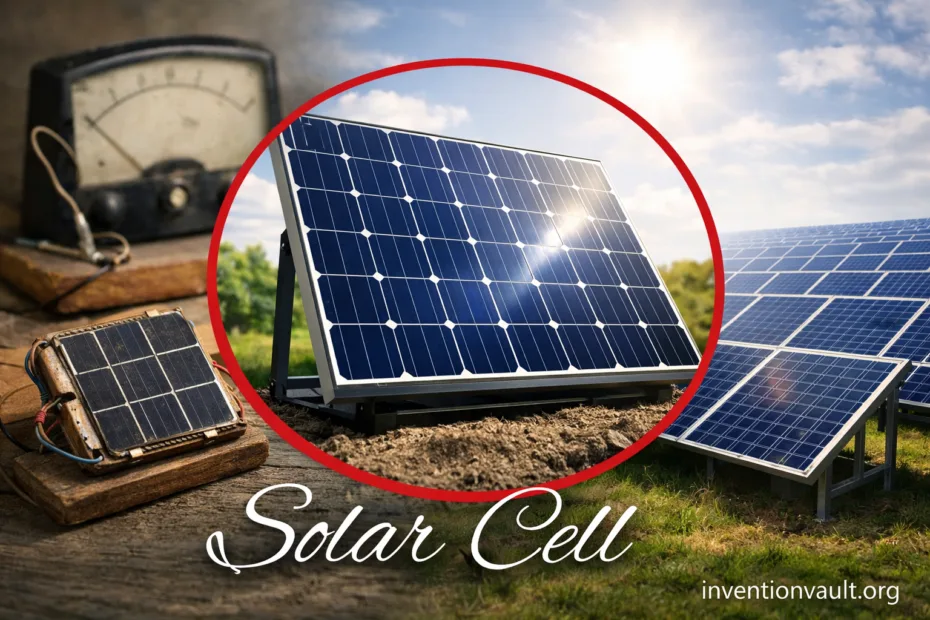
| Item | Details |
|---|---|
| Invention | Solar cell (also called a photovoltaic or PV cell) |
| What It Does | Converts light directly into electricity with no moving parts. |
| Core Physical Effect | Photovoltaic effect: light absorbed in a semiconductor helps free charge carriers that can be guided into an electric current. |
| Earliest Scientific Milestone | 1839: Edmond Becquerel observed the photovoltaic effect. |
| First Described “Solar Cell” Device | 1883: Charles Fritts described solar cells made from selenium wafers. |
| Modern Practical Breakthrough | 1954: Daryl Chapin, Calvin Fuller, and Gerald Pearson developed a practical silicon PV cell at Bell Labs. |
| Early Real-World Proof | 1958: Vanguard 1 flew with solar power in space, showing PV reliability beyond Earth’s surface. |
| Typical Output of One Cell | About 1–2 watts under strong light; cells are combined into modules and arrays for larger power. |
| Dominant Material Today | Crystalline silicon (monocrystalline is the most common in modern mass production). |
| Main Solar Cell Families | Crystalline silicon, thin-film (CdTe, CIGS, amorphous silicon), III–V multi-junction, and emerging (perovskites, organics). |
| Verified Research Efficiencies | Lab records include high-20% for advanced silicon cells and up to 47.6% for concentrated multi-junction cells. |
| Why It Matters | Solar cells scale from tiny electronics to grid systems, offering a quiet, modular way to harvest light energy. |
| Durability Reality | Cells are sealed inside protective stacks (glass and polymers), built for long outdoor exposure and stable performance. |
| End-of-Life Path | PV modules can be recycled, recovering valuable materials; improved processes continue to expand what can be recovered efficiently. |
A solar cell is one of the rare inventions that feels almost like a law of nature turned into hardware: light goes in, electricity comes out. No gears. No flames. No sound. Inside, it is a carefully engineered semiconductor surface that nudges freed electrons into an organized flow you can use.
- What A Solar Cell Is
- How Sunlight Becomes Electric Current
- The Core Parts Inside Most PV Cells
- The Conversion Process, Step By Step
- Key Milestones In Solar Cell History
- Main Types Of Solar Cells
- Crystalline Silicon Cells
- Thin-Film Cells
- Multi-Junction Cells
- Cell Families Compared
- Performance Metrics That Define A Solar Cell
- Where Solar Cells Show Up In Real Life
- Small And Precise
- Built Environment
- Space And Extreme Locations
- Durability, Materials, And End Of Life
- Environmental Footprint In Plain Terms
- Common Misconceptions About Solar Cells
- References Used for This Article
What A Solar Cell Is
In everyday language, people say “solar panel,” but the core invention is the solar cell itself. A panel (often called a module) is many cells wired together and sealed for long outdoor life. An array is multiple modules working as a larger system.
- Solar cell: the electricity-making unit.
- Module: a protected package of interconnected cells.
- Array: multiple modules combined for higher output.
A useful detail: some solar cells can convert artificial light into electricity too, which is why PV shows up in calculators, sensors, and low-power indoor devices.
How Sunlight Becomes Electric Current
Sunlight arrives as photons. When a photon is absorbed inside a semiconductor, it can provide enough energy to free an electron from its usual place. That alone is not “power” yet. The breakthrough is guiding those charges so they move in one preferred direction.
The Core Parts Inside Most PV Cells
- Semiconductor absorber: where light is absorbed and charge carriers form.
- Junction (often a p–n junction): creates an internal electric field that separates charges.
- Front contact grid and rear contact: collect current into a usable circuit.
- Surface coatings: reduce reflection and limit electrical losses at the surface.
The Conversion Process, Step By Step
| Step | What Happens | Why It Matters |
|---|---|---|
| 1 | Photons hit the cell; some reflect, some pass through, many are absorbed. | Only absorbed light can produce useful electrical charge carriers. |
| 2 | Absorbed light frees electrons, creating paired positive “holes.” | Charge carriers exist and can move through the material. |
| 3 | The internal field at the junction separates electrons and holes. | Separation prevents quick recombination and creates a usable voltage. |
| 4 | Contacts collect electrons through an external circuit. | That external flow is the electric current you can use. |
| 5 | Cells are wired together for practical voltage and power. | One cell is small (often around 1–2 W), so scale comes from smart interconnection. |
Solar cells are nonmechanical devices. The “motion” is electronic—charges moving through a circuit.
Key Milestones In Solar Cell History
The solar cell did not appear fully formed. It grew from materials science, careful measurement, and relentless refinement in efficiency and reliability.
| Year | Milestone | Why It Stands Out |
|---|---|---|
| 1839 | Edmond Becquerel observed the photovoltaic effect. | First clear signal that light can directly create electricity in a material. |
| 1883 | Charles Fritts described selenium-wafer solar cells. | An early “solar cell” design, even though efficiency was limited at the time. |
| 1905 | Albert Einstein published work on the photoelectric effect. | Strengthened the scientific understanding of light and electrons. |
| 1954 | Chapin, Fuller, and Pearson built a practical silicon PV cell at Bell Labs. | Marked the start of modern photovoltaic technology capable of powering everyday equipment. |
| 1958 | Vanguard 1 flew as the first solar-powered satellite. | Space proved PV’s reliability when maintenance is impossible. |
| 1970s | Major cost reductions enabled wider real-world use. | PV began moving from special applications toward broad deployment. |
| Today | Commercial silicon modules commonly exceed 24% efficiency; lab records reach 47.6% under concentration. | Shows how far device physics and manufacturing discipline can push the same core effect. |
Main Types Of Solar Cells
“Solar cell” is a family name. Different materials and architectures aim for different strengths: ruggedness, weight, flexibility, efficiency, or performance under unusual lighting.
Crystalline Silicon Cells
Monocrystalline and multicrystalline silicon dominate modern PV. Newer silicon cell designs focus on reducing losses at surfaces and contacts, helping modules reach very high practical efficiencies.
Thin-Film Cells
Thin-film technologies such as CdTe and CIGS use very thin absorber layers. They can be lighter than wafer silicon and can perform well in certain real-world conditions.
Multi-Junction Cells
High-end cells stack multiple semiconductor layers so each captures a different slice of sunlight. Under concentrated light, verified lab results reach 47.6% efficiency.
Cell Families Compared
| Family | What It Is Known For | Where You Often See It | Notes |
|---|---|---|---|
| Crystalline silicon | High reliability, strong manufacturing base, excellent module performance. | Rooftops, ground-mounted arrays, building-integrated systems. | Commercial modules commonly exceed 24% efficiency in modern top-tier products. |
| CdTe thin-film | Thin absorber layer, competitive module efficiency growth over time. | Utility-scale projects, large-area installations. | Module efficiencies have climbed toward 20% in commercial products. |
| CIGS thin-film | High thin-film lab efficiencies; adaptable manufacturing approaches. | Specialty modules, some flexible and lightweight formats. | Verified lab records exceed 23% for CIGS cells. |
| III–V multi-junction | Top-tier efficiency, especially with optical concentration. | Spacecraft power, concentrator PV systems. | Lab concentration records reach 47.6%. |
| Perovskite (emerging) | Rapidly improving lab performance; strong promise for tandems. | Research prototypes; early-stage commercialization efforts. | Verified lab records are in the mid-to-high 20% range for single-junction perovskites. |
| Organic / dye-based (emerging) | Potential for lightweight, flexible, low-light applications. | Sensors, specialty and indoor PV research areas. | Performance and lifetime trade-offs are active research topics. |
Performance Metrics That Define A Solar Cell
Solar cells are often discussed with one headline number—efficiency—but performance is a package of measurable behaviors. Understanding the language makes specifications feel straightforward instead of mysterious.
| Metric | What It Means | Why It Matters |
|---|---|---|
| Efficiency | How much incoming light energy becomes electrical power. | Higher efficiency means more power from the same area. |
| Power | Electrical output under a defined illumination condition. | One cell is typically small (1–2 W), so modules scale output by combining many cells. |
| Voltage and current | The electrical “push” and the flow of charge. | Cells are wired in series to raise voltage and in parallel to raise current. |
| Fill factor | A measure of how “square” the current–voltage curve is. | Strong fill factor signals low internal losses and better real output. |
| Temperature behavior | Output shifts as the cell warms or cools. | Real systems are designed around predictable changes in the field. |
Where Solar Cells Show Up In Real Life
The solar cell’s strength is modularity. The same physics can power a pocket device or support large electrical systems, simply by changing scale and packaging.
Small And Precise
- Calculators and low-power electronics
- Sensors for lighting, motion, and environmental monitoring
- Remote instruments where changing batteries is difficult
Built Environment
- Rooftop systems on homes and commercial buildings
- Building-integrated PV on facades and architectural surfaces
- Carports and shaded outdoor structures that also generate power
Space And Extreme Locations
- Satellites, where solar cells offer dependable long-term power
- Remote relay stations and research sites
- Specialty systems designed for weight limits and harsh environments
Durability, Materials, And End Of Life
A solar cell is delicate on its own. Real-world PV succeeds because the cell is protected by a layered package that resists weather and mechanical stress while letting light through. This is why modules are typically glass-and-polymer sandwiches built for stability.
Environmental Footprint In Plain Terms
- Energy payback can be about a year in strong-sun locations and modestly longer in less-sunny regions, depending on technology and supply chains.
- Modules can be recycled, recovering valuable materials; ongoing improvements aim to make recovery deeper and more cost-effective.
- Modern manufacturing uses rigorous quality control to keep outdoor operation stable and safe.
Common Misconceptions About Solar Cells
- “A solar cell stores electricity.” A cell generates electricity; storage is a separate component such as a battery.
- “Solar cells need heat.” They need light; performance is tied to illumination and device design, not warmth.
- “One cell can power large devices.” One cell is typically around 1–2 W; useful power comes from combining many cells in a module.
- “All solar cells are the same.” Silicon, thin-film, and multi-junction cells target different trade-offs in efficiency, weight, and use case.
References Used for This Article
- U.S. Department of Energy — The History of Solar (PDF): A detailed milestone timeline covering early PV discoveries and the 1954 silicon breakthrough.
- U.S. Energy Information Administration — Photovoltaics and Electricity: A clear explanation of how PV cells convert photons into electrical current and how cells scale into panels.
- U.S. Department of Energy — Solar Photovoltaic Technology Basics: A practical overview of PV cells, modules, and typical power per cell.
- Smithsonian National Museum of American History — Experimental Silicon Solar Cell: Museum record documenting early silicon PV development and key Bell Labs contributors.
- NASA — Vanguard Satellite, 1958: Official NASA description of Vanguard 1 as the first solar-powered satellite and its launch date.
- Fraunhofer ISE — Photovoltaics Report (PDF): A concise, regularly updated summary of verified efficiency records, module trends, and energy payback figures.