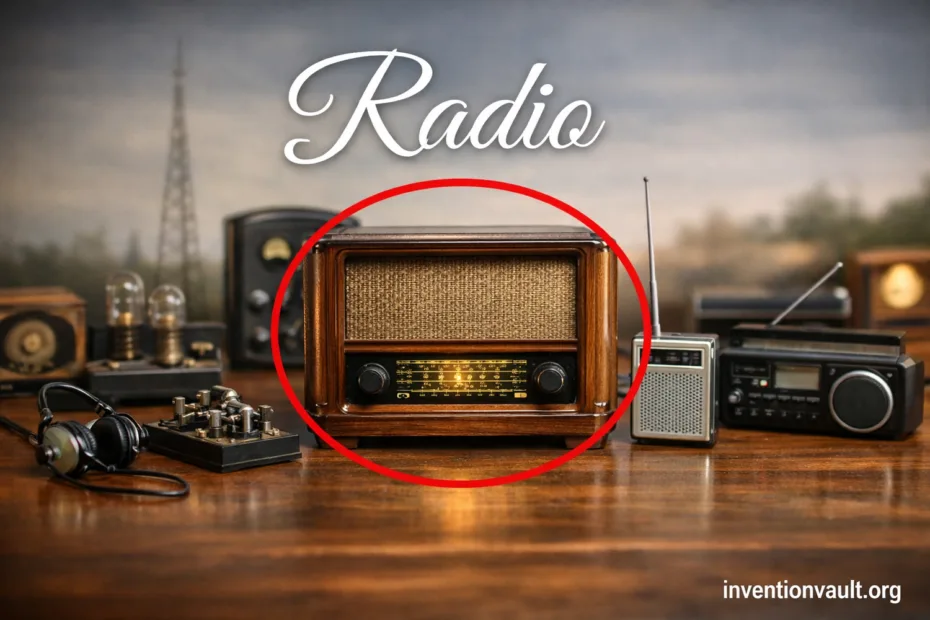
| Detail | Verified Information |
|---|---|
| Invention Name | Radio as wireless audio broadcasting (sound sent through radio waves to many listeners at once) |
| Core Breakthrough | Turning sound into an electrical signal, then encoding it onto a carrier wave using modulation |
| How It’s “Invented” | Radio did not arrive as one single moment. It grew through physics, engineering, and broadcast practice over decades |
| Scientific Foundation | Electromagnetic wave theory formulated by James Clerk Maxwell (1864–1865) |
| First Lab Proof Of Radio Waves | Heinrich Hertz demonstrates electromagnetic waves in experiments (1887–1888) |
| Early Practical Wireless Signaling | Guglielmo Marconi files an early system patent for wireless telegraphy (June 2, 1896) using Hertzian waves |
| First Speech By Radio | Reginald A. Fessenden transmits intelligible speech over radio waves (December 23, 1900) |
| First Long-Distance Audio Program | Fessenden broadcasts a music and voice program heard over long distances (December 24, 1906) |
| Key Enabling Device | Audion vacuum tube by Lee de Forest (first version 1906; later improved), enabling stronger amplification |
| Major Audio Quality Leap | Wideband FM by Edwin H. Armstrong (patented 1933), reducing static and improving clarity |
| Broadcast Forms Today | AM, FM, shortwave, digital terrestrial (such as DAB+), and satellite radio |
Radio is the practical art of sending sound through electromagnetic waves so a simple receiver can turn it back into audio. It feels ordinary now, yet the idea is bold: one transmitter can reach countless listeners, each with a tiny device and an antenna.
- What Wireless Audio Broadcasting Means
- How Radio Carries Sound
- Milestones That Shaped Radio
- AM and FM Broadcasting
- AM
- FM
- Broadcast Bands and Propagation
- Transmitters and Receivers
- Inside A Transmitter
- Inside A Receiver
- Digital Radio and Hybrid Systems
- What Changes With Digital
- Radio Types You Still Meet Today
- Why Radio Stays Useful
- Common Questions and Clear Answers
- Is Radio The Same As “Wireless”
- Why Do Stations Use Different Frequencies
- Does A Radio Need The Internet
- References Used for This Article
What Wireless Audio Broadcasting Means
Broadcasting means one transmitter sends a single signal that many receivers can tune in to, at the same time. The signal rides on a carrier frequency, and your radio selects that frequency, then extracts the audio content.
- One-to-many delivery: one station, many listeners, one airwave
- Tuning replaces addressing: you choose a frequency, not a specific device, to hear the program
- Works with simple hardware: an antenna, a tuner, a demodulator, and an audio stage
How Radio Carries Sound
| Stage | What Happens | Why It Matters |
|---|---|---|
| Audio Capture | Microphones (or studio sources) create a baseband electrical signal | Sound becomes a controllable signal that can be processed |
| Carrier Creation | An oscillator generates a steady radio-frequency carrier | The carrier is the “vehicle” that travels efficiently through space |
| Modulation | Audio changes the carrier using AM or FM (or digital methods) | This step encodes meaning onto the wave, not just energy |
| Power Amplification | The signal is boosted so an antenna can radiate it strongly | Determines practical coverage and reliability |
| Propagation | Waves travel by ground, line-of-sight, or ionospheric reflection | Explains why some bands travel far and others stay local |
| Reception | A tuner selects one station; a detector extracts the audio | Your device ignores most signals and focuses on one program |
| Playback | An amplifier drives a speaker or headphones with sound | The invisible wave becomes a familiar voice and music |
A radio broadcast is one message turned into physics, then back into sound inside your room.
Milestones That Shaped Radio
- 1864–1865: Maxwell links electricity and magnetism, predicting waves that move like light
- 1887–1888: Hertz generates and detects radio waves in the lab, proving the theory works in reality
- 1896: Marconi formalizes early wireless signaling with a patent filing, accelerating practical systems
- 1900: Fessenden sends speech over radio waves, showing audio can ride on a carrier
- 1906: Fessenden airs a long-distance music and voice program; listening becomes a new kind of experience
- 1906–1908: De Forest develops the Audion, pushing reception and amplification forward with electronics
- 1920: A scheduled broadcast from station KDKA helps define modern broadcast routines and regular programming
- 1933: Armstrong patents wideband FM, opening the door to clearer audio fidelity
AM and FM Broadcasting
AM
Amplitude Modulation varies the strength of the carrier to match the audio waveform. It can travel well at lower frequencies, especially as groundwave or nighttime skywave.
- Pros: good reach, simpler receivers, resilient for speech
- Tradeoff: more sensitive to static and electrical noise
FM
Frequency Modulation varies the carrier’s frequency with the audio. This design rejects many kinds of noise, so music and speech can sound clean and stable.
- Pros: better clarity, strong for music, less static
- Tradeoff: mostly line-of-sight coverage at typical FM bands
Broadcast Bands and Propagation
Frequency shapes everything: antenna size, coverage style, and how easily a signal bends or reflects. Lower bands can follow the ground or reflect from the upper atmosphere, while higher bands tend to travel in straighter, line-of-sight paths.
| Band | Typical Broadcasting Use | Propagation Style |
|---|---|---|
| MF (AM) | AM broadcast services for wide-area listening | Groundwave by day, skywave often at night |
| HF (Shortwave) | Long-distance international and specialty broadcasts | Ionospheric reflection for very long hops |
| VHF (FM) | High-quality local/regional audio broadcasting | Line-of-sight, aided by height and terrain |
Transmitters and Receivers
Inside A Transmitter
- Audio processing for consistent loudness and clean tone
- Modulator that applies AM, FM, or digital encoding
- Power amplifier that drives the antenna without distortion
- Antenna matching so energy becomes radiated waves, not wasted heat
Inside A Receiver
- Tuner that selects one station from many
- RF front end that rejects strong nearby signals and improves selectivity
- Demodulator that recovers the audio from the carrier
- Audio amplifier that drives a speaker; every reciever depends on this stage for real volume
Digital Radio and Hybrid Systems
Digital broadcasting converts audio into data, then sends it using robust signaling and error correction. The goal is simple: stable sound and efficient spectrum use. Many regions use DAB+, while some systems combine analog and digital in the same channel.
What Changes With Digital
- Audio becomes bits, then travels with error correction for cleaner playback
- More metadata can ride with the sound (program name, track info) without harming coverage
- Reception feels different: it is often “solid” until it drops, instead of gradually getting noisier like analog
Radio Types You Still Meet Today
- AM broadcast radio for wide coverage and strong speech intelligibility in many settings
- FM broadcast radio for higher fidelity music and clearer local listening
- Shortwave broadcasting for long-distance signals using ionospheric reflection
- DAB+ and other digital terrestrial systems for efficient channel use and stable sound
- Satellite radio for broad-area service where a clear view of the sky supports reception
Why Radio Stays Useful
Radio is a rare technology that scales beautifully: a single transmitter can serve huge audiences with modest power per listener. It is also hardware-light—a small receiver, a simple antenna, and you are set. Even in a world full of screens, audio remains the easiest companion for work, travel, and daily routines.
Common Questions and Clear Answers
Is Radio The Same As “Wireless”
Radio uses wireless electromagnetic waves, but “wireless” is the larger family that also includes modern data links. Broadcasting focuses on one-to-many delivery of audio (and sometimes data), usually without pairing devices.
Why Do Stations Use Different Frequencies
Two signals on the same frequency would collide, so each broadcaster is assigned a distinct channel. The frequency also sets how the wave travels and what antenna sizes are practical, shaping coverage and sound quality.
Does A Radio Need The Internet
Traditional radio does not. A classic receiver can tune a broadcast signal directly through the air. Some modern devices combine broadcast tuners with streaming, but the core idea of wireless audio stands on its own.
References Used for This Article
- Smithsonian Institution — Radio History: Provides an authoritative historical overview of radio development and broadcasting milestones.
- Federal Communications Commission — Radio Broadcasting: Explains how radio broadcasting works, spectrum allocation, and regulatory foundations.
- IEEE Engineering and Technology History Wiki — Radio: Details the engineering principles and key inventors behind radio technology.
- The Royal Society — Maxwell’s Equations (1865): Documents the theoretical foundation of electromagnetic waves essential to radio.
- Encyclopaedia Britannica — Radio Technology: Summarizes radio principles, modulation methods, and historical evolution.
- International Telecommunication Union — History of Radio: Covers global coordination, standards, and international development of radio services.
- NASA — What Are Radio Waves?: Explains radio waves within the electromagnetic spectrum using clear scientific descriptions.