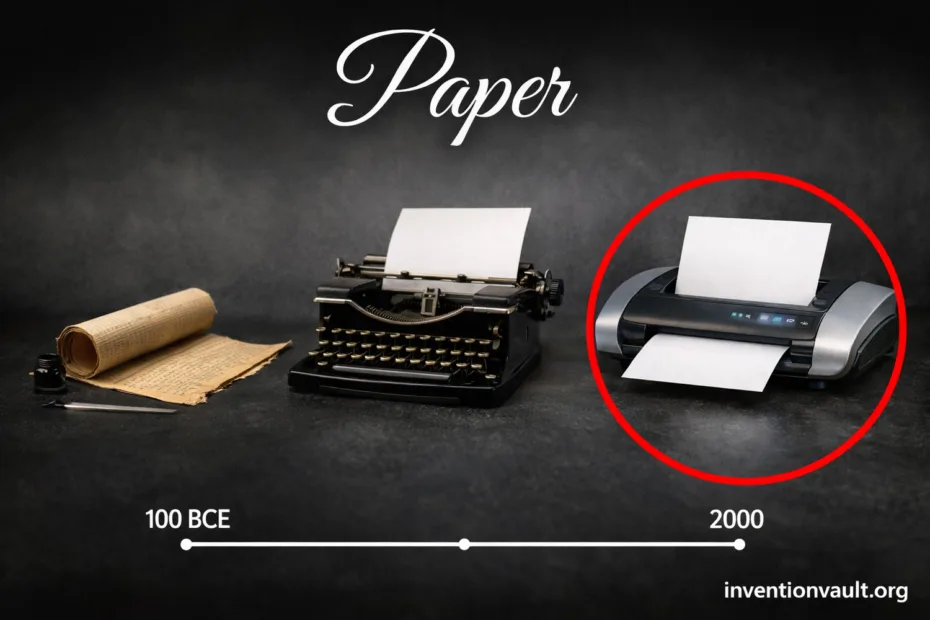
Paper Details
| What It Is | A sheet made from interlocked plant-based fibers (mostly cellulose) that bond as water drains and the web dries. |
| Traditional Credit | Cai Lun, an official in the Eastern Han court, is traditionally credited with presenting an improved process around 105 CE. |
| Early Inputs | Tree bark (often described as mulberry), hemp waste, old rags, and fishnets—macerated into a watery pulp. |
| Core Breakthrough | Turning a thin fiber slurry into a uniform sheet using a screen mold, then pressing and drying for strength. |
| Before Paper | Bamboo or wooden slips, silk, papyrus, and parchment each solved one problem while creating another (cost, weight, scarcity, or surface limits). |
| Early European Milling | Xàtiva (Spain) is often cited with a mill recorded in 1151; Fabriano (Italy) became a major quality center by 1276. |
| Machine Era | 1798: Nicolas-Louis Robert builds a moving-screen concept; 1807: improved engineering makes the Fourdrinier approach practical for continuous sheets. |
| Wood-Based Expansion | 1840s: groundwood pulp becomes viable through wood-grinding innovations; wood replaces scarce rag fiber for many everyday grades. |
| Recycling Milestone | 1690: a mill associated with the Rittenhouse family uses recycled linen rags in Germantown—an early sign of fiber re-use. |
| Why It Matters | Paper became a low-cost memory surface that is portable, stackable, and friendly to ink, shaping education, commerce, art, and record-keeping. |
Paper is easy to overlook because it feels ordinary. Yet this thin sheet of fibers became a portable stage for ideas—contracts, poems, maps, lessons, and letters—moving knowledge from one mind to many without losing its shape.
- Paper Details
- What Paper Is Made Of
- The Fiber Network
- More Than Fibers
- How Paper Is Made
- Milestones That Changed Paper
- Paper Families And Subtypes
- Coated, Tissue, And Specialty Grades
- Paper And Printing: A Perfect Match
- Paper Properties That Actually Matter
- Why Paper Can Feel “Smooth” Or “Toothy”
- Keeping Paper Durable Over Time
- What Preserves A Sheet
- Paper In A Circular World
- References Used for This Article
What Paper Is Made Of
The Fiber Network
At the center of paper is cellulose, a natural polymer that forms long, flexible fibers in plants. When fibers tangle and dry, hydrogen bonding helps them cling into a stable sheet with a surprising mix of strength and foldability.
- Hardwood fibers are often shorter and help create a smoother surface and better formation.
- Softwood fibers are often longer and boost tear resistance and tensile strength.
- Cotton or linen rag fibers can be very durable, valued for archival and fine-art papers.
More Than Fibers
Most papers also include carefully chosen additives to control feel and performance. Sizing helps resist feathering; fillers can improve opacity and brightness; coatings can create a very smooth printing face.
| Sizing | Controls absorbency so ink stays crisp and lines remain sharp. |
| Fillers | Improve opacity and surface; common examples include mineral fillers. |
| Coatings | Create a smooth, controlled surface for high-detail printing and rich color. |
How Paper Is Made
Paper-making is a controlled dance between water and fiber. The goal is consistent: create an even web, remove water gently, and lock the sheet’s structure as it dries, all while shaping surface and strength.
Step 1: Pulp Preparation
Fibers are separated into a workable slurry called pulp. Depending on the grade, makers choose rag, mechanical pulp, or chemical pulp, then refine it to tune how fibers bond and how the sheet forms.
Step 2: Sheet Formation
The dilute slurry flows onto a moving screen (the modern relative of the mold). Water drains, fibers interlock, and a wet web appears. Evenness here decides later qualities like smoothness and print clarity.
Step 3: Pressing And Drying
Pressing removes water and tightens contact between fibers for stronger bonding. Drying completes the transformation: as moisture leaves, the network sets, and the sheet gains stiffness while keeping flexibility.
Step 4: Finishing
Finishing can include calendering (smoothing with rollers), surface sizing, or coatings for specialty needs. This is where paper becomes clearly “for printing,” “for packaging,” or “for art,” rather than just a sheet.
A quiet engineering truth: paper’s power comes from structure more than thickness—tiny fibers, placed well, can hold ink, pressure, and time.
Milestones That Changed Paper
| Period | What Happened | Why It Mattered |
|---|---|---|
| 105 CE | Cai Lun presents an improved method using bark, hemp waste, rags, and fishnets. | Sets a practical recipe for reliable writing paper that is more affordable than silk. |
| 1151 | A recorded mill at Xàtiva (Spain). | Signals paper’s firm footing in the Mediterranean as a scalable craft. |
| 1276 | Fabriano (Italy) rises as a quality center. | Refines methods that support durability, watermarking, and consistent grades. |
| 1798–1807 | Robert’s moving-screen idea matures into practical Fourdrinier engineering. | Makes continuous paper possible, changing cost and volume. |
| 1840s | Groundwood pulp becomes viable through wood-grinding innovation. | Expands supply for everyday grades, moving beyond limited rag fiber. |
| Late 1800s | Kraft (sulfate) pulping develops, enabling strong packaging papers. | Boosts strength for bags, cartons, and industrial uses. |
Paper Families And Subtypes
Not all paper behaves the same. Small shifts in fiber, processing, and surface treatment create families with distinct feel, strength, and aging. Knowing the families makes paper’s “mystery” feel practical.
Rag Paper
Rag paper is built from cotton or linen fibers, often prized for longevity and a pleasant hand feel. It is common in fine stationery, conservation work, and certain art papers.
- Strength and fold endurance can be excellent.
- Often chosen where aging behavior matters.
Groundwood Paper
Groundwood (mechanical) papers keep more of the wood’s original components, which supports high yield and low cost. Many mass-circulation and short-life products have relied on this efficient pulp route.
It can feel nice and printable, but it may not be the best choice for documents meant to last for decades, even when stored carefully.
Chemical Pulp Papers
Chemical pulping removes much of the non-fiber material, producing stronger, cleaner fibers for printing and many grades of writing paper. This family underpins a wide range, from office sheets to premium book stocks.
- Good balance of strength and surface control.
- Often compatible with archival manufacturing targets.
Kraft Paper
Kraft paper is known for strength. It can be left brown or made lighter, and it shines in bags, wraps, and boxes where tear resistance matters.
When you feel a sturdy shopping bag, you’re meeting a fiber network tuned for toughness, not just looks.
Coated, Tissue, And Specialty Grades
| Type | What Makes It Different | Typical Uses |
|---|---|---|
| Coated Paper | Added coating for a very smooth surface and controlled ink holdout. | Magazines, catalogs, art prints, packaging where color needs to look rich. |
| Tissue Paper | Engineered for softness, bulk, and absorbency with lightweight fiber webs. | Hygiene, cleaning, protective wrapping with a gentle touch. |
| Filter Paper | Designed with controlled porosity and wet strength. | Coffee/tea, lab filtration, processes that need reliable flow. |
| Thermal Paper | Uses a heat-reactive coating so images appear without liquid ink. | Receipts and labels where fast, quiet printing is useful. |
| Archival Paper | Manufactured to resist rapid degradation; often acid-free with an alkaline reserve. | Books, documents, art storage where long life is the point. |
Paper And Printing: A Perfect Match
Paper did not change the world alone. It became unstoppable when it met repeatable printing. A sheet that could be made in volume was also a sheet that could carry standardized text, clean diagrams, and consistent pages, enabling scalable learning.
- Ink compatibility mattered: paper surfaces could be tuned to hold ink without smearing.
- Uniform thickness helped presses apply even pressure for clean impressions.
- Stackability made books practical: paper sheets store, ship, and bind with ease.
Even today, paper remains the quiet partner of many technologies. It can hold precise marks made by pens, printers, and plotters, and it still supports tasks that benefit from a tactile, distraction-free surface—teh kind you can fold, pin, or annotate in seconds.
Paper Properties That Actually Matter
If you’ve ever wondered why one sheet feels “right” and another feels wrong, you are noticing measurable traits. Paper is engineered around structure, surface, and stability.
| Grammage | Sheet mass per area; shapes perceived heft and stiffness. |
| Opacity | Resistance to show-through; helps double-sided reading feel clean. |
| Sizing | Controls absorbency so lines stay crisp and colors don’t bleed. |
| Grain Direction | Fiber alignment influences how paper folds, curls, and tears. |
Why Paper Can Feel “Smooth” Or “Toothy”
Smoothness often comes from calendering and coatings that flatten surface peaks. A toothy surface leaves more micro-texture, which can improve pencil control and certain dry media effects.
- Smooth: sharp text, clean linework, glossy color reproduction.
- Toothy: expressive sketching, watercolor control, richer tactile feedback.
Keeping Paper Durable Over Time
Paper can outlast generations when its chemistry and storage match the job. Modern permanence-focused papers are often acid-free and buffered, which supports slower aging for books and documents that should remain readable and flexible.
What Preserves A Sheet
- Stable environment: moderate humidity and temperature reduce stress on fibers.
- Gentle handling: creases break fibers; repeated folds can weaken edges.
- Clean storage: inert folders and boxes help prevent unwanted chemical contact.
Paper In A Circular World
Paper is one of the most naturally circular everyday materials because fibers can be recovered and reformed into new sheets. Recycling is not new—records point to rag-based re-use in the 1600s and a notable 1690 recycling-linked milestone in Germantown—yet modern systems made it routine at scale.
There is a practical limit: each recycling loop shortens fibers, so mills blend recovered fiber with fresh pulp to keep strength. That balance—reuse plus reinforcement—explains why you can have recycled content while still getting reliable performance.
Paper is not just “made.” It is tuned: fiber, water, and finishing choices decide whether a sheet becomes a soft tissue, a crisp book page, or a tough kraft wrap.
References Used for This Article
- Library of Congress — The Deterioration and Preservation of Paper: Some Essential Facts: A concise overview of why paper ages and how fiber sources and pulping methods affect longevity.
- Encyclopaedia Britannica — Cai Lun: Summarizes the traditional attribution of papermaking improvements to Cai Lun around 105 CE.
- Robert C. Williams Museum of Papermaking (Georgia Tech) — The Advent of the Paper Machine: Explains the continuous-sheet concept tied to Nicolas-Louis Robert and the early machine era.
- Fabriano Paper and Watermark Museum — Home Page: Provides institutional coverage of Fabriano’s papermaking heritage and watermark tradition.
- Robert C. Williams Museum of Papermaking (Georgia Tech) — Watermarks: Describes watermarking methods and their relationship to machine-made paper production.
- UNESCO Intangible Cultural Heritage — Washi, craftsmanship of traditional Japanese hand-made paper: Documents hand papermaking techniques and fiber preparation using paper mulberry.
- International Organization for Standardization (ISO) — ISO 9706:2025 (Paper for documents — Requirements for permanence): Defines permanence requirements that underpin “archival” and long-life paper specifications.
- National Information Standards Organization (NISO) — ANSI/NISO Z39.48-1992 (R2009): Permanence of Paper: Details technical criteria used by libraries and archives for durable paper in publications and records.