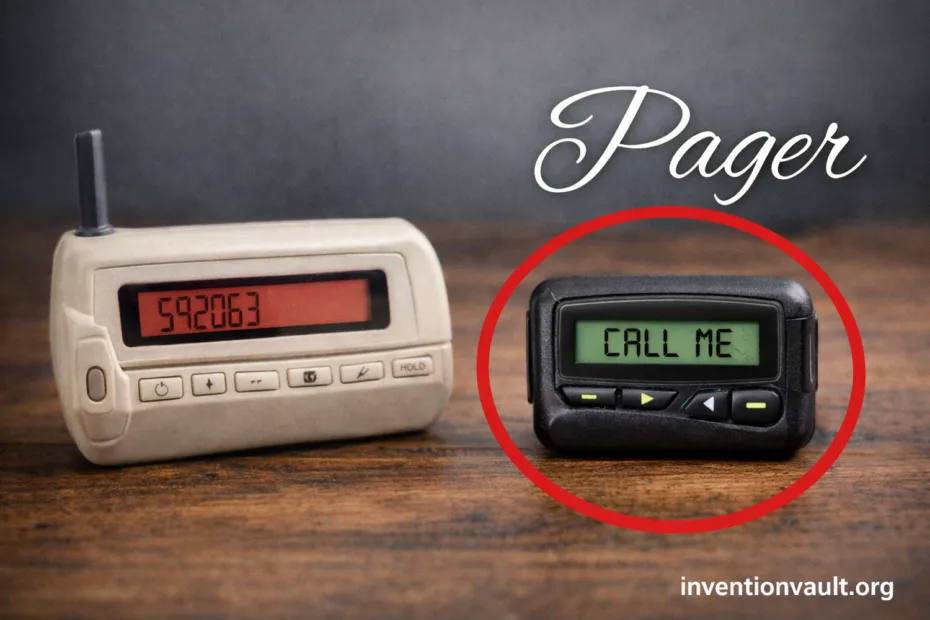
| Invention | Pager (personal radio paging receiver) |
| Core Idea | Deliver short alerts and messages on the go using a radio network |
| Early Paging Roots | Pager-like radio dispatch traces back to 1921 (Detroit Police Department) |
| Telephone Pager Milestone | Irving “Al” Gross built and patented a telephone pager concept in 1949 |
| Early Medical Use | Designed with doctors in mind; early hospital adoption followed soon after |
| Consumer Breakthrough | Motorola Pageboy I (introduced 1964) is widely cited as the first successful consumer pager |
| Typical Message Styles | Tone-only, numeric, alphanumeric, and two-way variants |
| How One Device Gets “Your” Message | Network broadcasts widely, but uses selective addressing so only the right pager ID alerts |
| Major Digital Paging Code | POCSAG (CCIR Recommendation 584 accepted in Feb 1981) |
| High-Speed Paging Era | FLEX was announced by Motorola in June 1993 |
| Why It Matters | High alert reliability, excellent battery life, and strong building penetration in many deployments |
A pager is a small receiver built for one job: getting a clear alert and a short message when you are away from a desk. It looks simple, yet the engineering behind selective paging is surprisingly elegant—and it shaped how people expected mobile communication to feel.
- Pager Basics
- What A Pager Typically Delivers
- How A Pager Receives A Message
- Sender Side
- Network Side
- Pager Side
- From Dispatch To Pocket Pagers
- Pager Types and Variations
- Inside The Paging Signal
- Key Building Blocks
- Major Paging Standards
- Why Pagers Stayed Valuable
- Battery Discipline
- Alert Clarity
- Pager Messages as a Design Language
- Common Message Patterns
- What This Invention Changed
- References Used for This Article
Pager Basics
A pager is not a phone, and it is not a walkie-talkie. It is closer to a personal alarm with a message channel. Most classic pagers are one-way: the network sends, the device receives. That one-direction design is a feature, not a limitation, because it supports simple hardware and long battery life.
What A Pager Typically Delivers
- Alert first: beep, vibration, or both
- Identity second: a targeted address so the right device reacts
- Message third: numbers, text, or a coded instruction (depends on model)
How A Pager Receives A Message
The paging experience feels instant, but the network is doing careful work. A sender triggers a paging terminal, the system encodes an address plus a short payload, and base stations broadcast it. The pager listens for its own pager ID, then alerts. This is teh small trick: wide broadcast with selective response.
Sender Side
A message may start from a phone, a dispatch console, or software. In many workflows the “message” is intentionally short: call back, room number, or a task cue.
Network Side
The system schedules transmissions so many subscribers can share one channel. It repeats key parts and uses error checking so short messages arrive cleanly under real-world radio noise.
Pager Side
The pager is a receiver with strict power discipline. Many designs “wake up” on a timed rhythm, check for their address, then sleep again—one reason pager batteries can last so long.
From Dispatch To Pocket Pagers
| Period | What Changed | Why It Mattered |
|---|---|---|
| 1921 | Early pager-like radio dispatch work appears in police service | Mobility becomes practical: message reaches people in motion |
| 1949 | Telephone pager concept patented by Al Gross | Selective signaling aimed at professionals who must be reachable |
| 1964 | Motorola Pageboy I popularizes portable tone-only paging | Personal devices move from niche to broader use |
| 1981 | POCSAG accepted as CCIR Radio Paging Code No. 1 | Digital paging scales to more users and better battery performance |
| 1993 | FLEX announced for higher-speed paging | More text, better throughput, improved network efficiency |
| 1990s | ERMES in Europe; two-way families emerge | Standardization and expanded message capabilities |
Pager Types and Variations
“Pager” is one label for several device styles. The differences are not cosmetic; they change what the network can deliver and how a user reacts. A tone pager pushes action through sound patterns. A text pager pushes action through clear words.
| Type | What You See or Hear | Typical Message Meaning | Common Settings |
|---|---|---|---|
| Tone-Only Pager | Beeps or tones; no display | Pre-agreed cue: call in, go to a station, check a phone | On-call staff, internal teams |
| Numeric Pager | Digits only | A callback number or a short numeric code | Service desks, facility operations |
| Alphanumeric Pager | Text on a small screen | Short instruction: location, request, status | Hospitals, dispatch, maintenance |
| Two-Way Pager | Text plus basic reply ability | Request-and-response in limited bandwidth | Field coordination where short replies help |
| “Restaurant” Coaster Pager | Light or vibration at a table | Queue notification; simple alert | Hospitality waiting systems |
Inside The Paging Signal
Radio paging succeeds because it treats the airwaves like a shared bulletin board, then uses addresses to keep it personal. Each transmission carries a destination identity and a compact message. Your pager stays quiet unless it recognizes its own identity. That is why paging can reach many receivers without making every device “busy.”
Key Building Blocks
- Selective Addressing: only the right pager reacts to the broadcast
- Framing and Timing: devices can sleep between checks, saving power
- Error Control: small messages arrive readable even in noisy radio conditions
- Service Coverage: base stations are positioned for wide-area reach and indoor reception
Major Paging Standards
Paging grew faster once digital codes matured. A well-known milestone is POCSAG, accepted as a CCIR paging code in February 1981. Later, Motorola announced FLEX in June 1993 to support higher throughput. Europe also pursued harmonization with ERMES, developed by ETSI in 1990.
| Standard | Direction | Design Goal | Notable Detail |
|---|---|---|---|
| POCSAG | Mostly one-way | Scalable digital paging with good receiver efficiency | Adopted as CCIR Radio Paging Code No. 1 (Rec. 584) |
| FLEX | one-way | Higher speed paging and improved throughput | Announced by Motorola in June 1993 |
| ReFLEX | two-way family | Short replies plus paging-like reliability | Built on FLEX concepts with return capability |
| ERMES | Mostly one-way | Pan-European standardization for paging | ETSI developed ETS 300 133 for ERMES in 1990 |
Why Pagers Stayed Valuable
Even as mobile phones became universal, pagers kept a role in places that value reach and reliability. Paging networks can be engineered for strong coverage, and devices are optimized for battery endurance. The result is a tool that does one thing very well: deliver an unmissable alert.
Battery Discipline
A pager is built around low-power listening. It checks for its address, then sleeps. This disciplined cycle is why many deployments prize pagers for multi-day operation without constant charging.
Alert Clarity
Paging is designed to cut through noise. The device’s beep or vibration is hard to ignore, and the message length stays short so urgency stays clear.
Pager Messages as a Design Language
Short paging messages created a practical style of communication. A good pager message is specific, actionable, and small. That constraint shaped habits that still feel modern: clear location, clear request, minimal fluff. When seconds matter, brevity stops being a preference and becomes a design rule.
Common Message Patterns
- Callback Number (numeric pager classic)
- Location + Reason (alphanumeric workflows)
- Priority Cue (a single word or code that signals urgency)
- Short Status (for teams coordinating handoffs)
What This Invention Changed
The pager made “reachable” feel normal. Before it, being contacted while away from a phone depended on luck. With paging, a person could be selectively signaled across a city, a campus, or a region. That expectation—urgent contact anywhere—helped prepare the world for later mobile messaging and always-on coordination.
Small device, big shift: selective radio messaging turned mobility into a working standard, not a special case.
References Used for This Article
- USPTO (PTAB) — When Was the Pager Invented?: Summarizes the early telephone pager milestone and situates it within U.S. patent history.
- Federal Communications Commission (FCC) — A Short History of Radio: Provides an official overview of early mobile radio adoption in public safety, including Detroit’s 1921 experimentation.
- International Telecommunication Union (ITU-R) — Recommendation M.584-1: Documents the international technical baseline for Radio-Paging Code No. 1 associated with POCSAG.
- ETSI — ETS 300 133-1 (ERMES) Part 1: Defines the European Radio Message System (ERMES) framework and terminology for standardized paging.
- Virginia Tech Special Collections and University Archives — Collection: Al Gross Papers: Describes archival materials that support claims about Al Gross and early paging development.
- Smithsonian Institution — Motorola Pager: Offers a museum catalog record grounding pager technology in curated material culture documentation.
- Science Museum Group Collection — Motorola tone pager, 1980–1990: Provides an institutional object record explaining pager usage patterns and practical operating context.
- Virginia Tech (VTechWorks) — Design and Implementation of a Practical FLEX Paging Decoder: Explains FLEX paging protocol structure from an academic engineering perspective.
- Internet Archive — Motorola Tone and Voice Pageboy Radio Pager (Manual): Preserves primary documentation on Motorola pager equipment and operational characteristics.