| Invention Name | Newspaper as a repeat, dated publication for current information |
| What It Solved | Turned scattered updates into a shared daily record with repeatable publishing |
| Often Credited “First Printed Newspaper” | Relation aller Fürnemmen und gedenckwürdigen Historien (printed beginning in 1605) by Johann Carolus in Strasbourg |
| Early Step Toward Daily Publishing | Einkommende Zeitungen (published 1 July 1650) by Timotheus Ritzsch in Leipzig, issued six times a week |
| First British Daily Example | The Daily Courant (first issue 11 March 1702), founded by Elizabeth Mallet |
| Core Technologies Behind Scale | Movable type, faster presses, paper mills, reliable distribution, and later industrial printing |
| How It Reached Readers | Street sales, subscriptions, delivery routes, kiosks, and organized bundling |
| Typical Physical Form | Folded sheets of newsprint with sections and a front page built for fast scanning |
| Enduring Impact | Normalized daily information habits, created repeatable verification workflows, and shaped how people track public life |
| Major Related Offshoots | Broadsheet, tabloid, Berliner/compact, local papers, trade papers, and digital editions |
Newspapers did something quietly radical: they made fresh information arrive in a predictable rhythm, shaped into a single package you could hold, share, and save. That repeatability—dated pages, regular editions, and consistent layout—turned “news” into a daily habit, not a rare event.
- What Made The Newspaper Different
- Early Roots of Shared News
- From Weekly Sheets To Daily Rhythm
- Why “Daily” Was Hard
- Printing Breakthroughs That Enabled Scale
- The Rotary Press and Continuous Motion
- How A Daily Issue Was Built
- Newsroom Flow
- Pressroom Flow
- Inside The Newspaper Page
- Common Building Blocks
- Formats and Types
- Broadsheet
- Tabloid / Compact
- Berliner
- Trust, Verification, and Visible Responsibility
- Signals Readers Learned To Look For
- Preserving Newspapers For Future Reading
- References Used for This Article
What Made The Newspaper Different
A newspaper is more than printed text. It is a system that repeats: gathering items, editing them, arranging them, and distributing them as a dated edition. That structure is why newspapers could scale from small runs to mass circulation without losing their daily identity.
- Regular release (weekly, then daily) created expectation and routine.
- Headlines and front pages made information scannable in seconds.
- Sections (local items, markets, culture, notices) packaged different needs into one product.
- Standard layouts let readers spot what matters fast.
Early Roots of Shared News
Long before printed newspapers, people still wanted timely updates. Ancient public notices, merchant letters, and handwritten newsletters acted like community bulletin boards. They were limited by labor: copying by hand kept circulation small, and delivery moved at the pace of people and roads.
The breakthrough came when printing met repeat publishing. A press could produce the same page many times, and that “same page” idea is essential. It made shared reality possible: many readers seeing the same wording, dated and bundled, in a recognizable format.
From Weekly Sheets To Daily Rhythm
Early printed papers often appeared weekly, because printing, sourcing items, and delivering copies took time. Even so, a weekly issue trained readers to expect a fresh bundle on schedule—an important step toward daily editions later on.
When daily publication arrived, it changed the tempo of information. A daily newspaper doesn’t just add frequency; it forces a new workflow: regular deadlines, tighter editing, and a distribution machine that runs almost like a morning utility. This shift made the paper teh clock of the city in a very practical way.
Why “Daily” Was Hard
- Supply: enough paper and ink for continuous runs.
- Speed: faster presses and later mechanized processes.
- Delivery: routes, vendors, and subscriptions that could move same-day.
- Content flow: steady streams of items, not occasional bundles.
Printing Breakthroughs That Enabled Scale
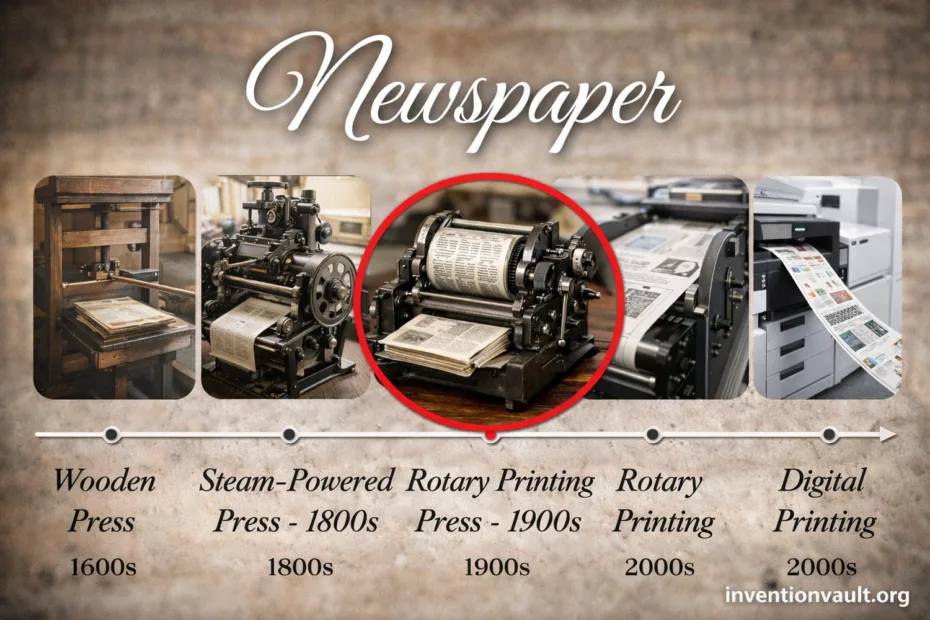
Daily publishing required repeatable speed. Over time, newspapers adopted technologies that pushed output from hundreds to thousands, and eventually to mass runs. The key was not a single invention, but a chain: press design, paper handling, plate making, folding, and bundling—each improvement shaving minutes off the daily cycle.
| Production Stage | What Changed | Why It Mattered For Daily News |
|---|---|---|
| Hand press era | Manual printing on flat forms | Strong craft control, but limited volume |
| Rotary press era | Cylinders and continuous motion | Huge jump in speed for daily circulation |
| Modern web offset | Plates, web-fed rolls, fast drying inks | Efficient runs, consistent quality, and rapid folding for delivery |
The Rotary Press and Continuous Motion
The rotary press made high-speed newspaper printing realistic by shifting type and printing surfaces onto rotating cylinders. Instead of stopping and starting, the machine could keep moving, which is exactly what a daily deadline demands. It also encouraged a new factory-like approach: planned maintenance, standardized parts, and repeatable output night after night.
How A Daily Issue Was Built
A daily newspaper is a synchronized chain. The newsroom creates the words and layout; the pressroom turns that plan into physical copies; distribution moves them while the day is still fresh. Miss one handoff, and the whole daily promise breaks.
Newsroom Flow
- Gather items from beats and verified inputs.
- Edit for clarity, accuracy, and style.
- Design pages with hierarchy: headline, deck, body.
- Lock pages by deadline so presses can run on time.
Pressroom Flow
- Make plates or print forms from the final pages.
- Run the press with calibrated ink and tensioned paper rolls.
- Fold and cut into sections at speed.
- Bundle by route so delivery stays fast.
Inside The Newspaper Page
Newspapers trained readers to scan. The headline signals priority, the lead provides the core, and the body adds detail in a structured way. This architecture helped daily readers get value even with only a few minutes, while still offering depth for people who wanted full context.
Common Building Blocks
- Front page: major items plus a map to what’s inside.
- Local coverage: practical updates with nearby relevance.
- Markets and listings: prices, schedules, and classifieds.
- Features: longer reads that add texture to daily life.
- Puzzles and small delights: habits that keep daily reading sticky.
Formats and Types
“Newspaper” covers many shapes. Format affects reading style, printing efficiency, and where the paper fits in a day—on a table, a bus seat, or a café counter. The best format is the one that supports clear navigation and durable daily use.
Broadsheet
Broadsheets use larger pages that fit more columns and allow dense layout. They are well-suited to longer articles and careful page structure, especially when a paper wants strong section identity.
Tabloid / Compact
Tabloid or compact sizes are easier to handle and quick to scan, which supports fast daily reading. A smaller page can still carry serious reporting when design discipline is strong.
Berliner
Berliner sits between broadsheet and tabloid, balancing space and handling. It often supports a clean grid that keeps daily sections recognizable without feeling cramped.
| Type | Main Purpose | Typical Sections |
|---|---|---|
| Local paper | Neighborhood-scale daily usefulness | Community updates, events, notices, service info |
| Business paper | Markets and economic tracking | Prices, company news, analysis, data tables |
| Trade paper | Industry specialization | Product updates, interviews, calendars, professional listings |
| Community weekly | Roundup rhythm vs daily | Highlights, features, local schedules, announcements |
Trust, Verification, and Visible Responsibility
Daily newspapers earned loyalty by making responsibility visible: bylines, consistent style rules, and published corrections when needed. Even when readers disagreed with an angle, a clear process signaled that the paper cared about accuracy and accountability.
Signals Readers Learned To Look For
- Date and edition label, so the time of information is clear.
- Attribution and named roles, which makes work traceable.
- Separation of news items from opinion pages when a paper uses them.
- Corrections that preserve reader trust over time.
Preserving Newspapers For Future Reading
Newsprint is designed for speed and low cost, not centuries of storage. Paper can yellow and become brittle, so libraries and archives relied on careful handling, controlled storage, and later microfilm and digitization. Preservation keeps the daily record searchable, and it lets researchers compare how information was presented on the day it arrived.
Digital access changed how people read, but the core newspaper idea remains recognizable: a dated edition, curated and structured, built to be read quickly and revisited later. Whether on paper or screen, the newspaper’s lasting invention is the repeatable daily package—a format that still shapes how humans make sense of what just happened.
References Used for This Article
- Library of Congress — The Daily Courant: Confirms the publication run and issue dating for The Daily Courant, supporting its status as an early British daily newspaper example.
- Universitätsbibliothek Heidelberg — Relation: Aller Fuernemmen und gedenckwuerdigen Historien: so sich hin …: Provides digitized editions and bibliographic context for the Relation, supporting the 1605-era origin and its role in early printed news.
- Deutsche Digitale Bibliothek — Relation: Aller Fuernemmen und gedenckwürdigen Historien: so sich hin …: Offers a curated cultural-heritage record that corroborates the work’s identity and historical placement in early newspaper history.
- Deutsche Nationalbibliothek — 370 Years of Newspaper Printing in Leipzig. A Centuries-Old Tradition: Documents Timotheus Ritzsch and the 1 July 1650 start date for Einkommende Zeitungen, supporting the move toward near-daily publication in Leipzig.
- Staats- und Universitätsbibliothek Bremen — Historische Zeitungen / Einkommende Zeitungen. Leipzig : [Timotheus Ritzsch] …: Presents library-hosted issue records that validate the title’s existence and publication details within 17th-century newspaper holdings.
- Smithsonian Institution — Printing Machines: Explains rotary/cylinder press mechanics and throughput, supporting how continuous-motion printing enabled higher-volume newspaper production.
- Library of Congress Digital Preservation — The National Digital Newspaper Program: Describes newspaper fragility and preservation approaches, including microfilming, supporting the article’s preservation and access claims.
- ISSN — The International Centre for the registration of serial publications – CIEPS: Defines the ISSN authority’s role in identifying and describing serials, supporting the concept of newspapers as standardized continuing resources.