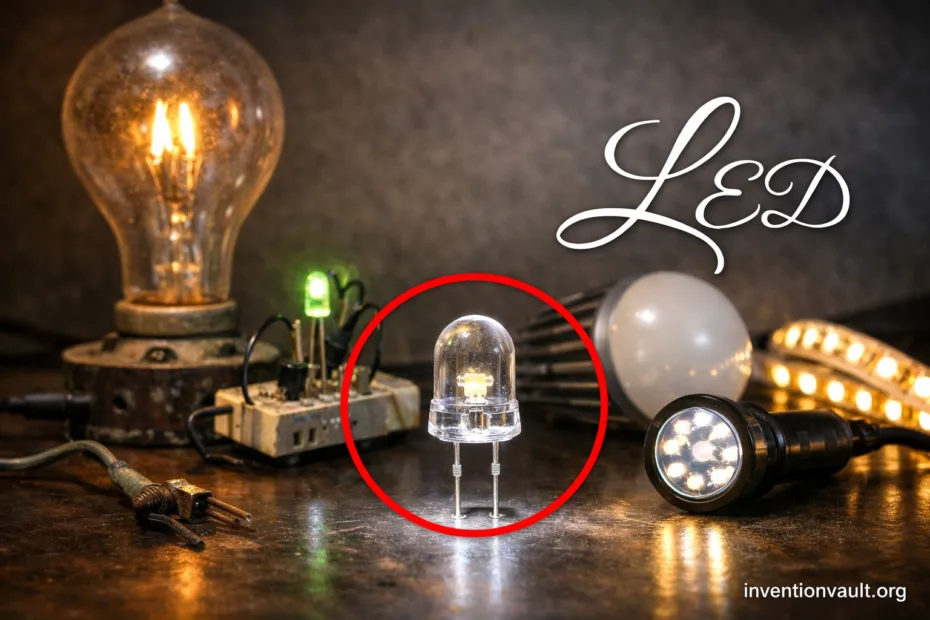
| Field | Details |
|---|---|
| Invention Name | LED (Light-Emitting Diode) for efficient solid-state lighting |
| Core Principle | Electroluminescence in a semiconductor p–n junction, where electron–hole recombination releases photons |
| Light Generation Type | Solid-state (no filament, no gas discharge) with performance shaped by materials, optics, and electronics |
| First Practical Visible LED | Demonstrated by Nick Holonyak Jr. on Oct. 9, 1962 (visible red emission using GaAsP) |
| White Light Enabler | Efficient blue LEDs made bright, energy-saving white LEDs possible (recognized by the 2014 Nobel Prize in Physics) |
| Common White LED Methods | Phosphor conversion (blue LED excites phosphor) or color mixing (RGB or multi-channel) |
| Efficiency Benchmarks | DOE target: 266 lm/W for LED packages and 200+ lm/W for luminaires; real products are lower due to driver, thermal, and optical losses |
| System Losses | Driver, thermal, and optical effects can reduce luminaire efficacy by more than 30% versus the LED packages inside |
| Color Quality Metrics | CRI (color shift vs. a reference) and CCT (blackbody-correlated appearance) influence perception and often trade off with maximum efficacy |
| Thermal Reality | Junction temperature is central; typical LED junction temperatures in luminaires are above 60 °C, with 100 °C+ possible in demanding designs |
| Measurement Anchor | Solid-state lighting relies on absolute photometry and standardized photometric/colorimetric quantities to keep claims comparable |
| Safety Standard Example | IEC 62471 guides photobiological safety evaluation for lamps and lamp systems |
LED lighting is the defining success story of modern illumination: a semiconductor device that turns electrical energy into light with high efficiency, long service life, and precise control. Its impact is practical—lower energy demand for the same light output—yet the real breakthrough is technical: LEDs scale from tiny indicators to powerful luminaires because their performance is engineered through materials, optics, thermal design, and electronics.
- What an LED Is
- Semiconductor Junction
- Solid-State Lighting
- Why LEDs Are Efficient
- Efficiency Starts With the Metric
- Benchmarks That Show the Ceiling and the Reality
- How White LEDs Make White Light
- Phosphor Conversion
- Color Mixing
- Milestones in LED Lighting
- LED Lighting Architectures
- Color and Visual Quality
- Lifetime and Reliability
- Measurement and Standards That Keep Claims Comparable
- Where LEDs Deliver Value
- References Used for This Article
What an LED Is
Semiconductor Junction
An LED is a p–n junction semiconductor. When forward-biased, electrons and holes meet in the active region and release energy as photons. The bandgap largely determines the photon wavelength, shaping the LED’s native color.
Efficiency is not a single number inside the chip. It is a chain: how many carriers become photons, how many photons escape the package, and how much of the final light output is preserved through optics and drivers.
Solid-State Lighting
In lighting, “solid-state” means the light source is an electronic device rather than a hot filament or gas discharge. That shift enables instant start, fine dimming control, compact form factors, and light distribution that can be designed into the luminaire.
It also changes how performance is verified. LEDs are sensitive to temperature, drive current, and optics, so standardized measurement methods and calibrated instruments are essential for meaningful comparisons.
Why LEDs Are Efficient
Efficiency Starts With the Metric
The headline number is luminous efficacy, measured in lumens per watt (lm/W). It describes how much visible light output is delivered for each watt of electrical input. In research and standards work, the language may also separate “lumens per watt of optical radiation” from “lumens per watt of electrical input,” because the electrical-to-optical conversion and the optical-to-visual weighting are different steps.
| Where the Number Comes From | What It Captures |
|---|---|
| LED package efficacy | Performance of the LED “building block” before system-level losses from drivers, heat, and optics |
| Lamp or luminaire efficacy | What matters in real installations: total light delivered divided by total input power |
| Color and spectrum choices | Warm vs. cool white, CRI targets, and spectral design can raise or lower achievable efficacy |
DOE guidance highlights the gap between component and system performance: driver, thermal, and optical losses can reduce efficacy by more than 30% in complete luminaires, even when high-performing packages are used.
Benchmarks That Show the Ceiling and the Reality
- DOE has published targets that illustrate what high-performance LEDs can reach: 266 lm/W for LED packages and 200+ lm/W for luminaires under target conditions.
- Phosphor-converted white LEDs have been described as a widely used, high-efficiency route, with package efficacy reported as greater than 130 lm/W in DOE materials.
- A large DOE product listing snapshot (February 2013) reported system efficacy spanning below 10 lm/W to around 120 lm/W, with many products clustered between 40 and 80 lm/W, underscoring how design choices shape outcomes.
How White LEDs Make White Light
Phosphor Conversion
Most general-illumination white LEDs are built from a blue LED plus a phosphor layer. Part of the blue light is converted into longer wavelengths, and the combined spectrum appears white. This approach supports compact lamps, efficient luminaires, and stable color points when materials and thermal paths are well matched.
Because conversion reshapes the spectrum, design choices for CRI and CCT influence achievable efficacy and the look of surfaces under the light.
Color Mixing
Another method blends multiple LED colors (often RGB or multi-channel) to produce white or tunable light. It can enable wide tuning ranges and dynamic color, especially in architectural and entertainment lighting where control is part of the product value.
Mixed-color systems depend heavily on control electronics, calibration, and spectral design to maintain consistent appearance across dimming and temperature changes.
Milestones in LED Lighting
| Year | Milestone | Why It Matters |
|---|---|---|
| 1962 | First practical visible-light LED demonstrated by Nick Holonyak Jr. | Visible emission made LEDs viable beyond infrared and set the foundation for commercial indicator and display applications. |
| 1990s | Efficient blue LEDs enabled bright white light sources | Blue emission is central for phosphor-converted white LEDs and high-quality mixed-color systems. |
| 2014 | Nobel Prize recognized blue LED invention as an enabler of energy-saving white light | Marked the scientific turning point that accelerated adoption in general illumination and advanced materials research. |
LED Lighting Architectures
“LED lighting” describes a family of architectures, not a single format. The chip is only the start; performance depends on packaging, thermal pathways, optics, and the driver that shapes electrical current. In specification language, terms like LED package, module, light engine, lamp, and luminaire refer to different levels of integration.
| Architecture | Typical Use | Main Design Focus |
|---|---|---|
| Mid-power SMD arrays | Panels, troffers, linear fixtures | Uniformity, thermal spreading, optical efficiency |
| High-power LEDs | Spotlights, outdoor luminaires, high-intensity applications | Thermal management and sustained output at higher currents |
| COB modules | Downlights, directional optics | Tight source size for beam control and glare management |
| Chip-scale packages | Compact luminaires, high-density arrays | Optical extraction and precise thermal coupling |
| Remote phosphor systems | Large-area luminaires | Color stability and reduced heat load on phosphor materials |
| Filament-style LED lamps | Decorative retrofits | Thermal limits in small envelopes and uniform omnidirectional appearance |
Color and Visual Quality
Correlated Color Temperature (CCT) describes the color appearance of the light by comparison to a blackbody radiator. Lower CCTs are often called “warm,” higher CCTs “cool,” yet both can be engineered for high efficiency when spectra and packaging are optimized.
Color Rendering Index (CRI) is defined in ENERGY STAR materials as a measure of the degree of color shift objects undergo under a light source compared with a reference source of comparable color temperature. It remains widely used in specifications and product listings.
Spectrum matters because the eye weights wavelengths unevenly. Changing spectral content can raise or lower measured efficacy, and color quality targets can influence what is physically possible within a given architecture.
Flicker is another quality dimension. In solid-state lighting, modulation is tied to driver design, dimming methods, and power electronics. DOE publications discuss how standardized practices can help evaluate flicker characteristics in a consistent way.
Lifetime and Reliability
LEDs rarely “burn out” like filaments. Instead, performance is typically described through lumen maintenance—how much light output remains after a given operating time. Temperature is central: DOE notes that typical LED junction temperatures in luminaires exceed 60 °C, and higher temperatures can reduce emitted lumens and shift spectral output.
- Thermal path: heat must move from the junction into the luminaire body without bottlenecks.
- Driver durability: the power electronics can set practical lifetime in many products.
- Materials stability: phosphors, encapsulants, and optics must resist long-term stress without large color shift.
Measurement and Standards That Keep Claims Comparable
LED performance is measurable in precise ways: photometric quantities (lumens, candela, lux), radiometric quantities (watts of optical radiation), and colorimetric quantities (chromaticity, CRI, CCT). NIST literature emphasizes that accurate optical measurement and standardization are essential because LEDs vary with temperature, drive conditions, and spectral design.
| Area | What Is Standardized | Why It Matters |
|---|---|---|
| Photometry | How total flux, intensity distribution, and efficacy are measured for solid-state products | Prevents “apples to oranges” comparisons across fixtures and form factors |
| Colorimetry | Definitions and methods for CRI and related color rendering properties | Supports consistent color expectations across product families and installations |
| Safety | Photobiological safety evaluation for lamps and lamp systems | Frames risk assessment and classification using recognized criteria |
| Program Specifications | Performance definitions used in certification programs (e.g., CRI and CCT terminology) | Creates shared language for labeling and procurement |
Where LEDs Deliver Value
- General illumination in homes and workplaces through lamps and integrated luminaires
- Outdoor lighting where optical control, efficiency, and durability are crucial
- Displays and signage using compact sources with controllable color
- Transportation applications that benefit from fast response and robust packaging
- Architectural lighting where tunability, beam shaping, and consistent color are part of the design intent
References Used for This Article
- U.S. Department of Energy — Energy Efficiency of LEDs: Explains efficacy definitions, package-vs-system losses, and benchmark targets.
- National Institute of Standards and Technology — Optical Metrology for LEDs and Solid State Lighting: Reviews photometric, radiometric, and colorimetric quantities used to measure LED performance.
- Nobel Prize — The 2014 Nobel Prize in Physics (Press Release): Documents the recognition of efficient blue LEDs enabling bright, energy-saving white light sources.
- University of Illinois Urbana-Champaign — Nick Holonyak Jr., Pioneer of LED Lighting, Dies: Provides the dated account of the first visible-light LED demonstration in 1962.
- ENERGY STAR — Luminaires V2.2 Final Specification: Defines CRI and CCT terms used in widely adopted lighting specifications.
- International Commission on Illumination (CIE) — Method of Measuring and Specifying Colour Rendering Properties of Light Sources: Describes the formal publication underpinning CRI-based color rendition concepts.
- International Electrotechnical Commission — IEC 62471: Photobiological Safety of Lamps and Lamp Systems: Lists the standard scope for evaluating photobiological safety of lamps and luminaires.