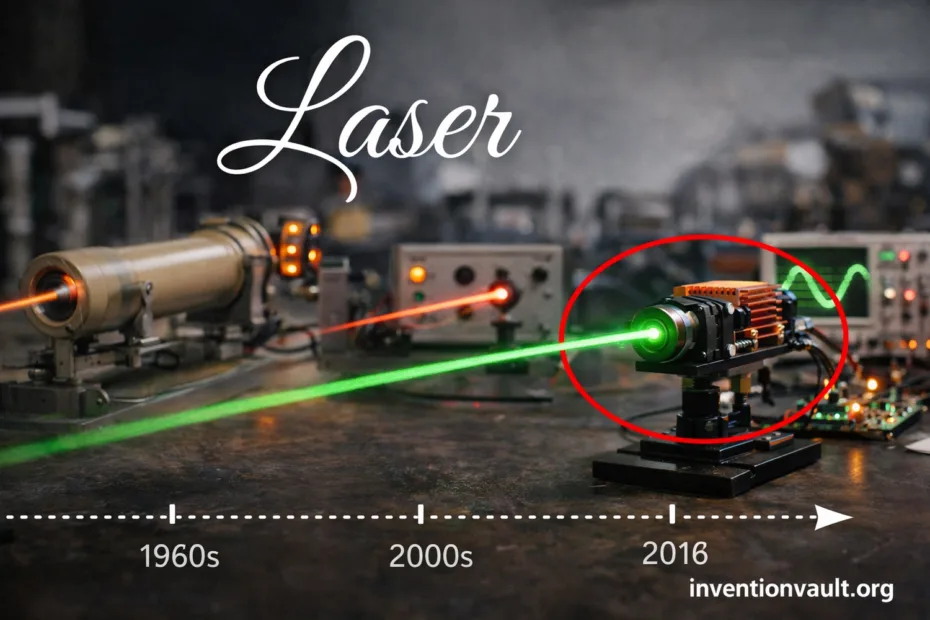
| Invention Name | Laser (Light Amplification by Stimulated Emission of Radiation) |
| Core Idea | Stimulated emission inside an optical resonator produces coherent light with a well-controlled phase |
| First Demonstrated | Theodore H. “Ted” Maiman, May 16, 1960 (ruby laser) |
| Key Patent | U.S. Patent 3,353,115 (first working laser) |
| Why It Changed Communication | Narrow beams + stable wavelengths + high modulation bandwidth made optical links practical at scale |
| Telecom Wavelength “Sweet Spots” | 850 nm (short reach), 1310 nm (low dispersion window), 1550 nm (low-loss window; amplifier-friendly) |
| Common Communication Laser Families | Semiconductor lasers (DFB/DBR, ECL, VCSEL), fiber lasers, solid-state lasers, tunable lasers |
| Typical Linewidth Range (Communication) | kHz–MHz class (depends on design); narrower linewidth supports more demanding coherent detection |
| Common Modulation Approaches | Intensity modulation (direct detection) and phase/amplitude modulation (coherent optical systems) |
| Where You Meet Lasers Daily | Fiber internet backbones, data centers, metro networks, point-to-point free-space optical links |
A laser is not just a bright light. It is a controlled source of coherent light whose wavefront stays organized over distance, so information can ride on it cleanly. In communication, that order matters: it lets systems pack more data into a beam, keep signals separable, and push links farther without turning the message into noise.
- What Makes Laser Light Coherent
- Terms You Will See in Laser Specs
- How a Laser Produces a Communication-Grade Beam
- Laser Types Used in Communication
- Semiconductor Lasers (Laser Diodes)
- VCSELs for Short-Reach Links
- Fiber Lasers and Solid-State Sources
- Wavelength Choices in Optical Communication
- How Data Rides on Coherent Light
- Transmitter Side
- Link in the Middle
- Receiver Side
- Noise and Distortion That Matter in Laser Links
- Free-Space Laser Communication
- Coherent Optical Communication Inside Fiber Networks
- Milestones That Connect Lasers to Modern Communication
- Common Laser Parameters That Shape Link Performance
- References Used for This Article
What Makes Laser Light Coherent
Coherence means the light’s phase follows a predictable relationship in space and time. With coherent light, the beam behaves like a disciplined stream rather than a jumble. That is why laser communication can use very narrow filters, very selective receivers, and advanced modulation without falling apart.
- Temporal coherence: a stable optical frequency (small linewidth) helps maintain phase integrity for coherent detection.
- Spatial coherence: a well-formed wavefront enables tight beam divergence and efficient coupling into optical fiber.
- Polarization control: consistent polarization can boost performance in modern optical links and advanced receivers.
Terms You Will See in Laser Specs
- Linewidth: how “spread out” the laser’s frequency is; narrower supports phase-sensitive communication.
- Coherence length: how far the light stays phase-related; it connects directly to signal stability.
- Relative intensity noise (RIN): tiny power fluctuations; low RIN keeps data symbols cleaner.
- Side-mode suppression ratio (SMSR): how well a laser stays in one main optical mode; high SMSR helps WDM links.
How a Laser Produces a Communication-Grade Beam
Every laser needs three essentials: a gain medium, a pump that energizes it, and an optical cavity that selects which light waves survive. Once the system reaches threshold, stimulated emission dominates and the output becomes a stable, usable carrier for communication.
| Building Block | What It Does for Communication |
|---|---|
| Gain medium | Provides optical amplification so the carrier stays bright and controllable |
| Pump (electrical or optical) | Creates population inversion so stimulated emission wins over loss |
| Resonator / feedback | Chooses a narrow set of frequencies, improving coherence and spectral purity |
| Output coupling | Extracts a predictable fraction of light so power stays steady |
Laser Types Used in Communication
Communication systems pick laser types the way pilots pick instruments: the choice depends on the route. Some designs prioritize single-frequency stability. Others prioritize efficiency or low cost. The unifying goal is the same: a clean optical carrier that can be modulated fast and recovered reliably.
Semiconductor Lasers (Laser Diodes)
Laser diodes dominate optical networks because they are compact, efficient, and easy to integrate with electronics. In fiber communication, engineers lean on devices that hold wavelength tightly and keep phase noise low enough for the chosen modulation.
- DFB lasers: built-in grating favors one mode, supporting WDM and stable single-frequency operation.
- DBR lasers: use reflector sections for controlled feedback and good spectral control; often used where tunability matters.
- External-cavity lasers (ECL): add an external resonator to reach very narrow linewidth for demanding coherent optical links.
- Electro-absorption modulated lasers (EML): combine a laser with an integrated modulator for fast, clean intensity modulation.
VCSELs for Short-Reach Links
VCSELs (vertical-cavity surface-emitting lasers) shine in data centers and short links, often around 850 nm. They pair naturally with multimode fiber and can be produced in high volume, making high-density optical I/O practical.
Fiber Lasers and Solid-State Sources
Fiber lasers and solid-state lasers show up when systems want exceptional beam quality, spectral stability, or higher optical power than a typical diode alone. For communication-focused roles, designers value low-noise output and the ability to stay locked to a desired wavelength over time.
Wavelength Choices in Optical Communication
Optical networks do not pick wavelengths at random. They cluster around windows where glass loss is low and components perform well. That is why 850 nm, 1310 nm, and 1550 nm keep returning in specifications, generation after generation.
| Nominal Wavelength | Common Link Style | Why It Is Popular |
|---|---|---|
| 850 nm | Short reach (often multimode) | Cost-effective optics; VCSEL ecosystem; great for dense interconnects |
| 1310 nm | Metro / access (often single-mode) | Historically tied to a low-dispersion region; solid choice for clean signal shape |
| 1550 nm | Long haul / high capacity (single-mode) | Lowest loss window in silica and a natural home for optical amplification |
How Data Rides on Coherent Light
A laser provides the carrier. Communication hardware then imprints data by changing the light in measurable ways: power, phase, frequency, or polarization. The more precisely the light is controlled, the more elegantly the receiver can separate signal from noise.
| Family | What Changes | Where You See It |
|---|---|---|
| IM/DD (Intensity Modulation / Direct Detection) | Optical power varies with symbols; receiver measures intensity | Short to medium links; many simple and robust optical systems |
| PAM4 (multi-level intensity) | Multiple power levels per symbol for higher throughput | High-speed short reach, especially where cost and density matter |
| Coherent modulation (QPSK/QAM families) | Phase and amplitude are tracked with a local oscillator laser | Long-haul and high-capacity links that prioritize spectral efficiency |
Transmitter Side
- Laser source sets the carrier with stable wavelength and low noise.
- Modulator shapes symbols; external modulation can keep the laser calm while data changes fast.
- Multiplexing combines channels in WDM so one fiber carries many wavelengths.
Link in the Middle
- Optical fiber guides light with low loss when wavelength sits in the right window.
- Amplifiers (often EDFA at 1550 nm) boost signals without converting them back to electricity.
- Dispersion and polarization effects are real; systems design around them with smart engineering.
Receiver Side
- Photodiode turns light into current for direct detection systems.
- Coherent receivers mix the signal with a local oscillator laser to recover phase and amplitude.
- DSP cleans the signal digitally, making high-capacity coherent links practical in real networks.
Noise and Distortion That Matter in Laser Links
Even with coherent light, the link is not magically perfect. Power fluctuations, phase jitter, and fiber physics shape what arrives at the receiver. Modern optical communication succeeds because it treats these effects as measurable engineering realities, not mysteries.
| Effect | What It Does | What Systems Commonly Use |
|---|---|---|
| Chromatic dispersion | Different wavelengths travel at slightly different speeds; symbols can spread | Dispersion-aware design and DSP equalization |
| Laser phase noise | Random phase drift; can blur tight constellations | Narrow-linewidth lasers and carrier recovery algorithms |
| Nonlinear effects | At higher powers, fiber response can mix channels and distort waveforms | Power management plus modulation formats that tolerate the channel |
| Polarization changes | State of polarization drifts; coherent systems must track it | Polarization-diverse receivers and adaptive DSP |
Free-Space Laser Communication
Free-space optical communication sends a laser beam through air or space instead of glass. The attraction is simple: a tight beam can deliver high data rates with relatively small apertures, and coherent techniques can push sensitivity when signals are faint. The challenge is equally clear: the link must keep the beam pointed accurately, every second.
- Pointing and tracking keeps the optical alignment stable, especially over long distances.
- Atmospheric turbulence can shimmer the beam in the air; systems counter it with robust link design.
- Wavelength choice still matters; many designs favor bands that balance efficiency and practical components.
Safety Note (general, non-technical): Communication systems treat laser safety as a design requirement, not an afterthought. Real products follow established laser classification standards and include labeling so the technology stays comfortable for everyday environments.
Coherent Optical Communication Inside Fiber Networks
In high-capacity systems, coherent optical communication uses a second laser in the receiver as a local oscillator. By mixing the incoming signal with that reference, the receiver recovers amplitude and phase together, then lets DSP do the heavy lifting. This is why modern long-haul links can carry dense constellations and stay stable in the real world—right down to the optics module and trasnceiver.
- Higher spectral efficiency: more bits per second per hertz, so fiber capacity grows without adding new fibers everywhere.
- Better sensitivity: coherent receivers can detect weaker signals by leveraging phase information.
- DSP flexibility: equalization and impairment compensation can adapt as networks evolve.
Milestones That Connect Lasers to Modern Communication
The path from the first laser to today’s optical communication is a chain of practical breakthroughs. Each step made the light source more controllable, more stable, or more compatible with fiber systems, and each step moved coherent light from the lab into the backbone of everyday connectivity.
| Year | Milestone | Why It Matters for Communication |
|---|---|---|
| 1960 | First working laser (ruby) | Proved controlled coherent light was physically achievable |
| 1962 | Semiconductor lasers demonstrated | Opened the door to compact light sources that pair naturally with electronics |
| 1965–1966 | Optical fiber attenuation target recognized as achievable | Turned fiber from a curiosity into a realistic transmission medium for networks |
| Modern era | DSP-based coherent systems | Enabled high-capacity transport with phase-aware modulation at scale |
Common Laser Parameters That Shape Link Performance
Two lasers can both be “communication lasers” and still behave very differently. The difference lives in measurable parameters: linewidth, output power, RIN, chirp, and tuning stability. When you see these specs, you are looking at the engineering knobs that decide whether a system prefers simple direct detection or ambitious coherent modulation.
- Extinction ratio: how clearly “on” and “off” levels separate; a clean ratio supports readable symbols.
- Chirp: frequency shift during modulation; too much can interact with dispersion and blur edges.
- Tuning stability: wavelength drift affects WDM spacing and filter alignment.
- Power stability: long links and amplified systems benefit from steady launch power.
References Used for This Article
- International Telecommunication Union (ITU) — Recommendation ITU-T G.652: Characteristics of a single-mode optical fibre and cable: Defines key single-mode fiber transmission properties and the 1310/1550 nm operating regions.
- National Institute of Standards and Technology (NIST) — What Is A Laser?: Explains the laser principle (stimulated emission, pumping, and resonator mirrors) in clear technical terms.
- Stanford University School of Engineering — Theodore Maiman: Summarizes Maiman’s first working laser milestone and its historical significance.
- Google Patents — US3353115A: Ruby laser systems: Provides the full patent record for the ruby laser system associated with the first working laser.
- National Institute of Standards and Technology (NIST) — Laser Stabilization and Coherence with Optical Resonators: Describes how cavity locking improves linewidth and frequency stability for phase-sensitive applications.
- NASA Technical Reports Server (NTRS) — Coherent Architectures for Free-Space Optical Communications: Details pointing/acquisition/tracking needs and turbulence impacts in free-space laser links.
- U.S. Food & Drug Administration (FDA) — Laser Products: Conformance with IEC 60825-1 (Laser Notice No. 56): Outlines recognized approaches to laser safety compliance and labeling expectations in regulated products.