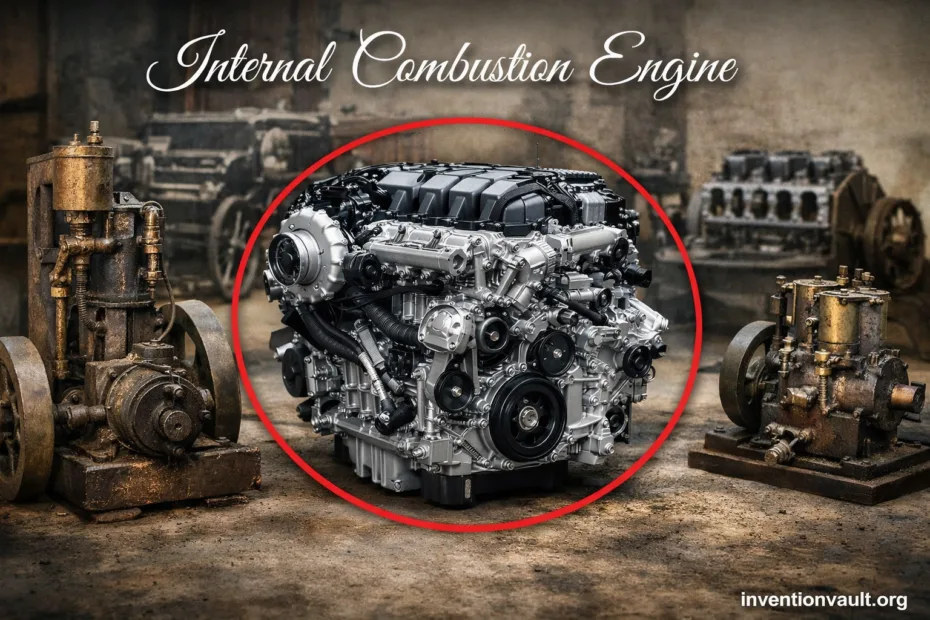
| Invention | Internal Combustion Engine (often shortened to ICE) |
| Basic Idea | Burn fuel inside the engine so expanding gases deliver force directly to moving parts. |
| Why It Was Different | Unlike steam engines (where heat is made outside), the combustion chamber is part of the machine that creates motion. |
| Early Documented Concept | Late 1600s experimental “explosion” engines, including work associated with Christiaan Huygens (1670s). |
| Early Fuelled Prototype | François Isaac de Rivaz (1807) built an early engine using a combustible gas mixture and mounted it on an experimental vehicle. |
| First Large-Scale Production | The Lenoir gas engine (1860) became one of the first internal combustion engines produced and sold in meaningful numbers. |
| Cycle That Set The Pattern | Four-stroke compression-and-expansion engines, proven in practice by Nikolaus August Otto (1876). |
| Efficiency Leap | Rudolf Diesel (patent 1892; first successful engine demonstrated in 1897) pushed efficiency by using compression ignition. |
| Main Families Today | Spark-ignition piston engines, compression-ignition piston engines, two-stroke and four-stroke variants, rotary designs, and gas turbines. |
| Enduring Legacy | A compact power source that enabled modern mobility, mechanized work, and reliable on-demand mechanical power. |
The internal combustion engine did not arrive as a single finished machine. It emerged through a chain of ideas, prototypes, and hard-won refinements until engineers could finally turn a controlled burn into dependable rotation. That achievement reshaped transport, industry, and everyday tools because it delivered high power from a package small enough to move with the job.
- What Internal Combustion Means
- How Heat Becomes Motion
- A Timeline Of Breakthroughs
- Early Ideas and Experiments
- What Was Already Clear
- What Was Hard To Solve
- Lenoir and The First Wave Of Practical Engines
- Otto, Deutz, and The Four-Stroke Cycle
- Four Strokes, One Power Pulse
- High-Speed Engines and Early Vehicles
- What Vehicles Needed
- What Engineers Delivered
- Diesel and Compression Ignition
- Major Families and Subtypes
- Key Parts That Define an Engine
- Why This Invention Shaped Modern Life
- Mobility
- Work and Industry
- Engineering Knowledge
- Modern Direction
- References Used for This Article
What Internal Combustion Means
An internal combustion engine creates motion by burning fuel inside a confined space. The burn releases heat, the hot gases expand, and the expansion applies force to a moving element such as a piston or a turbine blade. That force is then converted into rotation or thrust.
- Combustion happens in the machine, not in a separate furnace.
- The engine’s “working fluid” is typically the air–fuel mixture and the resulting hot gases.
- Power comes in repeating events called cycles, which organize intake, compression, combustion, and exhaust.
How Heat Becomes Motion
- Air (and often fuel) enters the cylinder or chamber.
- The mixture is compressed, preparing it for a faster, more controlled release of energy.
- Combustion raises pressure sharply; expansion pushes on a piston or turbine.
- A linkage (crankshaft, gearbox, or turbine shaft) turns that push into useful output.
- Exhaust leaves so the next cycle can begin.
A Timeline Of Breakthroughs
| Year | Milestone | Why It Mattered |
|---|---|---|
| 1673 | Explosion-driven engine experiments linked to Huygens | Early proof that a rapid burn could move mechanical parts directly. |
| 1807 | De Rivaz builds a gas-fuelled engine and mounts it on a vehicle | A formative step toward mobile power using on-board fuel. |
| 1860 | Lenoir introduces a commercially produced gas engine | Moves the technology from workshop curiosity to practical installations. |
| 1876 | Otto demonstrates a successful four-stroke compressed-charge engine | Sets a foundation for efficient, controllable piston engines. |
| 1885–1886 | High-speed petrol engines enable early road vehicles | Shows that internal combustion can power light, usable transport. |
| 1892–1897 | Diesel patents compression-ignition ideas; first successful engine runs | Opens a path to higher efficiency and heavy-duty applications. |
| 1900s–Today | Ignition, fuel injection, boosting, and emissions control mature | Improves drivability, reliability, and performance across many uses. |
Early Ideas and Experiments
What Was Already Clear
- A fast release of energy could create motion more directly than slow heating.
- Contained pressure could do mechanical work if it was captured and guided.
- Repeating a controlled event was the key to steady output.
What Was Hard To Solve
- Ignition timing that was repeatable, not accidental.
- Materials that survived heat and stress for long periods.
- Fuel delivery that stayed consistent as load and speed changed.
- Cooling and lubrication systems that made continuous running realistic.
Seventeenth-century explosion engines were dramatic demonstrations, yet they also revealed a lesson that would echo for centuries: without control, power is wasteful. Early nineteenth-century experiments then shifted toward fuels and mixtures that could be handled more predictably, paving the way for engines that could run repeatedly rather than as one-time events.
Lenoir and The First Wave Of Practical Engines
In 1860, the Lenoir gas engine made internal combustion practical for workshops and small installations. It used a combustible gas supply and spark ignition to create a repeating power event in a cylinder. While later designs would surpass it, Lenoir’s achievement proved that an internal combustion engine could be manufactured, sold, and kept running by ordinary operators.
| Feature | Lenoir-Type Gas Engine | Otto Four-Stroke Pattern |
|---|---|---|
| Compression Before Ignition | Limited or absent | Central principle |
| Efficiency Direction | Useful but relatively low | Higher efficiency through controlled compression and expansion |
| Best Fit At The Time | Stationary power where gas supply existed | Broad adoption, including the base for later vehicle engines |
Otto, Deutz, and The Four-Stroke Cycle
The leap from “it runs” to “it runs efficiently” came from embracing compression. Compressing the charge before ignition raises temperature and pressure conditions so combustion can deliver more useful work from the same cylinder size. Otto’s successful four-stroke engine of 1876 became a durable template because it organized the process into distinct, repeatable steps.
Four Strokes, One Power Pulse
- Intake: Air (and fuel, in many designs) enters the cylinder.
- Compression: The piston compresses the charge, preparing it for efficient combustion.
- Power: Ignition triggers combustion; expanding gases push the piston down.
- Exhaust: Burned gases leave so the next cycle starts cleanly.
Why “Otto Cycle” Became A Common Term
The phrase Otto cycle is widely used to describe spark-ignition, four-stroke piston engines in their classic form. Many later engines refined the details, yet the core rhythm—intake, compression, power, exhaust—remained recognizable.
High-Speed Engines and Early Vehicles
Once engines became compact and faster-running, internal combustion power could move from factory floors to the road. In the mid-1880s, engineers began building vehicles designed around petrol engines rather than simply adding engines to existing carriages. This design mindset mattered because the engine’s weight, cooling, and vibration shaped the entire vehicle architecture.
What Vehicles Needed
- Reliable starting and steady low-speed running
- Fuel storage that was practical for travel
- Cooling suited to varying speeds and ambient conditions
- Drive systems that translated rotation into usable movement
What Engineers Delivered
- Higher engine speeds for better power-to-weight
- Improved carburetion and ignition for consistent combustion
- Purpose-built frames and drivetrains around the engine
- Early road tests that proved the concept in daily conditions
Diesel and Compression Ignition
The diesel engine’s defining move is simple to state and difficult to perfect: compress air so strongly that injected fuel ignites from heat alone. That compression ignition approach can support high efficiency and strong low-speed torque. Diesel’s patent in 1892 and the successful 1897 engine demonstration marked a turning point for heavy-duty power, where durability and fuel economy mattered as much as speed.
- No spark plug is required in classic diesel operation; compression provides the ignition conditions.
- Fuel delivery is timed so combustion happens close to the most useful part of the cycle.
- Robust construction supports higher pressures than many spark-ignition designs.
Where Diesel Engines Historically Excelled
- Long-running stationary engines and generators
- Commercial transport and heavy machinery
- Applications where efficiency and endurance are central goals
Major Families and Subtypes
“Internal combustion engine” covers a wide family tree. The common thread is combustion inside the device, but the way engines breathe, ignite, and deliver power varies greatly. Knowing the main families makes historical descriptions clearer and helps modern readers connect old breakthroughs to present designs.
| Family | Signature Trait | Typical Uses | Notes |
|---|---|---|---|
| Spark-Ignition Piston | Spark lights a prepared air–fuel mixture | Cars, small machines, light aircraft (in some designs) | Often described with the Otto cycle vocabulary. |
| Compression-Ignition Piston | Fuel ignites from compression heat | Trucks, ships, generators, heavy equipment | Built for higher pressures; efficiency-focused design. |
| Two-Stroke Variants | Power event every crank revolution (design-dependent) | Small engines, specialized applications | Can be compact, though modern requirements shape design choices. |
| Rotary (Wankel-Type) | Rotating chamber elements replace pistons | Niche vehicles and specialty uses | Distinct packaging advantages; different sealing challenges. |
| Gas Turbine | Continuous combustion drives turbine blades | Aircraft propulsion and some power generation | Still internal combustion because burning occurs inside the engine. |
Key Parts That Define an Engine
Across the history of internal combustion, the most influential advances often came from improving how engines manage air, fuel, heat, and timing. The parts below appear again and again because each one governs a basic physical limit.
- Cylinder and piston (or rotor housing): where pressure becomes force.
- Crankshaft and connecting rod: turn linear motion into rotation.
- Valves and camshaft: control breathing and keep the cycle synchronized.
- Ignition system (spark designs) or injection system (diesel designs): governs when energy is released.
- Cooling and lubrication: keep friction and temperature within safe operating ranges.
- Air management such as turbocharging: increases the oxygen available for combustion and can raise power density.
Why This Invention Shaped Modern Life
Mobility
Internal combustion engines enabled vehicles that could carry their own energy supply, deliver strong power for their size, and operate without the long warm-up associated with many earlier systems. That portability changed how people and goods moved.
Work and Industry
From pumps and generators to tractors and construction machines, compact engines brought mechanical power close to where it was needed. This helped spread mechanization beyond large fixed factories.
Engineering Knowledge
The internal combustion engine pushed advances in materials, thermodynamics, machining, and measurement—skills that influenced many other technologies.
Modern Direction
Today’s internal combustion engines reflect more than a century of refinement. Many modern designs prioritize cleaner combustion, tighter control of fuel and air, and smarter integration with electric systems. Even as new powertrains expand, the internal combustion engine remains a core reference point for understanding how heat can be engineered into dependable motion.
References Used for This Article
- Smithsonian National Museum of American History — Lenoir Gas Engine: Museum documentation for the 1860 Lenoir engine artifact.
- Institution of Mechanical Engineers Archives — Technology Timeline 1600–1799: Timeline entry noting early explosion-engine work linked to Huygens in 1673.
- Technik Museum Speyer — Nicolaus August Otto and the Four-Stroke Engine: Museum overview of Otto’s development and the 1876 four-stroke breakthrough.
- Science and Industry Museum — Otto and Langen Gas Engine: Museum explanation of early gas-engine development leading toward wider adoption.
- Deutsches Museum — Energy: Motors: Exhibition page describing the diesel milestone and the first diesel engine run in 1897.
- The Henry Ford — Working Model of First Automobile Built by Karl Benz: Museum record summarizing the Benz Patent-Motorwagen and its 1885 origins.
- Encyclopaedia Britannica — Internal Combustion Engine: Reference overview of engine types, operating principles, and historical development.
- Encyclopaedia Britannica — Nikolaus August Otto: Biographical details supporting the 1876 four-stroke achievement.
- Energies (MDPI) — Hydrogen Internal Combustion Engine Vehicles: A Review: Scholarly review noting early hydrogen-engine work associated with de Rivaz in 1807.