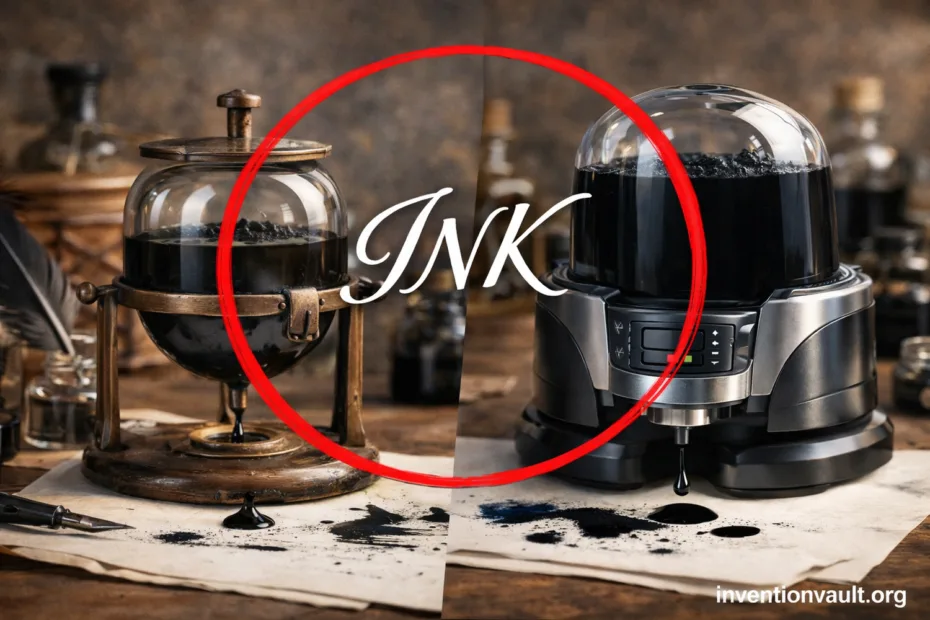
| Detail | Information |
|---|---|
| What It Is | Ink is a colorant carried by a liquid vehicle so it can be placed on a surface as a controlled mark. |
| Core Job | To deliver color with precision, then stay put after drying. |
| Who Invented It | No single inventor. Ink emerged through practical experimentation in early writing cultures. |
| Early Evidence | By around 2600 BCE, both Egyptian and Chinese traditions used writing inks based on soot (carbon black). |
| Early “Black” Formula | Soot dispersed in water, stabilized with a natural gum or animal glue to keep particles suspended. |
| Major Historical Shift | Iron gall ink (iron salts + tannins) became a long-running standard for Western manuscripts from late antiquity into the modern era. |
| Printing Breakthrough | Mid-1400s: oil-based printing inks (often with lampblack) adhered better to metal type than watery inks. |
| Modern Pigment Era | 19th–20th centuries: growth of synthetic dyes and durable synthetic pigments (example: phthalocyanine blues commercialized in the 1930s). |
| Where Ink Lives Today | Writing, printing, packaging, art, and specialized fields like security printing and functional inks for industrial marking. |
Ink looks simple until you study what it must do: flow through a tiny gap, form a clean edge, then become a stable film that resists time, touch, and light. The long story begins with soot, travels through reactive inks like iron gall, and arrives at modern engineered pigments designed for specific tools and surfaces.
- What Ink Is Made Of
- Two Ways To Color Ink
- Soot And Gum: The First Reliable Black
- Iron Gall Ink And Chemical Black
- Printing Ink And The Move To Oils
- Synthetic Dyes and Modern Pigments
- Ink Types You Meet Today
- Fountain Pen Inks
- Ballpoint and Gel Inks
- Inkjet Dye and Pigment Inks
- Industrial and Specialty Inks
- How Ink Performance Is Judged
- Why Pigments Matter
- References Used for This Article
What Ink Is Made Of
Most ink recipes—ancient or modern—balance four essentials: a colorant (pigment or dye), a vehicle that carries it, a binder that helps it form a film, and additives that fine-tune behavior.
- Colorant: pigment particles or dye molecules
- Vehicle: water, oil, or solvent blends
- Binder: gums, resins, or polymers that add cohesion
- Additives: surfactants, humectants, waxes, and preservatives
Two Ways To Color Ink
Pigment inks use insoluble particles (think carbon black), so they rely on good dispersion. Dye inks dissolve fully in the vehicle, often giving bright color with very smooth flow.
Soot And Gum: The First Reliable Black
Early writing demanded a black mark with strong contrast. The answer was soot: fine carbon produced by combustion, often called carbon black or lampblack. Mixed into water and stabilized with a natural gum or animal glue, it formed a practical carbon ink that could be brushed or reed-written onto early writing materials.
These inks work because carbon is chemically calm: it does not easily fade, and it stays dark even in thin films. The challenge is physical, not chemical—keeping tiny particles from settling, clumping, or clogging. That is where binders like gum arabic earned their place in the history of ink.
| Carbon-Based Ink Type | Typical Form | What Makes It Special |
|---|---|---|
| Carbon Ink (soot ink) | Liquid (water + binder) | Deep black from carbon; stable color; depends on good dispersion. |
| Inkstick Ink | Solid stick ground with water | Portable, long-lasting; soot + animal glue forms a dense, controllable ink. |
| India Ink (Chinese ink) | Liquid or solid | Often very opaque; prized for crisp lines and durability in drawing. |
In several traditions, soot wasn’t just “soot.” Makers refined it by controlling fuel sources and collection methods to get a consistent particle size, then tuned the ink with gum arabic for flow and film strength. It is an early example of materials engineering, built around repeatability and control.
Iron Gall Ink And Chemical Black
Carbon ink sits on the surface; iron gall ink can bond more deeply into fibers. Its classic chemistry combines tannins (often from galls) with iron salts, forming dark complexes as the writing ages. That shift—going from a suspended pigment to a reactive mixture—made iron gall ink a powerful tool for dense, durable script.
For historians and conservators, iron gall writing is instantly recognizable: it can start slightly pale, then darken as it reacts with oxygen and the page. The ink’s strength comes from chemistry, not just particle color, which is why it became a long-running standard in many manuscript cultures.
Ink is stored time: a recipe that turns motion into meaning, and meaning into a mark that can outlast its maker.
Printing Ink And The Move To Oils
Movable type pushed ink into a new job: transfer a clean film onto paper again and again without flooding fine edges. Water-based writing inks were a poor fit for metal type, so printers developed oil-based inks built on drying oils and resins. With lampblack as the colorant, these inks clung to type and released to paper with strong, sharp blacks.
Historical accounts of early printing describe experimentation with ingredients such as linseed oil, resins, and black soot pigments to reach the right tack and drying behavior. That balance—flow under pressure, then set into a stable film—still shapes modern press inks used in books, packaging, and labels.
Synthetic Dyes and Modern Pigments
The 19th century brought a turning point: synthetic dyes made color more predictable and scalable. In 1856, the first widely known commercial synthetic dye, mauveine, signaled what organic chemistry could do for color. Not long after, synthetic versions of natural colorants (like alizarin in 1869) expanded the palette available to inks, paints, and printing.
The 20th century refined the idea of pigment as an engineered material. A famous example is phthalocyanine blue, first prepared in 1927 and commercialized in the 1930s. Its appeal is practical: strong tinting power, excellent stability, and lightfast color—qualities that matter when an ink must stay vivid for years.
| Milestone | What Changed | Why It Matters For Ink |
|---|---|---|
| ~2600 BCE | Soot inks in early writing cultures | Stable black with simple ingredients; the birth of practical writing ink. |
| 5th–19th Centuries | Iron gall ink widely used | Chemical darkening and fiber bonding enabled dense, lasting script. |
| Mid-1400s | Oil-based printing inks | Better adhesion to type and clean transfer in repetitive printing. |
| 1856 | Synthetic dyes expand rapidly | New colors with industrial consistency; a big step toward modern formulations. |
| 1927–1930s | Engineered pigments (e.g., phthalocyanines) | High performance color with durability and strong tinting. |
| Late 1970s–1980s | Inkjet engineering accelerates | Precise droplet control demands carefully tuned viscosity, surface tension, and particle stability. |
Ink Types You Meet Today
Fountain Pen Inks
Fountain pen ink must flow through a narrow feed without clogging. Many formulas lean on dyes for smoothness, plus additives that manage drying and keep the tip from crusting. When pigments are used, they need exceptionally stable dispersion so the pen stays reliable.
Ballpoint and Gel Inks
Ballpoints favor thick, viscous inks that do not leak, paired with a rolling ball that meters delivery. Gel inks take a different route: a water-based gel holds colorants in a semi-solid network, giving a smooth line with strong color. Both depend on rheology—how a fluid behaves under force—more than people expect.
Inkjet Dye and Pigment Inks
Inkjet printers push ink through microscopic nozzles as droplets. Thermal inkjet work matured quickly after late-1970s research into fast, low-cost droplet firing. That history explains why inkjet ink is so engineered: it must jet cleanly, land predictably, and dry into a consistent film—microsopic problems with visible results.
| Inkjet Approach | Colorant | Typical Strength | Common Tradeoff |
|---|---|---|---|
| Dye Ink | Soluble molecules | Very smooth color transitions | Can be less light-stable depending on paper and dye family. |
| Pigment Ink | Dispersed particles | Often stronger water resistance and better longevity on many papers | Needs excellent dispersion; poor stability risks clogging and reduced print uniformity. |
| Hybrid Systems | Dyes + pigments, or treated papers | Balanced performance | More formulation complexity, more variables to control. |
Industrial and Specialty Inks
Beyond pens and printers, ink appears in barcode marking, packaging, and security printing. These inks may use fast-evaporating solvents, UV-curable systems, or tailored resins to bond to plastics, glass, or coated papers. The headline is simple: the “same” ink idea splits into many subtypes once the surface and speed change.
How Ink Performance Is Judged
When engineers test ink, they focus on measurable behavior: how it flows, how it wets a surface, and what film it leaves behind. A great black is useless if it spreads, and a brilliant color fails if it cannot form an even layer.
- Viscosity: thickness and flow under shear; critical for jetting and pen feeds
- Surface Tension: controls wetting, beading, and edge sharpness on paper
- Drying Mechanism: evaporation, absorption, oxidation, or curing into a stable film
- Lightfastness: resistance to fading; often stronger with many pigments
Why Pigments Matter
Modern pigments are designed for stability: controlled particle shape, known crystal forms, and reliable dispersion. That is why pigment-based systems are often preferred for archival qulity prints and documents where longevity is part of the job.
References Used for This Article
- Library of Congress — Iron Gall Ink Corrosion (Preservation Science) : Official conservation overview of iron gall ink deterioration and preservation considerations.
- The Morgan Library & Museum — The Invention of Printing (Gutenberg) : Museum reference explaining early printing constraints and why oil-based inks mattered for metal type.
- National Diet Library (Japan) — Incunabula: Art of Printing : Institutional overview of early printing methods, including ink materials used in Gutenberg-era practice.
- The British Museum — Great Harris Papyrus (Collection Record) : Collection record contextualizing ancient Egyptian writing materials and ink use on papyrus.
- Science History Institute — Mauve (1856) and the rise of synthetic dyes : Museum-grade history of Perkin’s mauveine and the industrial shift toward synthetic dye colorants.
- ISO — ISO 2846-1:2017 (Printing ink colour and transparency) : International standard defining color and transparency targets for process printing inks (offset lithography).
- Museum of Fine Arts, Boston (CAMEO) — Phthalocyanine Blue : Conservation encyclopedia entry summarizing the pigment’s identity, properties, and historical adoption.
- Nature (Scientific Reports) — Scientific analysis of ancient carbon inks (PDF) : Peer-reviewed study examining composition of ancient inks on papyrus and how carbon-based inks were formulated.
- Springer — Review research on historical black writing inks : Academic article summarizing major historical black ink families (carbon, plant-based, iron-gall) and their differences.
- Guinness World Records — Largest pen sentence : Record-authority reference included as a verified modern cultural data point related to writing and ink usage.