| Field | Verified Details |
|---|---|
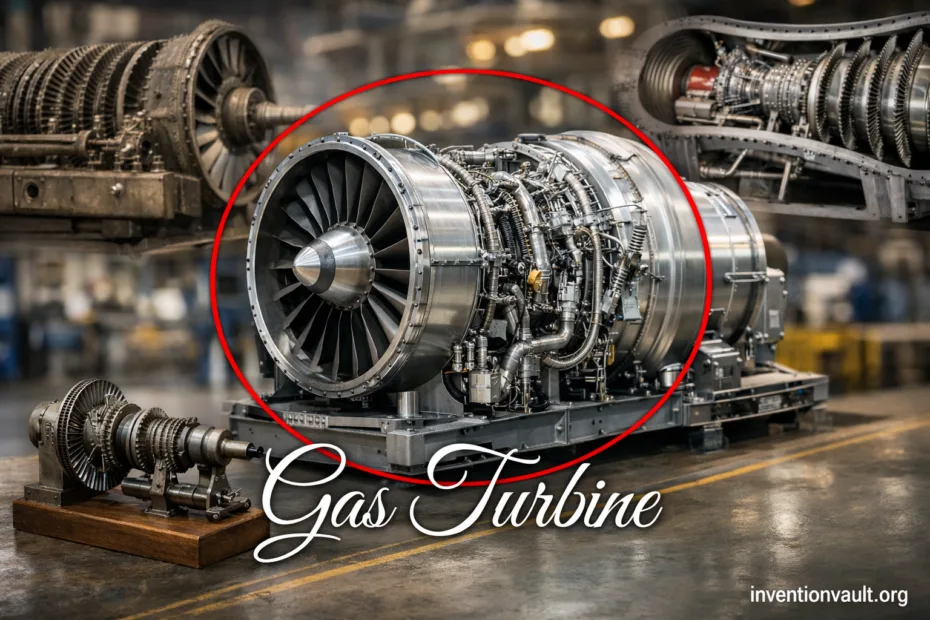
| Invention Focus | The gas turbine (often called a combustion turbine) is a heat engine where a continuous flow of hot gas drives a turbine. |
| Core Working Principle | Air is compressed, fuel is burned in the compressed air, and the expanding gas spins a turbine that powers the compressor and can deliver useful shaft power. |
| Thermodynamic Cycle | Most modern designs follow the Brayton cycle (compression → heat addition → expansion), implemented as a practical turbomachinery system. |
| Earliest Documented Patent | 1791: John Barber’s patent is widely cited as an early, recognizable layout of a compressor–combustor–turbine system. |
| First Net-Power Demonstration | 1903: Norwegian inventor Ægidius Elling built a gas turbine reported to produce net power output (NTNU describes an output of 8 kW). |
| First Commercial Electricity-Generating Set | 1939: Brown Boveri’s Neuchâtel machine is recognized as the first successful commercial electricity-generating gas turbine; ASME records 4 MW output and 17.4% efficiency. |
| Early Aviation Milestones | 27 August 1939: Turbojet-powered flight is documented for the Heinkel He 178 using the HeS 3B engine; 15 May 1941: the Gloster-Whittle E.28/39 made its first official flight. |
| Key Enablers | High-efficiency compressors, high-temperature materials, and stable continuous combustion made practical gas turbines possible at scale. |
| Main Families Today | Industrial heavy-frame, aeroderivative, and multiple aviation forms (turbojet, turbofan, turboshaft, turboprop), plus smaller microturbines. |
The invention of the gas turbine is not a single “aha” moment. It is an engineering story that unfolds across patents, test rigs, and materials breakthroughs—until the same core idea became reliable enough to power electric generators, aircraft engines, and industrial compressors. Understanding that evolution makes the technology feel less mysterious and far more impressive.
- What A Gas Turbine Is
- A Simple Flow Diagram
- Why The Gas Turbine Took Centuries
- Key Milestones In The Invention Timeline
- 1791: The Patent That Looks Familiar
- 1903: Net Power Becomes Real
- 1939: The Moment Industry Could Trust
- Neuchâtel Machine At A Glance
- Gas Turbines In Power Generation
- Simple Cycle
- Combined Cycle
- Gas Turbines In Aviation
- Major Gas Turbine Families
- Components That Define The Invention
- Compressors
- Combustors
- Turbines
- Performance Terms You Will See In Gas Turbine History
- Common Questions About The Invention
- Was The Gas Turbine Invented By One Person?
- What Made Early Designs Fail To Deliver Useful Power?
- Why Do Power Plants Often Use Combined Cycle?
- References Used for This Article
What A Gas Turbine Is
A gas turbine is a flow machine. Instead of pushing pistons up and down, it moves a steady stream of air and hot gas through rotating stages. The basic hardware is remarkably consistent across versions:
- Compressor: raises air pressure.
- Combustor: adds heat by burning fuel in the compressed air.
- Turbine: extracts energy from the hot gas to drive the compressor and provide usable power.
A Simple Flow Diagram
Air → Compressor → Combustor → Turbine → Exhaust
                 ↑_______________________↓
                   Shaft power to compressor
                   (plus optional output power)
If you see the term combustion turbine, it usually refers to the same core machine, especially in power-plant language.
Why The Gas Turbine Took Centuries
The concept looks straightforward on paper, yet early builders faced hard limits. A working gas turbine needs the turbine to produce more power than the compressor consumes. That balance depends on a few demanding ingredients:
- Compressor efficiency high enough to avoid “spending” all turbine power on compression.
- Materials that survive high temperature and high rotational stress.
- Combustion that is stable in a fast-moving airflow, without damaging pressure oscillations.
- Manufacturing precision for tight clearances, durable bearings, and reliable sealing.
Early inventors often built impressive prototypes that could run, but not run usefully. The breakthrough came when compressors, turbines, and materials advanced together—bringing the net-power problem under control.
Key Milestones In The Invention Timeline
| Date | Milestone | Why It Mattered |
|---|---|---|
| 1791 | John Barber patents a gas-turbine-like system | Often cited as an early layout of compressor + combustion + turbine in one concept. |
| 1872 | F. Stolze receives a patent for a “fire turbine” concept | Anticipated many features of the modern arrangement, but component efficiency remained the barrier. |
| 1903 | Ægidius Elling builds an experimental turbine with net output | One of the clearest early demonstrations that net power was achievable. |
| 1906 | Armengaud–Lemale tests a turbine with no useful power | Showed the gap between a running machine and an efficient prime mover. |
| 1910 | Holzwarth develops intermittent (constant-volume) combustion turbines | Explored an alternate combustion approach while steady-flow designs matured. |
| 1939 | Neuchâtel gas turbine enters commercial power service | A major step from laboratory machines to an operational grid asset. |
| 27 Aug 1939 | Heinkel He 178 flies with the HeS 3B turbojet | A landmark demonstration of gas turbine propulsion in flight. |
| 15 May 1941 | Gloster-Whittle E.28/39 makes its first official flight | Publicly documented proof that turbojet propulsion could be practical. |
1791: The Patent That Looks Familiar
Barber’s 1791 patent is often highlighted because it resembles the modern architecture: air compression, a combustion zone, and a turbine-like rotor. Even without a successful build, it captured the essential chain that defines gas turbines today.
1903: Net Power Becomes Real
Ægidius Elling’s 1903 work stands out because it is described as producing net power output. That phrase matters. It means the turbine did more than keep itself spinning; it delivered usable energy beyond what the compressor consumed—an engineering threshold that turns a concept into a true prime mover.
1939: The Moment Industry Could Trust
The 1939 Neuchâtel installation is remembered because it operated as a commercial electricity generator, not a research demonstration. Once a turbine can deliver power on schedule, survive long operating hours, and integrate with a station’s routines, the invention has crossed into everyday infrastructure.
Neuchâtel Machine At A Glance
- Installed: 1939 (municipal power station in Neuchâtel, Switzerland).
- Output: 4 MW at the generator terminals (as recorded by ASME).
- Efficiency: 17.4% (simple-cycle, as recorded by ASME).
- Why Engineers Still Cite It: It proved a gas turbine could be a dependable power-plant workhorse.
Gas Turbines In Power Generation
In electric power, a gas turbine’s strengths are compactness, fast start capability in many designs, and the ability to produce large power output from a comparatively small machine. Modern plants often pair a gas turbine with a steam cycle to capture exhaust heat, creating a combined cycle arrangement that improves overall efficiency.
Simple Cycle
A single gas turbine drives a generator directly. It is mechanically straightforward, and it highlights the invention’s core: compressor, combustor, turbine—working as one.
Combined Cycle
Exhaust heat is routed to a heat recovery steam generator so a steam turbine can add more electricity. That pairing turned the gas turbine from a standalone machine into a system cornerstone for many modern grids.
Gas Turbines In Aviation
In flight, gas turbines flourish because they deliver high power for their size and can sustain continuous operation at high rotational speeds. The earliest turbojet milestones are often told through two proof points: the Heinkel He 178 flight on 27 August 1939 powered by the HeS 3B, and the Gloster-Whittle E.28/39 official first flight on 15 May 1941.
From those beginnings came a family tree of propulsion engines, each tuned for a different priority—speed, efficiency, or shaft power. The underlying invention stays the same: compressor → combustion → turbine, refined into highly optimized variants.
Major Gas Turbine Families
| Family | What It Delivers | Typical Strength | Common Uses |
|---|---|---|---|
| Turbojet | Thrust from a high-speed exhaust jet | Simplicity in early jet layouts | Historical prototypes; specialized high-speed applications |
| Turbofan | Thrust with a large fan driven by the turbine | Efficiency and reduced exhaust velocity for many flight regimes | Most modern commercial aviation |
| Turboprop | Shaft power to a propeller via gearbox | Excellent performance at moderate speeds | Regional aircraft, patrol, and utility aviation |
| Turboshaft | Shaft power optimized for rotating machinery | High power-to-weight for compact installations | Helicopters and industrial drives |
| Industrial Heavy-Frame | Shaft power to an electric generator | Durability and long service intervals | Utility-scale power generation |
| Aeroderivative | Power generation using an aviation-derived core | Compact design and flexible deployment | Peaking power, offshore platforms, mobile plants |
| Microturbine | Small-scale electricity and heat | Packaging and steady operation | Distributed energy and on-site generation |
Components That Define The Invention
Many machines use turbines, and many machines use compressors. The gas turbine becomes a distinct invention when these parts are locked into a self-sustaining loop that maintains pressure, heat addition, and expansion in a continuous flow.
Compressors
- Centrifugal: robust, compact, often used in smaller engines.
- Axial: scalable to high flow rates, common in large engines.
- Key idea: higher efficiency means more turbine power is left for useful work.
Combustors
- Continuous combustion adds heat steadily, matching the turbine’s flow needs.
- Injector and liner designs focus on stable flames and hardware life.
- In stationary power, designs often emphasize reliability and emissions performance.
Turbines
- Extract energy in stages, converting hot-gas expansion into shaft work.
- Blade cooling and materials enable higher operating temperatures.
- Higher turbine inlet temperature often supports better thermal efficiency.
Performance Terms You Will See In Gas Turbine History
| Term | Meaning | Why It Matters For “Invention” |
|---|---|---|
| Pressure Ratio | Compressor discharge pressure divided by inlet pressure | Higher values can raise efficiency, but demand better aerodynamics and stronger hardware. |
| Net Power Output | Power available after the compressor’s consumption | This is the line between a spinning prototype and a useful engine. |
| Simple Cycle | Gas turbine only, exhaust released | Directly reveals what the core invention can do alone. |
| Combined Cycle | Exhaust heat drives a steam cycle for added power | Shows how the gas turbine became a centerpiece of efficient power systems. |
| Turbine Inlet Temperature | Temperature of gas entering the turbine section | Materials and cooling advances pushed this limit upward, unlocking modern performance. |
Common Questions About The Invention
Was The Gas Turbine Invented By One Person?
No. The history is a chain of contributions: early patents (like Barber), practical experimental advances (like Elling), and the first sustained industrial deployment (like Neuchâtel). Each solved a different piece of the same engineering puzzle.
What Made Early Designs Fail To Deliver Useful Power?
Low compressor and turbine efficiencies were the usual culprit. If the compressor absorbs nearly all turbine output, there is no net power left. Materials and temperature limits amplified the problem by restricting how much heat could be added safely.
Why Do Power Plants Often Use Combined Cycle?
Gas turbine exhaust still carries valuable heat. Using it to produce steam for a second turbine turns that heat into extra electricity, improving overall efficiency without changing the core gas turbine architecture.
References Used for This Article
- MIT Gas Turbine Laboratory — Early Gas Turbine History: A milestone timeline summarizing early gas turbine developments and key dates.
- Encyclopaedia Britannica — Development of Gas Turbines: A structured historical overview of early concepts and technical barriers.
- NTNU (Norwegian Society of Thermal Turbomachinery) — About (Father of the Gas Turbine): A profile of Ægidius Elling and the 1903 net-power output claim.
- ASME — #135 Neuchâtel Gas Turbine: Landmark documentation for the 1939 commercial electricity-generating gas turbine and its recorded performance.
- U.S. Department of Energy — How Gas Turbine Power Plants Work: A clear description of compressor–combustor–turbine sections in modern power turbines.
- U.S. Energy Information Administration — Glossary: Combined Cycle: A definition of combined-cycle power generation using gas turbine exhaust heat.
- Science Museum Group Collection — Gloster-Whittle E28/39 Jet Aeroplane, Built 1941: A museum record noting the aircraft’s first official flight date and its role in early turbojet validation.
- Smithsonian National Air and Space Museum — Heinkel (von Ohain) HeS 3B Turbojet Engine, Reproduction: A collection entry linking the engine to the Heinkel He 178’s 27 August 1939 flight.