| Detail | Fuel Cell Information |
|---|---|
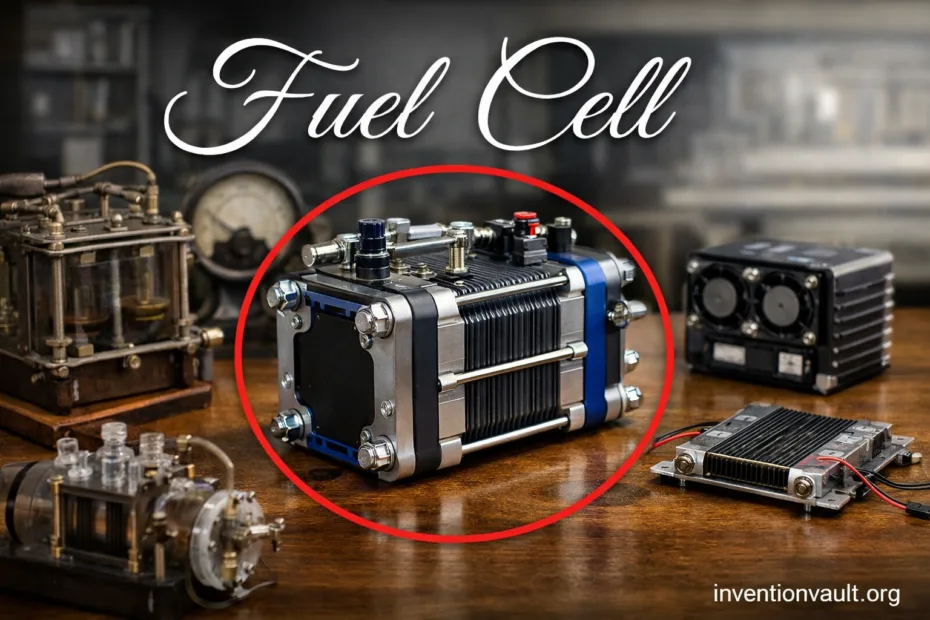
| Invention | Fuel Cell (electrical power generated by an electrochemical reaction) |
| Core Principle | Direct conversion of chemical energy into electricity via oxidation at the anode and reduction at the cathode, separated by an ion-conducting electrolyte |
| Early Scientific Foundation | Early experiments on combining gases at electrodes showed measurable electrical effects (19th century electrochemistry literature) |
| Early Publication Often Cited | W. R. Grove’s 1839 paper on the combination of gases by platinum (followed by fuller descriptions of gas-battery work in the early 1840s) |
| Key Early Figures | William Robert Grove (early experimental “gas battery”); F. T. Bacon (major step toward practical alkaline systems in the 20th century) |
| Minimum Building Blocks | Anode, cathode, electrolyte, plus a catalyst layer and pathways for fuel/air delivery |
| Common Reactants | Fuel (often hydrogen, sometimes hydrogen-rich fuels) and oxidant (usually oxygen from air) |
| Primary Outputs | Direct-current electricity and heat; many hydrogen systems also produce water as a reaction product |
| How Power Scales | Single cells produce modest voltage; practical systems connect many cells into a stack, then add balance-of-plant hardware (air handling, cooling, power electronics) |
| Main Families | PEMFC, AFC, PAFC, MCFC, SOFC, plus direct liquid-fuel variants (for specific niches) |
| Why It Matters | Quiet, modular power with high efficiency potential; widely studied for stationary power, mobility, backup systems, and aerospace power architectures |
| Engineering Priorities | Durability, materials stability, catalyst utilization, fuel quality tolerance, water/heat management, and system cost reduction |
A fuel cell is a disciplined idea: let chemistry do the work of electricity. Instead of burning a fuel to make heat and then converting heat into power, a fuel cell channels chemical reactions so electrons travel through an external circuit. The result is steady electricity from chemistry, produced as long as reactants are supplied.
- What A Fuel Cell Is
- Electricity From Chemistry
- How A Fuel Cell Works
- Anode Side
- Cathode Side
- Key Parts Inside A Fuel Cell
- Electrodes And Catalyst Layers
- Electrolyte And Ion Transport
- Bipolar Plates, Flow Fields, And Seals
- Stacks And Balance-Of-Plant
- Where The Idea Came From
- Main Fuel Cell Types
- PEM Fuel Cells
- Alkaline Fuel Cells
- Phosphoric Acid Fuel Cells
- Molten Carbonate And Solid Oxide Fuel Cells
- Fuel Choices and What They Change
- A Note On Byproducts
- Performance Measures That Explain Real-World Use
- Applications You Will Commonly See
- Stationary Power
- Mobility And Equipment
- Backup And Remote Power
- Aerospace And Specialty Systems
- Common Questions People Ask
- References Used for This Article
What A Fuel Cell Is
Fuel cells belong to electrochemistry: the science of chemical change that is inseparable from charge flow. Every practical design keeps the same backbone—two electrodes and an electrolyte—while refining materials, geometry, and operating conditions to suit a specific job.
Electricity From Chemistry
- At the anode, the fuel is oxidized, releasing electrons.
- The electrolyte carries ions inside the cell while blocking electrons.
- At the cathode, oxygen (or another oxidant) is reduced and the circuit is completed.
- Electrons choose the external path, so useful current is delivered to whatever is connected.
How A Fuel Cell Works
The cleanest mental model is a controlled “split” of responsibilities. The chemistry happens on surfaces; the ions move inside; the electrons move outside. That separation is not a detail—it is the mechanism that makes electrical power available.
Anode Side
Fuel reaches the anode through flow channels and porous layers. A catalyst encourages reactions that release electrons and create ions compatible with the electrolyte.
- Fuel delivery and distribution
- Surface reactions enabled by catalyst sites
- Water and heat management (design-dependent)
Cathode Side
Oxygen is supplied—often simply from air. It participates in reduction reactions and combines with ions and returning electrons, forming stable products such as water in many hydrogen systems.
- Oxygen transport through porous layers
- Electrode reactions and product formation
- Heat rejection or recovery depending on system goals
Because the cell is an electrochemical device, efficiency is shaped by reaction kinetics, losses across materials, and how effectively the system handles heat and water—not by the same limits that dominate combustion-only power plants.
Key Parts Inside A Fuel Cell
Fuel cells look simple in diagrams. Their real sophistication sits in the layers that decide how gases, ions, electrons, and heat move—without interfering with one another.
Electrodes And Catalyst Layers
Electrodes are engineered surfaces, often porous, designed to maximize reaction area while keeping flow paths open. Catalyst layers are tuned to accelerate reactions and reduce losses, allowing more of the fuel’s chemical potential to appear as electrical output.
Electrolyte And Ion Transport
The electrolyte is the traffic controller. It permits specific ions to pass while blocking electrons, forcing the electron pathway to run through the external circuit. Different electrolytes define entire fuel cell families because they influence temperature range, materials, and fuel tolerance.
Bipolar Plates, Flow Fields, And Seals
Plates distribute gases, collect current, and connect cells electrically. Flow-field patterns aim for uniform reactant access and effective removal of products. Seals keep reactants separated—fundamental for both performance and reliability.
Stacks And Balance-Of-Plant
A single cell is a unit of chemistry; a stack is a unit of power. Real systems add air handling, cooling, sensors, controls, and power electronics to deliver stable output for equipment, buildings, or vehicles.
Where The Idea Came From
The fuel cell’s origin story is rooted in a bold reversal: if electricity can split water into gases, could combining those gases produce electricity? Early electrochemistry explored that symmetry, and William Robert Grove’s 19th-century work is frequently cited for demonstrating electrical effects from gas combination at electrodes and developing the “gas battery” concept in the early 1840s.
For decades, fuel cells were scientifically intriguing yet hard to scale into robust machines. The path toward practical systems sharpened in the 20th century. Work associated with F. T. Bacon is widely referenced as a major step toward high-performing alkaline designs, and NASA’s space programs helped establish fuel cells as a proven power source under demanding conditions.
The enduring promise of the fuel cell is directness: chemical potential is converted into usable current with minimal intermediate steps.
Main Fuel Cell Types
Fuel cells are most often categorized by electrolyte. That single choice shapes ion species, operating temperature range, catalyst options, and suitable applications.
| Type | Electrolyte (Family) | Typical Temperature Class | Strengths Often Valued | Common Fit |
|---|---|---|---|---|
| PEMFC | Polymer electrolyte membrane | Low | Fast response, compact stacks, high power density | Mobility, backup power, distributed power modules |
| AFC | Alkaline electrolyte | Low | High performance with very pure reactants | Specialty systems; historically prominent in space power |
| PAFC | Phosphoric acid | Medium | Steady stationary operation, useful heat recovery potential | Stationary power and combined heat-and-power configurations |
| MCFC | Molten carbonate salts | High | Fuel flexibility and high-grade heat for industrial integration | Large stationary systems and industrial energy sites |
| SOFC | Solid ceramic oxide | High | Very high efficiency potential, broad fuel options | Stationary power, auxiliary power, long-duration operation |
| DMFC | Polymer-based (direct liquid fuel variant) | Low | Liquid fuel convenience for certain designs | Portable and niche power where compact refueling matters |
PEM Fuel Cells
Polymer electrolyte membrane fuel cells are widely discussed because they can be packaged compactly and respond quickly to changing power demand. Their electrolyte conducts ions while keeping gases separated, enabling consistent electrical output with careful water and thermal control.
Alkaline Fuel Cells
Alkaline systems have a long technical lineage, including prominent historical use in aerospace power. They perform strongly with very pure reactants, which makes reactant management a central design concern.
Phosphoric Acid Fuel Cells
Phosphoric acid designs are associated with steady stationary operation. They are often discussed alongside heat recovery because stationary installations can use both electrical output and useful thermal energy.
Molten Carbonate And Solid Oxide Fuel Cells
High-temperature families support distinct advantages: faster reaction kinetics, strong prospects for system efficiency, and broader compatibility with certain fuels. Their design focus shifts toward materials stability, thermal cycling, and long-life operation under sustained heat.
Fuel Choices and What They Change
Fuel cells are named for the cell, not the fuel, because multiple fuels can be used depending on type and system design. Still, the fuel selection sets the tone for everything else: purity needs, supporting hardware, and achievable lifetime.
- Hydrogen is the most direct option and is often paired with air as the oxidant.
- Hydrogen-rich fuels can be compatible in some architectures, with additional upstream processing handled by the system design.
- Some variants use liquid fuels for specialized portability requirements, trading different benefits and limitations.
- High-temperature families can accommodate a wider range of fuels, with materials and thermal management taking center stage.
A Note On Byproducts
In many hydrogen fuel cells, the electrochemical reaction forms water and heat alongside electricity. In systems using hydrogen derived from other fuels, upstream processing can influence overall emissions and efficiency, so system-level evaluation matters.
Performance Measures That Explain Real-World Use
Fuel cells are evaluated like serious power equipment. The most informative metrics describe electrical output, stability over time, and how gracefully a system handles heat, water, and changing demand.
- Efficiency: DOE materials commonly note that fuel cell systems can reach high electrical efficiencies in some stationary configurations, with even higher overall efficiency when useful heat is captured.
- Durability: performance retention over many operating hours, especially under cycling and variable load.
- Power density: how much power a stack delivers per unit volume or mass.
- Start-up behavior: how quickly a system reaches stable operation, strongly influenced by temperature class.
- Fuel and air management: maintaining uniform distribution, removing products, and protecting sensitive materials.
- Thermal integration: either rejecting heat reliably or recovering it where it adds value.
Applications You Will Commonly See
Stationary Power
Stationary systems value quiet operation, modular scaling, and steady efficiency. Many installations are designed so heat is not wasted, improving total energy use when the site can use thermal output.
Mobility And Equipment
Vehicles and mobile equipment highlight different strengths: rapid response, compact packaging, and long operating ranges when refueling logistics are well matched to the application.
Backup And Remote Power
For backup roles, the appeal is dependable power delivery with few moving parts and predictable runtime tied to available fuel supply.
Aerospace And Specialty Systems
Space programs demonstrated fuel cells under strict constraints: high reliability, high specific power, and valuable byproducts such as water in certain mission architectures.
Common Questions People Ask
Is a fuel cell the same as a battery? A fuel cell and a battery both use electrochemistry, yet a fuel cell is designed to keep producing power as long as it receives reactants, while a battery stores a fixed amount of reactants internally.
Why are there so many types? The electrolyte defines which ions move, what materials are stable, and what temperature range is practical. Those constraints naturally create families with different strengths.
Why does hydrogen appear so often? Hydrogen offers a direct, clean reaction pathway in many designs, producing water and heat as stable products while delivering electrical current through the external circuit.
What makes fuel cells feel “high-tech”? The performance depends on engineered interfaces—where gas, electrolyte, and catalyst meet—and on materials that maintain those interfaces over long operating time.
References Used for This Article
- U.S. Department of Energy — Fuel Cell Basics: Clear overview of fuel cell operation, components, and major categories.
- National Energy Technology Laboratory — Fuel Cell Handbook (Seventh Edition): Detailed reference on fuel cell fundamentals, types, and system-level considerations.
- NASA Technical Reports Server — The Fuel Cell in Space: Yesterday, Today and Tomorrow: Technical background on fuel cells in space power, including historical notes on practical systems.
- U.S. Department of Energy — Fuel Cells for Stationary Power Applications: Concise government summary of stationary fuel cell benefits and efficiency framing.
- Smithsonian National Museum of American History — A Basic Overview of Fuel Cell Technology: Museum overview explaining core components, stacks, and major fuel cell families.
- Smithsonian National Museum of American History — Fuel Cell Origins: 1840-1890: Historical overview of early fuel cell science and Grove’s “gas battery” concept.
- Zenodo — XXIV. On voltaic series and the combination of gases by platinum: Archived record of Grove’s 1839 article associated with early fuel cell history.
- Springer Nature Link — Birth of the Fuel Cell: Scholarly chapter summarizing early publications and milestones in fuel cell development.