| Primary Proposer | Robert (Bob) Metcalfe, who described the first design at Xerox PARC. |
| Key Collaborators | David Boggs (core collaborator) plus a broader PARC engineering team that helped implement early systems. |
| Organization | Xerox Palo Alto Research Center (PARC). |
| Location | Palo Alto, California (research lab setting focused on networked computing). |
| Design Memo Date | May 22, 1973 — a circulated memo where the word “Ethernet” appears early in documented form. |
| Early Working Network | 1973 — widely described as operational during that year; some accounts highlight November 1973 as an early “it works” milestone. |
| Early Data Rate | 2.94 Mb/s in early experimental form; later mainstream specifications moved to 10 Mb/s and beyond. |
| Early Medium | Shared coaxial cable acting as the common “channel,” with baseband signaling. |
| Core Access Idea | CSMA/CD (carrier sense multiple access with collision detection) for shared segments, enabling fair access without a central controller. |
| Standardization Path | DIX specification (Xerox–DEC–Intel, 10 Mb/s) influenced broad adoption; IEEE 802.3 became the long-running standards home. |
| Frame Size (Classic Ethernet) | 64–1518 bytes per frame (without VLAN tagging); 1522 bytes when an 802.1Q VLAN tag is present. |
| Payload (Typical) | 46–1500 bytes of payload in standard frames (padding used if payload is smaller). |
| Addressing | 48-bit MAC identifiers (EUI-48) used for local delivery on an Ethernet network. |
| Why The Name “Ethernet” | “Ether” described the shared medium where signals travel; a clear mental model for a broadcast cable that any station can use. |
| Why It Mattered | Simple wiring, repeatable rules, and a flexible frame format that scales from small offices to data centers. |
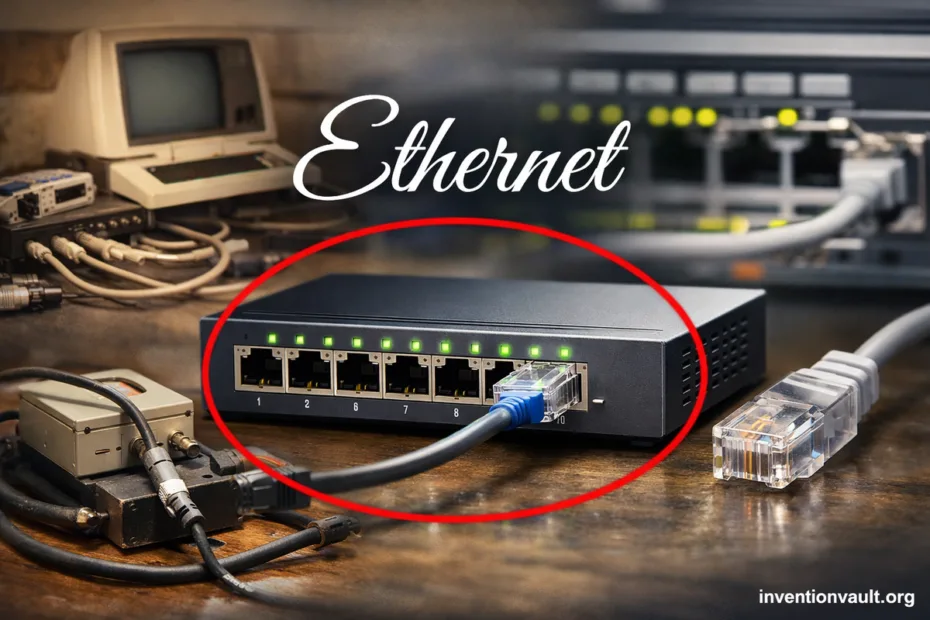
Ethernet is a family of wired networking technologies that move data as frames over copper or fiber. Under the IEEE 802.3 umbrella, it defines how devices share a link, how an Ethernet frame is structured, and how a switch can forward traffic with speed and predictability.
- What Ethernet Is
- What Ethernet Is Not
- How Ethernet Moves Data
- From Shared Cable To Switched Links
- Why Switching Changed Everything
- Physical Media and Major Ethernet Families
- Twisted Pair Copper
- Fiber Optic
- Special Cases and Legacy
- Ethernet Speeds and the Scaling Pattern
- Why Speed Labels Can Be Confusing
- Power over Ethernet
- Ethernet Terms That Actually Matter
- MAC Address
- MTU and Frame Size
- VLAN Tagging
- Link Aggregation
- Single-Pair Ethernet and Edge Devices
- Why Ethernet Endures
- References Used for This Article
What Ethernet Is
- Ethernet is both a link technology and a frame format used inside local networks.
- It relies on MAC addressing to deliver frames on the local segment, while IP typically handles end-to-end routing across networks.
- Modern switched Ethernet runs in full-duplex mode, sending and receiving at the same time on most links.
- It scales from short copper runs to long fiber links, keeping the same frame idea while swapping physical layers.
What Ethernet Is Not
- Ethernet is not the same thing as internet service; it is one way devices connect inside a network.
- An Ethernet cable is not always “faster” by magic; speed depends on link negotiation and hardware support.
- Ethernet does not replace routing; a router still decides how traffic moves between different networks.
- Not every Ethernet link uses the same medium: twisted pair, fiber, and legacy coax variants all exist.
Ethernet kept one powerful promise: a device can send a frame, every station can “hear” it on the medium, and only the right one accepts it.
How Ethernet Moves Data
An Ethernet frame is the unit of delivery on an Ethernet link. Each frame carries source and destination MAC addresses, a field that identifies the upper protocol (often called EtherType), and a trailer used for error detection.
| Frame Part | Typical Size | Why It Exists |
|---|---|---|
| Preamble + Start | 8 bytes | Synchronization so receivers lock onto the signal cleanly on a real cable. |
| Destination MAC | 6 bytes | Identifies the local recipient on the Ethernet segment. |
| Source MAC | 6 bytes | Shows who sent the frame, supporting switch learning and diagnostics. |
| Type (or Length) | 2 bytes | Tells the receiver what the payload means, like IPv4 or IPv6. |
| Payload | 46–1500 bytes | The actual data being carried, often an IP packet. |
| FCS | 4 bytes | A checksum (CRC) used to detect corruption on the wire. |
A Clear Way To Picture Frame Delivery
Think of an Ethernet frame as a sealed envelope. The destination MAC is the address on the front, the source MAC is the return address, and the payload is what’s inside. The FCS is the tamper check that helps catch damage in transit.
From Shared Cable To Switched Links
Early Ethernet often used a single shared medium. Stations listened for activity, transmitted when the line seemed clear, and relied on collision detection with timed retries when two devices talked at once. That logic made sense on a bus-style cable and later on hub-based layouts.
Most modern networks use Ethernet switches, giving each device a dedicated link. With full-duplex operation, collisions are not a normal part of the story anymore, and the network can deliver steadier latency and higher throughput across many concurrent conversations.
Why Switching Changed Everything
- A switch learns which MAC addresses live on each port, then forwards frames with precision instead of broadcasting everything.
- Each link can run at its best negotiated speed, so one slow device doesn’t steal the whole segment’s time.
- Full-duplex links reduce the old shared-medium constraints, improving consistency for demanding traffic.
Physical Media and Major Ethernet Families
Ethernet is a single idea expressed through multiple physical layers. The frame stays recognizable, while the signaling changes based on distance, noise, and desired capacity. Picking the right medium is about real-world constraints, not hype.
Twisted Pair Copper
The familiar RJ45 Ethernet cable is usually twisted pair copper. It dominates homes and offices because it’s practical, widely available, and supports autonegotiation for speed and duplex on most gear.
- Cat5e: commonly used for 1 GbE runs up to typical structured-cabling distances.
- Cat6: supports higher frequencies; often used for 10 GbE on shorter runs.
- Cat6A: built for 10 GbE across full-length channels in many installs.
- Cat8: aimed at very high speeds over short distances, common in rack and row environments.
Fiber Optic
Fiber Ethernet carries light instead of electrical signals, offering long reach and strong resistance to electromagnetic noise. It’s common for building links, data centers, and high-density switching.
- Multimode fiber: great for shorter structured runs with high capacity.
- Single-mode fiber: built for longer reach, often used between rooms or sites.
- Optics are chosen by reach and speed, while the Ethernet frame stays consistent.
Special Cases and Legacy
Ethernet’s history includes older coaxial forms and newer niche links. These options matter when you meet industrial constraints or need compatibility with existing infrastructure.
- Coaxial Ethernet: early bus media that shaped the original “shared ether” concept.
- Single-Pair Ethernet: brings Ethernet frames to sensors and edge devices over fewer conductors.
- Direct-attach cables: short copper assemblies used in dense equipment areas for clean cabling.
| Cable Category | Common Targets | Typical Notes |
|---|---|---|
| Cat5e | 1 GbE, often 2.5/5 GbE on suitable gear | Very common installed base; quality terminations protect real-world signal integrity. |
| Cat6 | 1 GbE, 10 GbE on shorter channels | Higher frequency headroom; distance matters for top speed. |
| Cat6A | 10 GbE across full structured runs | Designed for higher performance with better control of crosstalk and noise. |
| Cat8 | 25/40 GbE over short copper links | Best suited to short, dense environments; watch connector and channel specifications. |
Ethernet Speeds and the Scaling Pattern
One reason Ethernet feels timeless is its scaling rhythm. The same basic framing model keeps working as physical layers evolve from megabits to gigabits and into the realm of hundreds of gigabits. The practical result is simple: your switch port changes, not the whole way networks think.
| Era | Representative Rates | What Enabled It |
|---|---|---|
| Early LAN | 2.94 Mb/s then 10 Mb/s | Shared medium designs, simple access rules, and a repeatable frame format. |
| Office Backbone | 100 Mb/s and 1 Gb/s | Better cabling, improved signaling, plus widespread switching. |
| High-Demand Links | 10/25/40/100 Gb/s | Stronger PHYs, more efficient coding, and optical links where needed. |
| Scale-Out Networks | 200/400/800 Gb/s | Parallel lanes, advanced optics, and updated management parameters while keeping Ethernet framing. |
Why Speed Labels Can Be Confusing
A link rate (like 1 GbE or 10 GbE) is the raw signaling capacity of that port. Real transfer performance depends on protocol overhead, device limits, and how busy the network is. A clean, switched setup often feels faster because it delivers steadier bandwith and fewer pauses.
Power over Ethernet
Power over Ethernet (often shortened to PoE) lets one cable carry both data and electrical power. It’s widely used for Wi-Fi access points, IP phones, and many smart building devices, reducing the need for separate power adapters.
| PoE Family | Typical Name | Common Use Cases |
|---|---|---|
| 802.3af | PoE | Phones, basic access points, simple sensors with modest power needs. |
| 802.3at | PoE+ | Stronger access points, more capable cameras, and richer edge devices. |
| 802.3bt | Higher-Power PoE | High-performance access points, advanced cameras, and devices needing more headroom. |
PoE is designed with negotiation and detection so power is delivered intentionally, not blindly. That’s why many deployments treat PoE switches as clean building blocks for reliable, centrally managed edge power.
Ethernet Terms That Actually Matter
MAC Address
A MAC address is a local identifier used by Ethernet switching. It’s typically 48-bit (EUI-48) and helps a switch learn where devices live.
MTU and Frame Size
The default MTU in many Ethernet networks is 1500 bytes of payload. Standard frames sit in the familiar 64–1518 byte range, with a slightly larger size when VLAN tags are present.
VLAN Tagging
A VLAN logically separates traffic over shared switching hardware. The tag (commonly known as 802.1Q) adds a small header so one physical network can behave like multiple tidy networks.
Link Aggregation
Link aggregation groups multiple physical links into one logical connection for capacity and resilience. It’s common between switches where predictable throughput matters.
Single-Pair Ethernet and Edge Devices
As networks push closer to sensors and machines, Single-Pair Ethernet extends the Ethernet idea beyond typical four-pair cabling. It can carry Ethernet frames over fewer conductors, supporting edge scenarios where space, weight, or connector count is tightly limited.
One appealing part is how it keeps the Ethernet mental model intact. You still get familiar addressing and a recognized frame, but tuned physical layers make it realistic for distributed, long-reach, or multi-drop edge layouts.
Why Ethernet Endures
Ethernet lasts because it separates stable ideas from replaceable parts. The frame and local delivery model stay steady, while the physical layer keeps evolving to chase better reach, higher speed, and lower noise sensitivity.
That modular approach is quietly powerful. A network can upgrade from older copper to newer copper, or from copper to fiber, without abandoning the fundamental language of switching and Ethernet frames. It feels familiar, yet it keeps growing.
References Used for This Article
- Computer History Museum — Ethernet50: Confirms the May 22, 1973 memo and early Xerox PARC origins tied to Metcalfe and Boggs.
- IEEE Standards Association — IEEE 802.3-2022 (Standard for Ethernet): Defines Ethernet MAC/PHY behavior including CSMA/CD history and full/half-duplex operation.
- IEEE 802.3 Working Group — Ethernet Working Group Home: Provides the official working-group hub for current Ethernet project families and scope.
- IEEE Standards Association — IEEE 802.3af-2003: Establishes Power over Ethernet delivery over Ethernet cabling via the MDI power interface.
- IEEE Standards Association — IEEE 802.1Q-2022: Authoritative reference for bridged networks and VLAN-related switching behavior.
- IEEE Registration Authority — MAC Addresses: Explains EUI-48/EUI-64 address blocks used as MAC/Ethernet identifiers.
- ISO — ISO/IEC 11801-1:2017: Describes structured copper/fiber cabling requirements relevant to Ethernet physical media choices.
- DEC–Intel–Xerox — Ethernet Specification (Rev. 2.0, Nov 1982): Primary specification for Ethernet II framing conventions widely used in real-world networking.