| Detail | Information |
|---|---|
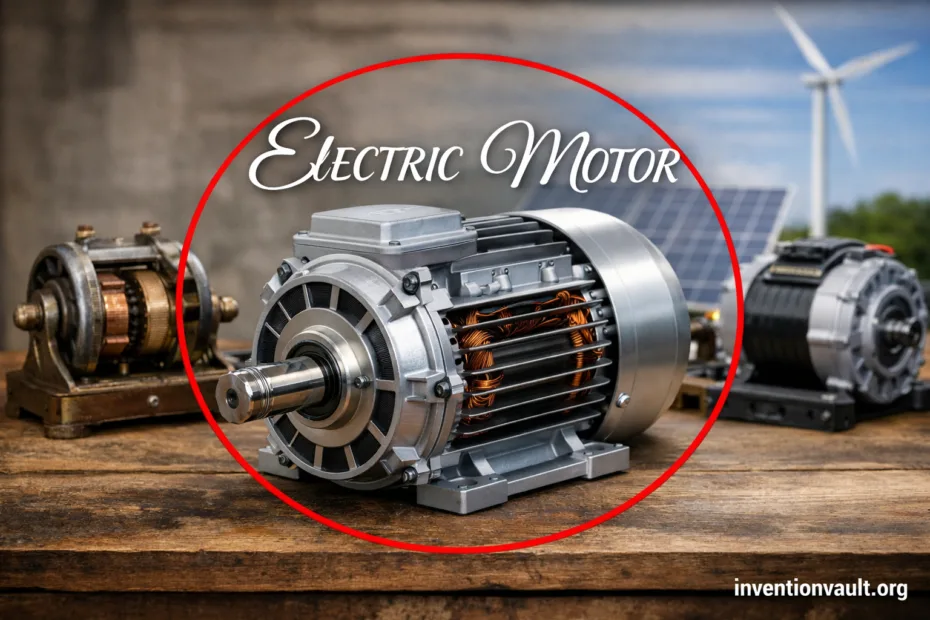
| Invention Name | Electric Motor |
| What It Does | Converts electrical energy into mechanical motion, most often rotation. |
| Core Physical Principle | Magnetic force on electric current creates torque on a rotor inside a magnetic field. |
| Why There Is No Single “One-Day” Inventor | The electric motor is a family of designs that matured from early laboratory rotation to practical machines over decades. |
| First Continuous Electromagnetic Rotation | Michael Faraday, demonstrated electromagnetic rotation on September 3, 1821. |
| Earliest Preserved Motor Apparatus | Faraday’s electromagnetic rotation apparatus, dated 1822, often presented as the first electric motor in physical form. |
| First Clearly “Work-Capable” Rotating Motor | Moritz Hermann Jacobi completed a practical rotating motor in May 1834 (continuous-duty output reported around 15 W). |
| Early Demonstration of Real-World Propulsion | Jacobi’s electrically driven paddle-wheel boat on the Neva River (demonstrated September 13, 1838; motor output reported about 300 W). |
| Often-Cited Early Motor Patent | Thomas Davenport received a widely cited early patent for an electric motor in 1837. |
| Major Breakthrough for Modern Power Systems | AC induction motor concept and system popularized by Nikola Tesla (patent filed October 12, 1887; granted May 1, 1888; public technical paper delivered May 16, 1888). |
The electric motor did not arrive as a single finished device. It emerged as a chain of ideas and hardware—each step turning a scientific insight into a machine that could do repeatable mechanical work. When people ask, “Who invented the electric motor?” the most accurate answer is a timeline: Faraday proving rotation was possible, Jacobi building a motor that could credibly power tasks, Davenport securing an early patent, and Tesla helping shift motors into an alternating-current era that scaled with electricity networks.
- Key Terms Used in Electric Motor History
- How Electric Motors Turn Electricity into Motion
- What Early Inventors Had to Solve
- From Faraday’s Rotation to Practical Machines
- Faraday Shows Continuous Rotation
- Jacobi Builds a “Work-Capable” Rotating Motor
- Davenport Secures an Early Motor Patent
- Milestones in the Invention Timeline
- Major Electric Motor Types
- Direct Current Motors
- Alternating Current Motors
- Electronically Commutated and Specialized Motors
- Core Parts and Design Advances
- Parts You Will See in Most Motors
- Where Electric Motors Do the Most Work
- Everyday Equipment
- Industry and Infrastructure
- Questions People Ask About the First Electric Motors
- Who “Invented” the Electric Motor?
- What Makes a Motor “Practical” in Historical Terms?
- Why Was the AC Induction Motor a Major Step?
- References Used for This Article
Key Terms Used in Electric Motor History
- Stator: the stationary magnetic part.
- Rotor: the rotating part that delivers torque.
- Torque: twisting force that produces rotation.
- Windings: coils that create magnetic fields.
- Commutator: a mechanical switch used in many early DC motors.
- Brushes: contacts that feed current to a rotating commutator.
- Rotating Magnetic Field: the key idea behind many AC motors.
- Induction: rotor currents are produced by changing magnetic fields, not direct wiring.
How Electric Motors Turn Electricity into Motion
An electric motor works because electricity and magnetism are linked. When current flows through a conductor, magnetic effects appear; when conductors sit in magnetic fields, they experience forces. Arrange those forces so they keep producing torque, and you get sustained rotation rather than a one-time twitch.
What Early Inventors Had to Solve
- Continuous rotation, not just a brief movement.
- Direction control, so torque keeps pushing the same way.
- Practical power, meaning enough output to move real loads.
- Reliable electrical supply, since early batteries were heavy and costly.
A useful mental model: a motor is a structured “argument” between magnetic fields and electric currents. The stator sets the field; the rotor carries currents (or becomes magnetized); and the geometry ensures the push keeps rotating the shaft.
From Faraday’s Rotation to Practical Machines
Faraday Shows Continuous Rotation
On September 3, 1821, Michael Faraday demonstrated a striking idea: an arrangement of current and magnetic field could produce continuous rotary motion. The demonstration mattered less for raw power and more for proof—electricity could be converted into ongoing mechanical motion.
A preserved electromagnetic rotation apparatus dated 1822 is often highlighted as an early physical example of a true electric motor. Early designs sometimes used materials now handled with strict safety standards, including mercury used as a conductor in certain historical setups.
Jacobi Builds a “Work-Capable” Rotating Motor
In May 1834, Moritz Hermann Jacobi completed a rotating motor that moved beyond demonstration into measurable performance. Reported continuous-duty power for that motor sits around 15 watts, with rotation speeds described in the range of roughly 60–130 rpm—numbers that made it possible to discuss motors as machines, not just curiosities.
Jacobi also made history on water. On September 13, 1838, he demonstrated an electrically driven paddle-wheel boat on the Neva River. Reports describe a motor output around 300 watts, a speed near 2.5 km/h, and capacity on the order of a dozen passengers.
Davenport Secures an Early Motor Patent
As motors matured, patents helped document what designers believed was new. Thomas Davenport received an influential early patent in 1837 that is frequently cited in historical accounts of the electric motor. Patent records and later technical histories emphasize that early patents did not mean the first physical motor ever built; they captured specific technical claims at a time when the field was evolving fast.
Milestones in the Invention Timeline
| Year | Milestone | Why It Matters |
|---|---|---|
| 1821 | Faraday demonstrates electromagnetic rotation. | Shows continuous motion from electricity is possible. |
| 1822 | Preserved Faraday rotation apparatus dated 1822. | Early physical example often presented as a first motor artifact. |
| 1834 | Jacobi completes a practical rotating motor (reported ~15 W). | Moves motor development toward measurable, repeatable work. |
| 1838 | Jacobi demonstrates an electrically driven paddle-wheel boat. | Signals that motors can push beyond the workshop into real tasks. |
| 1837 | Davenport receives an early electric motor patent. | Documents technical claims during an era of rapid experimentation. |
| 1887–1888 | Tesla files and receives a patent for an AC motor concept; delivers a major technical paper in 1888. | Helps establish the AC motor pathway that scales with power systems. |
Major Electric Motor Types
The “electric motor” is best understood as a set of related designs. The differences are not cosmetic; they shape efficiency, torque behavior, controllability, and where each motor thrives.
Direct Current Motors
- Brushed DC motor: uses a commutator and brushes to keep torque direction consistent.
- Permanent-magnet DC motor: simpler field creation, often compact.
- Series and shunt DC motors: classic variations that shape torque and speed behavior.
- Universal motor: a series-wound design that can run on AC or DC in many household tools and appliances.
Alternating Current Motors
- Induction motor: rotor currents are induced by the stator’s changing field; celebrated for robustness.
- Synchronous motor: rotor locks to the rotating magnetic field, maintaining precise speed under steady conditions.
- Single-phase and polyphase families: design choices that align with the available power supply and performance needs.
Electronically Commutated and Specialized Motors
- Brushless DC (BLDC): electronic switching replaces mechanical commutation; often compact and efficient.
- Stepper motor: moves in discrete steps for positioning.
- Switched reluctance motor: torque from a rotor’s tendency to align with magnetic circuits; often paired with modern power electronics.
- Linear motor: produces direct linear motion rather than rotation.
| Motor Type | Signature Trait | Common Uses |
|---|---|---|
| Brushed DC | Mechanical commutation with brushes. | Simple drives, educational setups, legacy systems. |
| AC Induction | Rotor torque from induced currents; sturdy construction. | Fans, pumps, compressors, industrial machinery. |
| Synchronous | Runs at field speed under steady operation. | Timing-critical industrial processes, some high-efficiency applications. |
| BLDC | Electronic commutation; high power density potential. | Computing, appliances, modern electric drives, precision equipment. |
| Stepper | Predictable stepwise motion for positioning. | Printers, instruments, CNC positioning stages. |
| Switched Reluctance | Torque from reluctance alignment; controller-driven. | Applications that prioritize robustness and wide speed range. |
Core Parts and Design Advances
Across centuries of development, the vocabulary stays remarkably consistent: stator, rotor, windings, magnetic materials, and mechanical support. What changes is how efficiently the motor turns input electricity into usable torque.
Parts You Will See in Most Motors
- Magnetic circuit: guides flux through iron/steel parts.
- Windings: create controllable fields and induced effects.
- Air gap: the engineered space where forces do their work.
- Bearings: support smooth rotation and long life.
- Switching method: mechanical (commutator) or electronic (inverter/controller).
A Turning Point in Motor Design
The move from mechanical commutation toward a rotating magnetic field reshaped what motors could do at scale. It opened a pathway to widely deployed AC motor systems, while later power electronics brought precise control to both AC and DC families.
Where Electric Motors Do the Most Work
Electric motors quietly deliver a large share of the mechanical motion in modern life, from small precision devices to heavy industrial systems. Their appeal is straightforward: clean local operation, high controllability, and strong efficiency potential when paired with well-designed drives.
Everyday Equipment
- Appliances (fans, pumps, compressors)
- Personal electronics (cooling and motion control)
- Tools (compact high-speed motors)
Industry and Infrastructure
- Manufacturing (machine drives)
- Water systems (pumping and treatment)
- Buildings (HVAC motion and air handling)
Questions People Ask About the First Electric Motors
Who “Invented” the Electric Motor?
It depends on what “invented” means. If it means proving continuous rotation, Faraday’s 1821 demonstration is central. If it means a work-capable rotating machine with reported performance, Jacobi’s 1834 motor is a landmark. If it means a patent that helped formalize motor claims, Davenport’s 1837 patent is often highlighted.
What Makes a Motor “Practical” in Historical Terms?
Historians usually look for repeatable output, credible measurement, and an ability to do a task beyond the bench. Jacobi’s reported power figures and his 1838 boat demonstration show a motor stepping into real-world work, even while early electrical supply remained a limiting factor.
Why Was the AC Induction Motor a Major Step?
AC motor concepts built around a rotating magnetic field helped reduce reliance on mechanical commutators, while matching the realities of large-scale electrical distribution. Tesla’s patent filing and his 1888 technical paper helped communicate and accelerate this direction in motor development.
References Used for This Article
- University of Niš University Library — “A New System of Alternate-Current Motors and Transformers” (PDF): Primary document for Tesla’s 1888 presentation details.
- Engineering and Technology History Wiki — Tesla’s Electro-magnetic Motor: Summarizes Tesla’s filing and grant dates and the shift toward AC motor concepts.
- Royal Institution — Michael Faraday’s Electric Magnetic Rotation Apparatus (Motor): Documents an early preserved motor apparatus dated 1822.
- Science Museum — Electric Motor: Provides an overview of Faraday’s 1821 rotation milestone and why it mattered.
- Karlsruhe Institute of Technology (KIT) — Jacobi’s Motor: Details Jacobi’s 1834 motor performance figures and the 1838 electric boat demonstration.
- German Patent and Trade Mark Office (DPMA) — Thomas Davenport Invents the Electric Motor: Explains Davenport’s 1837 patent significance within early motor history.
- OpenStax Physics — Motors, Generators, and Transformers: Clear physics-based explanation of torque production in a basic motor.
- U.S. Department of Energy — Electric Motors: Official definition of “electric motor” used in U.S. regulatory language.