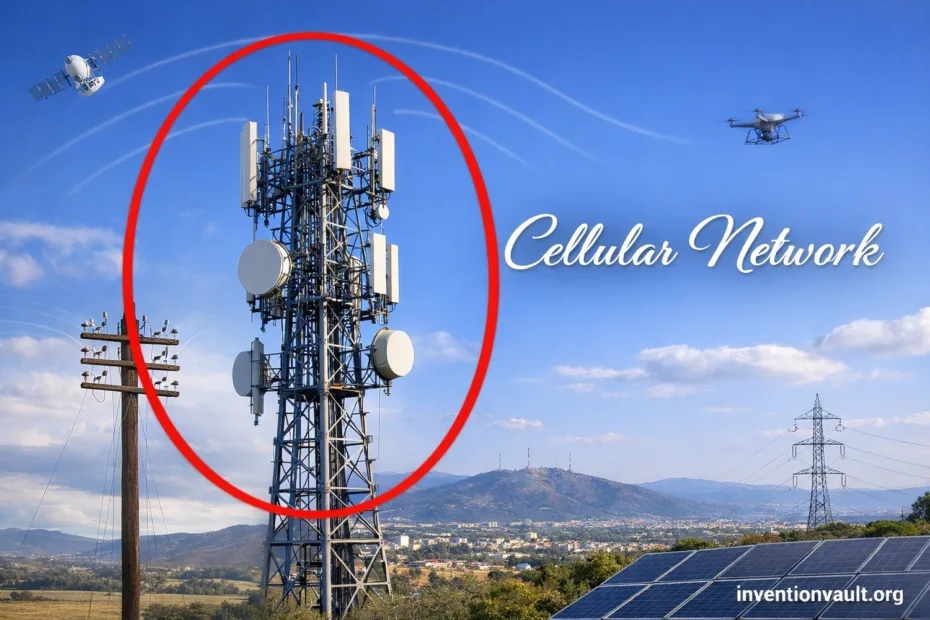
| Detail | Cellular Network Notes |
|---|---|
| Invention Name | Cellular network (mobile network with cells and handover) |
| Core Breakthrough | Frequency reuse across many small coverage areas, plus seamless handoff as users move |
| Why It Scales | One spectrum block can serve many people by reusing it in separated cells, guided by interference control |
| Early Documented Concept | Bell Labs work describing a cell-based layout and wide-area coverage ideas (mid-20th century) |
| Public Handheld Milestone | A famous early handheld cellular demonstration call in 1973 |
| First Commercial Cellular Era | Commercial analog cellular networks opened in 1979 (Japan) and expanded through the 1980s |
| Modern Standard Families | 3GPP technologies (GSM/UMTS/LTE/5G NR) and earlier regional families that shaped global roaming |
| Network Sections | Radio Access Network (RAN) + Core network + transport (backhaul/fronthaul) |
| Coverage Building Block | A cell (often split into sectors) served by a base station (site with antennas + radio equipment) |
| Identity and Access | Subscriber identity (commonly SIM/eSIM) with secure authentication to the network |
| Typical Frequency Regions | Low-band (long reach), mid-band (balanced), high-band (very high capacity, shorter reach) |
| Key Capacity Levers | Densification, sectorization, advanced antennas (MIMO), scheduling, and smarter spectrum use |
| Common Coverage Enhancers | Small cells, Distributed Antenna Systems (DAS), and carefully engineered indoor deployments |
| What “Coverage at Scale” Means | Many users get stable voice and data across cities, highways, and indoor spaces—without each user needing a dedicated frequency |
Cellular networks are the hidden infrastructure that makes mobile coverage feel effortless. A phone moves, a call stays clear, maps keep loading, and a message still goes out in a crowded street. That comfort comes from one big idea: split a region into cells, reuse spectrum with discipline, and let the network manage handover so the user never has to think about it.
- Cells, Towers, and Coverage
- The Scaling Trick: Frequency Reuse
- Handover: Staying Connected While Moving
- Spectrum and Bands
- Low-Band Coverage
- Mid- and High-Band Capacity
- RAN and Core: Two Halves of One System
- Cell Types and Why They Exist
- The Real “Capacity Levers” Behind Smooth Service
- Generations and What Changed
- What Your Phone Measures
- Indoor Coverage: Why It’s a Special Case
- Small Cells
- Distributed Antennas
- From Concept to Global Utility
- Key Terms You’ll See on Specs and Coverage Pages
- References Used for This Article
Cells, Towers, and Coverage
A cell is a planned coverage area served by a nearby base station. The base station is not “just a tower.” It is a site with antennas, radio units, and baseband processing that connects your device to the wider network. Operators place these sites so that coverage overlaps enough for smooth movement, yet stays organized enough for frequency reuse.
In practice, a single site often serves multiple sectors—think of it as slicing a circle into parts—so the same location can support more users with better directionality. This is where capacity and coverage meet: sector antennas help concentrate energy where people actually are, and they help limit interference so the network can keep reusing spectrum.
The Scaling Trick: Frequency Reuse
Early mobile systems were limited because a city had only so many usable radio channels. A cellular network changes the math. Instead of covering an entire city with one giant transmitter, the city is divided into many smaller cells that can reuse the same frequencies when spaced apart. That reuse is the heart of mobile coverage at scale, and it’s why cellular can serve millions of devices without needing millions of separate frequencies.
Reuse is not “free.” It demands careful engineering: power levels, antenna patterns, site spacing, and smart radio features that reduce interference. When this balancing act is done well, users experience stable signal, consistent data rates, and fewer drops—even as load changes across the day.
A simplified path of a mobile connection:

Phone/Modem
  ↓ (radio link)
Cell site (antennas + radios + baseband)
  ↓ (backhaul / transport)
Mobile core network (authentication + mobility + routing)
  ↓
Internet and phone networks
Handover: Staying Connected While Moving
Movement is where a cellular network proves itself. Your phone measures nearby signals and reports what it hears. The network then decides when to switch you from one cell to another, aiming for continuity with minimal disruption. When you hear people talk about “handoff” or “handover,” this is the mechanism that keeps a call alive while you walk, drive, or ride a train.
- Cell selection: your device attaches to a suitable cell based on signal quality and network rules.
- Measurement: it continuously checks neighbors and reports key metrics, often including signal strength and signal quality.
- Handover decision: the network chooses a target cell, considering load and radio conditions.
- Execution: the device re-attaches quickly, ideally with no user-visible interruption.
If a handover feels “bad,” it’s usually because the next cell is too weak, too busy, or too noisy. Good networks design overlap zones so the phone can find a strong neighbor in time, and so teh network can move users without stress. That overlap is a quiet hallmark of coverage engineering and capacity planning.
Spectrum and Bands
A cellular network lives inside licensed spectrum bands. Different frequencies behave differently, and operators mix them to get both reach and speed. A simple mental model helps: lower frequencies travel farther and penetrate buildings better, while higher frequencies can deliver more capacity but usually cover smaller areas.
Low-Band Coverage
Low-band spectrum is prized for wide-area coverage. It supports large cells, helps along highways, and often improves indoor reach. For many users, this is the layer that makes a phone feel reliable in everyday movement.
Mid- and High-Band Capacity
Mid-band often delivers the best balance of coverage and capacity. High-band layers can add huge capacity in dense zones, typically using smaller cells and more sites. Together, these layers help a network scale to crowds without sacrificing coverage.
RAN and Core: Two Halves of One System
People often picture “the network” as towers. In reality, cellular is a full system: the Radio Access Network handles the radio link, and the core network handles identity, mobility, and routing to voice and data services. That division is one reason cellular networks can evolve from one generation to the next without replacing everything at once.
| Part | Main Job | What You Notice as a User |
|---|---|---|
| RAN | Radio link, scheduling, handover, air-interface features | Signal bars, speed swings, call stability in motion |
| Transport | Moves traffic between sites and the core (backhaul) | Consistency under load, less buffering in busy hours |
| Core | Authentication, mobility management, IP routing, voice service integration | Fast attach, smooth roaming, dependable messaging |
Cell Types and Why They Exist
“A cell” is not one-size-fits-all. Modern networks combine several cell types to match geography and demand. This mix is a direct answer to coverage at scale: large cells for reach, smaller cells for dense areas, and specialized indoor systems for complex buildings. The names below are used widely, even if exact definitions vary by vendor and deployment style.
| Type | Typical Placement | What It’s Best At |
|---|---|---|
| Macrocell | Outdoor sites covering broad areas | Wide-area coverage and mobility support |
| Microcell | Street-level or dense urban layers | Extra capacity with tighter coverage control |
| Picocell | Indoor public spaces (malls, stations) | Targeted indoor coverage and localized capacity |
| Femtocell | Small indoor nodes, often limited-area use | Very local coverage improvements |
| DAS | Buildings, venues, tunnels (distributed antennas) | Even indoor coverage over hard-to-reach layouts |
The Real “Capacity Levers” Behind Smooth Service
When a city gets more users, a network cannot rely on hope. It uses proven engineering levers that increase capacity and protect coverage. The best part: many of these upgrades improve the experience without changing anything on your phone, because the intelligence is in the network design and radio planning.
- Densification: add more sites or small cells so each cell serves fewer users and shorter distances.
- Sectorization: split a cell into more sectors so the same site can handle more traffic with better directionality.
- MIMO and advanced antennas: use multiple transmit/receive paths to increase throughput and improve link robustness.
- Smarter scheduling: allocate time and frequency resources efficiently so users share the air interface fairly.
- Carrier aggregation: combine multiple spectrum channels to deliver higher peak rates where supported.
- Interference coordination: reduce cell-to-cell noise so frequency reuse remains effective at high load.
Generations and What Changed
Cellular generations are not just marketing. Each step introduced practical changes that improved coverage, capacity, and service variety. The details can get deep fast, so the table below focuses on the user-visible shift and the network-level idea behind it.
| Generation | Main Direction | Network Impact |
|---|---|---|
| 1G | Analog voice | Commercial cellular becomes real at city scale |
| 2G | Digital voice + messaging | Better spectral efficiency and robust signaling features |
| 3G | Mobile data expands | More consistent packet data; improved mobility handling for data services |
| 4G (LTE) | All-IP broadband | High throughput and lower latency for modern apps |
| 5G | Flexible layers + massive capacity | New spectrum options, advanced antennas, and network slicing concepts |
What Your Phone Measures
Your phone does not judge a cell site by height or brand. It evaluates link quality using radio measurements that help the network decide scheduling and handover. Better measurements mean better decisions, which often means better coverage and a steadier data experience.
- Signal strength: how much usable energy arrives at the device (reach).
- Signal quality: how clean that signal is compared to noise and interference (clarity).
- Load effects: a strong signal can still feel slow if the cell is busy; the network shares capacity among active users.
- Indoor loss: walls, glass, and structure materials can reduce or scatter signals; low-band often helps here.
Indoor Coverage: Why It’s a Special Case
Outdoor coverage maps can look perfect while indoor service still struggles. Buildings reshape radio waves in complex ways, and dense venues create intense demand spikes. That’s why operators use indoor-focused tools like small cells and DAS, designed to deliver predictable coverage where people actually spend time.
Small Cells
Small cells bring the network closer to the user. Shorter distance usually means better link quality and higher capacity. They are especially valuable for busy streets, stadiums, and large indoor spaces where one macro layer can’t carry the full load.
Distributed Antennas
DAS uses multiple antennas spread through a venue, connected back to central equipment. The goal is not just “more bars.” It’s even coverage across corridors, floors, and corners that would otherwise become dead spots.
From Concept to Global Utility
Cellular networking matured through decades of practical deployments: early research into cell layouts and reuse, landmark public demonstrations that proved portability, and commercial networks that showed city-scale viability. Over time, standards made phones and networks interoperable, so a user could depend on consistent service rather than one-off systems.
Cellular is not a single gadget. It is a system invention: radio engineering, network routing, identity management, and capacity planning working as one reusable platform.
Key Terms You’ll See on Specs and Coverage Pages
- Base station: the fixed radio equipment serving a cell; often called a “site.”
- Cell: a coverage area served by a base station; frequently split into sectors.
- Handover: switching your connection between cells to maintain continuity while moving.
- RAN: the radio part of the network; where the air interface is managed.
- Core network: the central system for authentication, mobility, and routing to services.
- Spectrum: the licensed frequency ranges used for cellular transmissions.
- Roaming: using partner networks so service continues beyond the home network footprint.
- Small cell: low-power node that boosts capacity and coverage in localized areas.
- MIMO: multiple antennas improving capacity and reliability through advanced signal processing.
References Used for This Article
- FCC — History of Commercial Radio: Notes the widely cited 1973 first public handheld cellular call milestone in the U.S.
- 3GPP — 5G System Overview: Summarizes 5G NR and the overall system architecture at a standards-body level.
- 3GPP — Specifications & Technologies: Explains how 3GPP publishes and maintains the specification set across releases.
- ITU-R — IMT-2020 (a.k.a. “5G”): Provides the official ITU-R program hub for IMT-2020 scope and documentation.
- ITU-R — Report ITU-R M.2410 (Minimum requirements related to technical performance for IMT-2020 radio interface(s)): Defines baseline performance requirements used to evaluate candidate IMT-2020 radio technologies.
- NTT DOCOMO — White Paper 5G Evolution and 6G (Version 5.0): Includes a documented operator statement about NTT’s 1979 launch of a cellular-system mobile service in Japan.
- ETSI — 2G: Global System for Mobile Communication (GSM): Gives an official overview of GSM standardization and links into the relevant specification families.