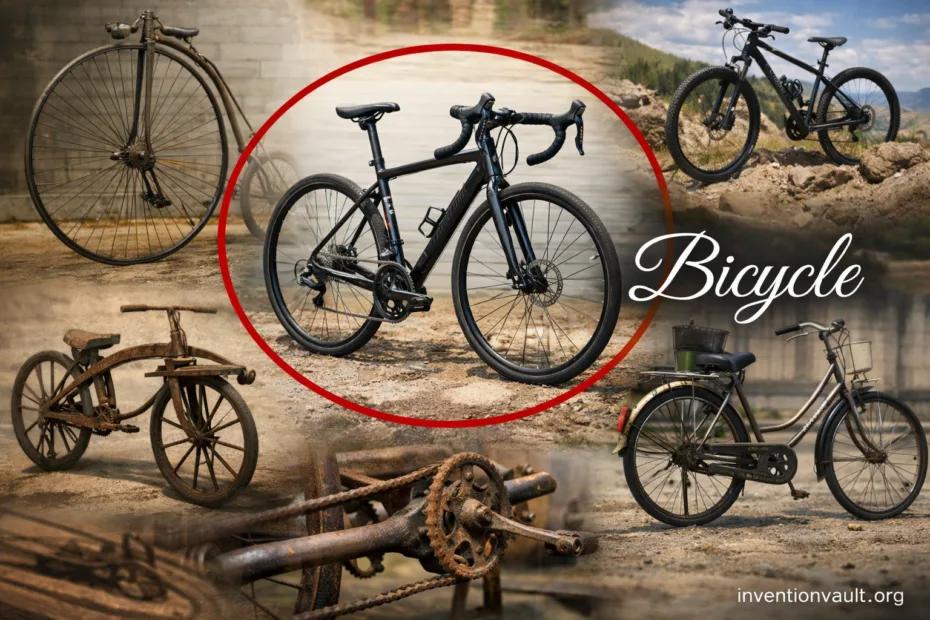
| Invention | Bicycle (Simple human-powered two-wheel transport) |
|---|---|
| Primary Purpose | Personal mobility using direct human effort with high mechanical efficiency |
| Core Operating Idea | Two inline wheels reduce rolling resistance; a drivetrain converts leg motion into wheel rotation while steering manages balance |
| Early Documented Forerunner | Karl Drais’s running machine (1817; surviving examples are often dated around 1818) |
| Modern Template | Chain-driven safety bicycle pattern (Rover design, 1885) |
| Comfort Breakthrough | Pneumatic tyre patent milestone (1888), accelerating everyday practicality |
| Essential Components | Frame, fork, wheels, steering, drivetrain (cranks/chain/sprockets), braking, rider contact points |
| Major Material Eras | Wood → iron/steel → alloy steels → aluminum alloys → advanced composites (alongside continued steel use) |
| Common Subtypes | Road, mountain, city, touring, cargo, folding, BMX, track, recumbent |
A bicycle is a remarkably direct idea: human energy becomes smooth forward motion through a compact set of parts that work in quiet agreement. Its history is not a single “lightbulb moment.” It is a chain of refinements—steering that feels predictable, wheels that roll cleanly, tires that soften vibration, and a drivetrain that turns leg power into useful speed with minimal waste.
- Bicycle Overview
- What A Bicycle Is
- How The Bicycle Works
- Power Path: Pedals To Wheel
- Stability and Steering
- Braking and Control
- Origins and Early Prototypes
- The Safety Bicycle Pattern
- Tyres, Bearings, and the Comfort Leap
- Key Parts and Why They Matter
- Bicycle Types and Subtypes
- Gears and Drivetrains
- Materials and Manufacturing
- Why This Invention Stays Relevant
- References Used for This Article
Bicycle Overview
Key Historical Milestones
- 1817 — Drais’s steerable running machine establishes the two-wheel, in-line balance concept.
- Early 1860s — Pedal-driven velocipedes appear, shifting propulsion from feet-on-ground to cranks.
- 1870s — High-wheel designs explore speed through large front wheels.
- 1885 — The Rover Safety pattern (chain drive, similar wheel sizes) sets a durable layout.
- 1888 — Pneumatic tyres reach a key patent milestone, improving ride quality and traction feel.
- 1890s — Manufacturing scale and braking refinements help bicycles become everyday machines.
What Makes It A Bicycle
- Two wheels arranged in line, designed to be balanced by the rider while moving.
- Steering through a front fork and handlebar system.
- Human-powered propulsion via pedals and cranks (most commonly through a chain-and-sprocket drivetrain).
- A frame that holds geometry steady while allowing efficient force transfer.
- Brakes that manage speed predictably across common surfaces.
What A Bicycle Is
In technical terms, a bicycle is a human-powered vehicle that uses rolling contact (wheels and tyres) plus a simple transmission (cranks, chain, sprockets) to move a rider with surprising efficiency. The design rewards clean alignment: when the frame, wheels, and drivetrain sit in the right relationship, a small, steady input can travel a long way with low energy loss.
Core Systems Working Together
- Support — The frame and fork carry load and preserve geometry under pedaling and braking forces.
- Motion — The drivetrain converts leg force at the cranks into torque at the driven wheel.
- Guidance — Steering inputs shift the contact patch under the rider, enabling balance while turning.
- Control — Brakes manage speed by applying friction at the rim, disc, or hub.
- Comfort — Tyres, pressure, and frame compliance shape vibration and surface feel.
How The Bicycle Works
Power Path: Pedals To Wheel
Push on the pedals and the cranks rotate. That rotation turns a front chainring, pulls the chain, and rotates a rear sprocket connected to the rear wheel. The key is mechanical advantage: different sprocket sizes change how much torque reaches the wheel for a given pedal force.
Stability and Steering
A bicycle stays upright while moving because steering can continuously place the front wheel under the combined center of mass. Geometry matters—head angle, fork offset, and wheelbase influence how the bike “self-corrects.” Riders feel this as calm tracking or quick turning, depending on the layout and wheel size.
Braking and Control
Brakes turn motion into heat through friction. Rim brakes act at the wheel’s rim; disc brakes act at a rotor near the hub; hub brakes place the friction system inside the hub. Each approach reflects a simple engineering trade: heat handling, exposure to weather, weight, and maintenance style.
A bicycle is a compact lesson in engineering: balance, leverage, rolling resistance, and control—built into one everyday machine.
Origins and Early Prototypes
The bicycle’s family tree begins with a two-wheel idea that already contained the essential challenge: balancing while traveling in a straight line. In 1817, Karl Drais designed a steerable, two-wheeled “running machine” propelled by walking. Surviving examples and museum records place this design at the start of the documented bicycle story.
Later, pedal power arrived. By the early 1860s, pedal-driven velocipedes appeared, moving propulsion from feet-on-ground to cranks. This shift changed everything: once legs could drive rotation continuously, designers could refine frames, wheels, and gearing around a stable power source rather than intermittent pushing.
The Safety Bicycle Pattern
Many layouts were tried, yet one arrangement proved unusually durable: two wheels of similar size, a low rider position, and a chain driving the rear wheel. In 1885, John Kemp Starley’s Rover design is widely recognized as the first successful “safety” bicycle to set the modern pattern—stable proportions, chain drive, and a form that looks familiar even now.
Why The Rover Layout Endured
- Weight placed lower, helping stability during starts and stops.
- Chain drive separates wheel size from pedaling position, opening the door to efficient geometry.
- Similar wheel sizes simplify handling and allow predictable steering behavior.
- The frame becomes a clear structure for mounting brakes, bearings, and later gearing systems.
Tyres, Bearings, and the Comfort Leap
A bicycle can only be as good as its rolling parts. Improvements in bearings, wheel construction, and braking hardware steadily raised performance. One change, though, transformed ride feel for everyday roads: the pneumatic tyre. A key patent milestone for John Boyd Dunlop’s pneumatic tyre arrives in 1888, and its spread helped bicycles deliver a smoother, more controllable ride over rough surfaces.
With comfort and control improving, adoption accelerated. In the United States, Smithsonian estimates show production rising from about 200,000 bicycles in 1889 to about 1,000,000 by 1899, alongside continuing refinement of brakes through the 1890s.
Key Parts and Why They Matter
| Component | Job | Common Forms |
|---|---|---|
| Frame | Holds geometry, transfers forces, supports rider load | Diamond frame, step-through, mixed-tube designs |
| Fork | Connects steering to the front wheel | Rigid fork, suspension fork (off-road focused) |
| Drivetrain | Turns pedaling into wheel rotation | Single-speed, multi-sprocket, internal gearing, belt drive |
| Wheels | Provide low-resistance rolling and structural support | Spoked wheels, varied diameters, different rim profiles |
| Tyres | Grip, comfort, and rolling characteristics | Narrow road tyres, wider mixed-surface tyres, knobby off-road tyres |
| Brakes | Control speed through friction | Rim brakes, disc brakes, hub brakes |
Bicycle Types and Subtypes
“Bicycle” is a broad category. Once the core template settled, designers tuned geometry, tyres, and contact points for different surfaces and loads. The names vary by region, yet the underlying distinctions are consistent: wheel choice, tyre width, frame angles, and the placement of the rider relative to the wheels.
| Type | Designed For | Defining Traits |
|---|---|---|
| Road | Paved speed and efficiency | Light frames, narrow tyres, aerodynamic riding position |
| Mountain | Trails and uneven terrain | Wide tyres, strong wheels, often suspension |
| City | Everyday short trips | Upright posture, practical fittings, durable components |
| Touring | Distance with cargo | Stable geometry, mounting points for racks, wide gear range |
| Cargo | Carrying heavy loads | Extended frames, reinforced wheels, load-focused steering geometry |
| Folding | Compact storage | Hinges and latches, smaller wheels, portability-first design |
| BMX | Tracks and tricks | Small wheels, strong frames, simple drivetrains |
| Track | Velodrome racing | Fixed gear, no coasting, tight geometry |
| Recumbent | Laid-back ergonomics | Reclined seat, altered aerodynamics, varied wheel layouts |
Gears and Drivetrains
Many bicycles use gearing to keep pedaling efficient across different speeds and slopes. The central concept is gear ratio: how many wheel rotations result from one crank rotation. Ratios can be changed externally with a derailleur and multiple sprockets, or internally with a sealed gear hub. Single-speed systems simplify the chain line and reduce moving parts, while multi-speed systems expand the usable range without changing wheel size.
Common Drivetrain Families
- Single-speed — One ratio, minimal complexity.
- Derailleur — External shifting across multiple sprockets, wide range and light weight.
- Internal gear hub — Enclosed shifting, protected from weather and impacts.
- Belt drive — Quiet, clean transmission paired with compatible sprockets and often internal gearing.
Materials and Manufacturing
Bicycles have been built from many materials, yet the engineering priorities stay steady: strength, stiffness where needed, fatigue resistance, and repairability. Steel remains valued for durability and predictable behavior. Aluminum alloys reduce weight and resist corrosion. Advanced composites can deliver precise stiffness tuning and aerodynamic shapes. Each material choice shapes how the frame responds to pedaling loads, road vibration, and long-term wear.
Why This Invention Stays Relevant
The bicycle persists because it solves a basic problem elegantly: moving a person efficiently with a machine that is easy to store, straightforward to maintain, and adaptable to many environments. From compact city frames to long-wheelbase cargo designs, the bicycle remains a living invention—stable in its core template, open to continual refinement in tyres, braking, and drivetrain engineering.
References Used for This Article
- Smithsonian National Museum of American History — The Safety Bicycle and Beyond: Explains the safety-bicycle shift and late-1800s innovations such as pneumatic tyres, improved brakes, and production growth.
- Science Museum Group Collection — Rover ‘Safety’ Bicycle, 1885: Collection record detailing J. K. Starley’s 1885 Rover design and its chain-driven modern layout.
- The Henry Ford — Draisine, circa 1818: Artifact description connecting the early two-wheeled running machine to the bicycle’s documented beginnings.
- Encyclopaedia Britannica — Bicycle: Reference overview covering definition, core components, and major historical development stages.
- German Patent and Trade Mark Office (DPMA) — Dunlop´s Pneumatic Tyre: Summarizes Dunlop’s pneumatic-tyre milestone and its patent-era significance for cycling comfort.