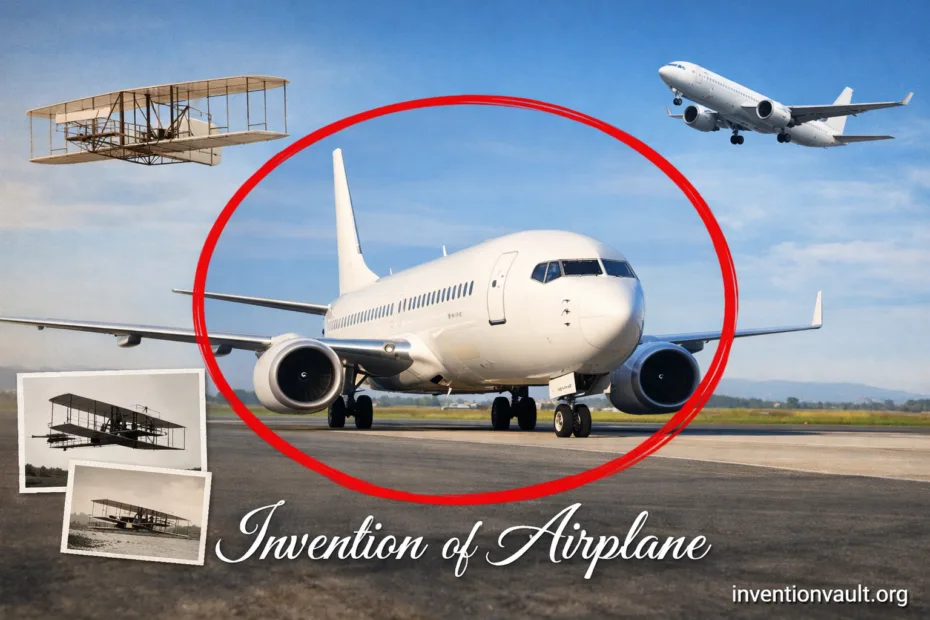
| Invention | Powered, piloted, heavier-than-air fixed-wing aircraft (airplane / aeroplane). |
|---|---|
| Defining Breakthrough | Controlled flight in three dimensions (pitch, roll, yaw) combined with onboard power. |
| Widely Credited Pioneers | Wilbur and Orville Wright (the Wright brothers). |
| Milestone Often Cited As The First | December 17, 1903: the first powered, sustained, and controlled flights with the Wright Flyer. |
| Aircraft | 1903 Wright Flyer (also called Flyer I / Kitty Hawk Flyer in some records). |
| Location | Kill Devil Hills near Kitty Hawk, North Carolina, United States. |
| Documented Performance That Day | First flight: 12 seconds over 120 feet (36 m). Best flight: 59 seconds over 852 feet (260 m). |
| How We Know | Surviving artifacts and museum records, contemporary photographs, and early patent documentation tied to flight control. |
| Power Source | Lightweight gasoline internal combustion engine (about 12 horsepower). |
| Propulsion | Two wooden propellers driven by chains; designed as efficient rotating wings, not simple “screws.” |
| Primary Materials | Wooden airframe with fabric covering, built to minimize weight while staying stiff enough to hold airfoil shape. |
| Next Major Step | By 1905, improved designs achieved longer, repeatable flights and more practical handling, demonstrating the airplane as a usable machine. |
When people say “the airplane was invented,” they usually mean one specific leap: a machine that could take off under its own power, stay aloft long enough to prove it was not a fluke, and be steered with intention. Many earlier designs could climb briefly or glide beautifully, yet the airplane became a true invention only when control was solved as carefully as lift and power.
- Defining The Invention
- What “Airplane” Means Here
- Why The Definition Matters
- Problems That Had To Be Solved
- Steps Before 1903
- From Gliders To A Powered Airplane
- The Often Missed Detail: Control Came First
- The 1903 Wright Flyer In Detail
- Airframe And Wings
- Engine And Propellers
- Control: The Three-Axis Solution
- A Common Misunderstanding
- How Wind Tunnel Data Shaped The Design
- Propellers As Rotating Wings
- Early Airplane Variants And Related Designs
- Wing And Airframe Layouts
- Operating Environments
- From First Flights To Practical Aviation
- Why The Airplane Matters As An Invention
- Important Terms
- References Used for This Article
The airplane is not “a wing plus an engine.” It is a system: aerodynamics, structure, propulsion, and pilot control working together.
This system view explains why aviation history can feel confusing at first. Different inventors achieved different “firsts.” The core story becomes clearer once you define what qualifies as an airplane in the strict invention sense.
Defining The Invention
What “Airplane” Means Here
An airplane is a powered, piloted fixed-wing aircraft that achieves sustained flight while remaining steerable in real time. That definition may sound strict, yet it matches how engineers evaluate whether a design is truly flyable.
Why The Definition Matters
Many early machines managed brief hops. The invention of the airplane is best understood as the first time powered flight became repeatable and controllable, not merely impressive.
| Criterion | What It Proves | Typical Evidence |
|---|---|---|
| Powered | The aircraft carries its own thrust source rather than relying on a push or a tow. | Engine specs, propeller drive layout, eyewitness accounts of powered climb. |
| Sustained | Flight lasts long enough to demonstrate real aerodynamic support, not a single bounce. | Measured time and distance, repeated flights on the same day or season. |
| Controlled | The pilot can steer and stabilize the machine while airborne. | Control surfaces, pilot inputs, documented turns and corrections. |
| Repeatable | The design can be flown again with consistent results. | Development sequence (gliders → powered versions), multiple test flights. |
Problems That Had To Be Solved
Airplane invention did not hinge on one lucky day. It required a chain of solutions that had to fit together with little room for error.
- Lift and drag: wings need enough lift with manageable drag at realistic speeds.
- Structural integrity: the airframe must stay rigid enough to hold its shape without becoming too heavy.
- Propulsion: the power-to-weight ratio must be high enough to accelerate into flying speed.
- Control: the pilot must command pitch, roll, and yaw without the aircraft diverging into instability.
Steps Before 1903
Long before powered flight, pioneers built the intellectual and practical foundations. Some clarified the forces acting on a wing; others proved that full-scale gliding was possible; still others advanced engines and structures. Each contribution narrowed the problem until a complete system could finally emerge.
| Period | Pioneer Or Program | What Changed | Why It Mattered |
|---|---|---|---|
| Early 1800s | Sir George Cayley | Separated lift, thrust, and stability into distinct design tasks. | Modern airplane layout (wing + tail) becomes a coherent engineering concept. |
| 1891–1896 | Otto Lilienthal | Thousands of controlled glides with full-size winged machines. | Proved sustained gliding was practical and made aerodynamic research tangible. |
| 1896 | Octave Chanute And Collaborators | Systematic glider experiments and improved structural ideas. | Shared test knowledge broadly and refined practical airframe building. |
| Late 1890s–Early 1900s | Multiple engine and airframe efforts | Better lightweight engines and fabrication methods. | Raised the ceiling for what could be powered without becoming too heavy. |
From Gliders To A Powered Airplane
The Wright brothers approached flight like disciplined designers. They tested gliders to learn stability and handling, then used that knowledge to decide where power belonged in the system. Their 1902 glider was a turning point because it moved beyond “staying up” and toward staying in command.
The Often Missed Detail: Control Came First
It is tempting to treat the engine as the “magic ingredient.” Yet, without reliable control, a powered machine simply becomes a faster way to crash. The Wrights treated pilot control as the central invention problem and designed power around it.
The 1903 Wright Flyer In Detail
Airframe And Wings
- Configuration: biplane layout for strong lift at low speeds.
- Wing shape: a carefully chosen airfoil profile to balance lift and drag.
- Structure: lightweight wood framework with fabric covering to hold aerodynamic form.
- Launch method: a rail and headwind helped reach flying speed on sandy ground.
Engine And Propellers
- Engine: a compact gasoline engine, roughly 12 hp, built to meet strict weight limits.
- Propellers: two wooden propellers driven by chains, designed for efficiency rather than brute force.
- Insight: propellers were treated as rotating wings, calculated like airfoils.
- Result: enough thrust to sustain flight without overpowering the fragile airframe.
Control: The Three-Axis Solution
“Control” sounds abstract until you map it onto the sky. In any gust, a fixed-wing aircraft can tilt, pitch up or down, or swing left and right. The practical airplane needed a way for a pilot to correct all three motions quickly and predictably.
| Axis Of Motion | What The Pilot Needs | Typical Control Surface | Practical Effect |
|---|---|---|---|
| Pitch | Nose up / nose down authority | Elevator (often at the tail; on early Wright designs, a forward elevator was used) | Sets climb or descent and stabilizes altitude changes. |
| Roll | Level wings, bank into a turn | Ailerons (or wing-warping in early designs) | Controls banking, turning, and recovery from side gusts. |
| Yaw | Nose left / right alignment | Rudder | Keeps the aircraft coordinated, reducing unwanted sideways slip. |
This is where many “first airplane” summaries become too thin. The deepest innovation was not merely moving a flap. It was recognizing that roll and yaw must work together in a turn, and building a control logic that a human could actually manage in real time.
A Common Misunderstanding
Stability and control are not the same thing. A very stable craft can be hard to turn. A very maneuverable craft can be easy to upset. The early airplane had to find a workable balance, so the pilot could correct the aircraft without fighting it.
How Wind Tunnel Data Shaped The Design
Early aeronautics suffered from a quiet problem: bad numbers. If your lift and drag estimates are off, you may build a wing that looks right but performs wrong. Wind tunnel testing offered a way to compare wing shapes under controlled airflow and choose designs based on measurement rather than guesswork.
- Why testing mattered: small changes in curvature and angle can shift the lift-to-drag balance.
- What was learned: which airfoils produced more lift with less drag in the speeds early engines could reach.
- What it enabled: wings and propellers that were sized realistically for the available power.
Propellers As Rotating Wings
A propeller is not just a spinning paddle. Each blade is shaped like an airfoil, and each section of the blade meets the air at its own effective angle. Treating propellers as rotating wings made it possible to design them for efficiency, producing useful thrust from limited horsepower without wasting energy in turbulence.
Early Airplane Variants And Related Designs
Once powered, controlled flight was demonstrated, inventors refined the airplane into families of designs. These are not separate inventions so much as branches of the same core idea: the fixed-wing aircraft.
Wing And Airframe Layouts
- Biplane: two wings stacked, helpful when materials limited wing strength.
- Monoplane: a single main wing, later favored as structures improved.
- Canard: a forward elevator surface; used in several early experiments.
- Triplane: three wings stacked; explored to gain lift in compact spans.
Operating Environments
- Landplane: wheels or skids for fields and prepared surfaces.
- Seaplane: floats or hulls enabling takeoff and landing on water.
- Amphibian: designed for both land and water operations.
- Glider: unpowered fixed-wing craft, essential to early learning and still important today.
From First Flights To Practical Aviation
The 1903 flights proved the principle, yet a practical airplane also needed dependable handling and the ability to fly longer distances with fewer surprises. In the next few years, improvements in control refinement, airframe strength, and operating technique transformed powered flight from a historic demonstration into a repeatable machine skill.
| Phase | What Improved | Why Users Cared |
|---|---|---|
| Demonstration | Proof that powered, controlled lift was achievable. | Established the airplane as a real engineering possibility. |
| Repeatability | More consistent takeoffs, steadier control response. | Reduced dependence on perfect weather or ideal terrain. |
| Practical Operation | Longer flights, better reliability, clearer pilot techniques. | Enabled real routes, training, and broader adoption. |
Why The Airplane Matters As An Invention
The airplane compressed distance in a way earlier transportation could not. It accelerated scientific fieldwork, expanded emergency access to remote areas, and connected communities through faster travel and mail. Most importantly, it created a new engineering discipline where aerodynamics, structures, propulsion, and control must be designed as one integrated whole.
Important Terms
- Airfoil: the cross-section shape of a wing or propeller blade that produces lift.
- Lift: aerodynamic force that supports the aircraft against weight.
- Drag: aerodynamic resistance that the engine and propellers must overcome.
- Thrust: forward force produced by propellers or other propulsion.
- Control surfaces: movable parts (elevator, ailerons, rudder) that steer the aircraft.
- Three-axis control: the ability to command pitch, roll, and yaw, keeping the airplane stable and steerable.
References Used for This Article
- Smithsonian Institution — 1903 Wright Flyer: Museum record with core dates, flight metrics, and identification details.
- NASA — 120 Years Ago: The First Powered Flight at Kitty Hawk: Clear overview of the 1903 milestone with measured time and distance.
- National Museum of the U.S. Air Force — Conquering the Sky: Dec. 17, 1903: Concise fact sheet on the first flights and their recorded sequence.
- Library of Congress — Timeline of Flight: The Dream of Flight: Curated timeline placing 1903 in broader aviation development.
- National Archives — Wright Brothers Patent for the Flying Machine: Archival overview linking early control concepts to official documentation.
- NASA Glenn Research Center — Wright Brothers Aircraft: Engineering-focused explanation of control axes and propulsion constraints.
- NASA — History of Wind Tunnels: Background on wind tunnel testing and its role in accurate aerodynamic design.
- Royal Aeronautical Society — A Celebration of the 250th Anniversary of the Birth of Sir George Cayley (PDF): Scholarly overview of Cayley’s foundational airplane concept and engineering steps.